This longer reference provides the background behind the topic. Read it alongside the recipe collection when you want to connect an ingredient or food idea with a dish to prepare.
In this story
OverviewDescriptionDistribution and habitatReproduction and lifespanCulinaryOther usesCulture and symbolismOverview
The jackfruit or jakfruit (Artocarpus heterophyllus) is a fruit tree in the mulberry family of Moraceae. Native to India, the species was first described under the name Artocarpus heterophyllus in Encyclopédie Méthodique, Botanique in 1789 by Jean-Baptiste Lamarck, based on a specimen collected by botanist Philibert Commerson.
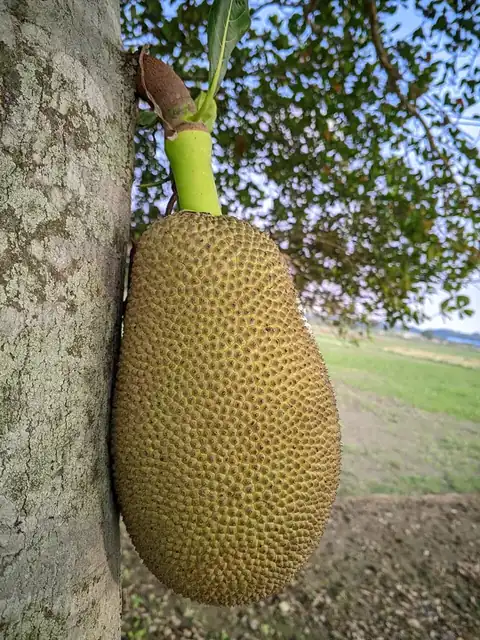
The jackfruit tree is a large evergreen tree that can grow up to 30 m tall. It has a dense foliage with leathery leaves which are smooth on one side and rough on the other. Fine hairs cover various parts of the tree, and the bark and leaves produce a sticky, milky sap. The tree is monoecious and produces an inflorescence consisting of cluster of small, pale green flowers from the trunk and large branches. The tree produces the largest of all tree-borne fruits, measuring up to 90 cm in length and 50 cm in width and weighing up to 50 kg. The yellowish-green fruit has a thick shell with numerous tubercles and emits a characteristic odour on ripening. The interior of the fruit consists of several yellow coloured fleshy bulbs each of which encloses a single seed.
Description
The jackfruit tree is an evergreen tree that grows up to 30 m. The bark is hard and rough, and covered with scales. It varies from greyish brown to dark grey in colour. Twigs arise from the trunk, and are 2 to 6 mm thick, with minute flattened hairs covering their surface. The foliage is denser when the tree is young, and it spreads out when the tree grows further. The leaves are alternately and spirally arranged.
The leaves contain three lobes in young trees, and become elliptical or obovate in shape later. The lamina measures 4 to 15 cm and 2 to 8 cm across the longer and shorter axes. The thin and leathery leaves are smooth on one side and rough on the other side. The leave surfaces has smooth hairs with the distribution sparser on the rough side. There are six to ten pairs of veins with whitish flattened hairs on the mid rib. There are ring-like stipules at the base of the leave stem. The petiole is 0.8 to 3 cm long and 1 to 2 mm thick, and is also covered with minute hairs. The bark and leaves ooze a milky and sticky sap.
Distribution and habitat
The jackfruit tree is native to India and might belong to the Western Ghats range in India. It spread to Southeast Asia, and to the islands of Indonesia and the Philippines. It was later introduced to East Africa and to the Americas. In addition to the various countries in South Asia and Southeast Asia, where it is extensively grown, it is also found in China, Brazil, Suriname, and Venezuela in South America, the Caribbean, Central, East and West Africa and the islands of Mauritius, Seychelles, and Reunion, and parts of Oceania and North America. It can become an invasive species as in Brazil's Tijuca Forest.
The jackfruit tree grows in a variety of habitats ranging from tropical rainforest to lowland and dry forests. It generally grows at lower altitudes (less than 1600 m), and trees growing in higher altitudes tend to produce low quality fruits. It requires optimal temperature between 19 and 29 C with sunlight. It is not drought resistant beyond a few months and requires adequate moisture. Though it grows in various soil types, it grows well in slightly acidic, moist and well drained soils. In India, it has been observed to grow thicker and stouter on conducive soils and thinner in sandy soils.
Reproduction and lifespan
The plant is generally grown from the seed, though it can be grown from stem cuttings and grafts. The first shoots arise anywhere between 10 and 40 days depending on the conditions. The plant can be transplanted in the initial few weeks. The tree matures and may start bearing fruits anywhere between 4 and 14 years though earlier occurrences have been noted. It reaches its maximum height around 20 years. In suitable conditions, the tree has a productive lifespan of more than a hundred years, though the yield might reduce or stop with ageing. Insects help in pollination with a three-way mutualism involving the tree, a fungus, and a species of gall midge, Clinidiplosis ultracrepidata, has been noted. The fungus forms a film which is a food source for the insects.
Culinary
The jackfruit is widely consumed in South and South East Asia, and is considered a partial solution for food security in developing countries. The ripe fruit gives a sweet, with subtle pineapple- or banana-like flavor. The fruit bulbs are often eaten when ripe while both ripe and raw fruits are used in cuisine. Unripe jackfruit can be canned in brine or with curry, dried and stored in tins, or pickled when young and tender. Ripe jackfruit pulp can also be preserved using various methods. The canned fruit can be preserved for up to a year and is marketed as a meat alternative. The fruit pulp can be stored up to two years under suitable temperature.
The ripe jackfruit is used to make a variety of sweet dishes and desserts. It is made into jams, jellies, and mixed with sugar or honey to make candies and beverages. In India, the dried bulbs are fried in oil to make chips. The fruit bulbs can be fermented and distilled to produce liquor. Unripe jackfruit is used in various South Asian and South East Asian cuisine to make curry and other dishes. It is cooked with coconut milk to improve the flavor.
Other uses
Jackfruit bark, pulp, and seeds have been used in traditional medicine. In traditional medicine, it is used as a natural coolant and an antidote to alcohol. The roots are used for the treatment of fever, asthma, diarrhea, and skin diseases, and the leaves are used as an antiseptic to treat wounds. The bark is used as an anesthetic and the ash is mixed with other ingredients such as coconut oil to treat ulcers. The seeds and the dried sap are considered as aphrodisiacs, and the sap is mixed with vinegar to make an antidote to snakebite.
Culture and symbolism
Jackfruit is the national fruit of Bangladesh and Sri Lanka. It is the state fruit of the Indian states of Kerala and Tamil Nadu.
More to savor

Chicken Vindaloo

Samosa
Cucumber in the Kitchen: Exploring an Everyday Ingredient