This longer reference provides the background behind the topic. Read it alongside the recipe collection when you want to connect an ingredient or food idea with a dish to prepare.
Overview
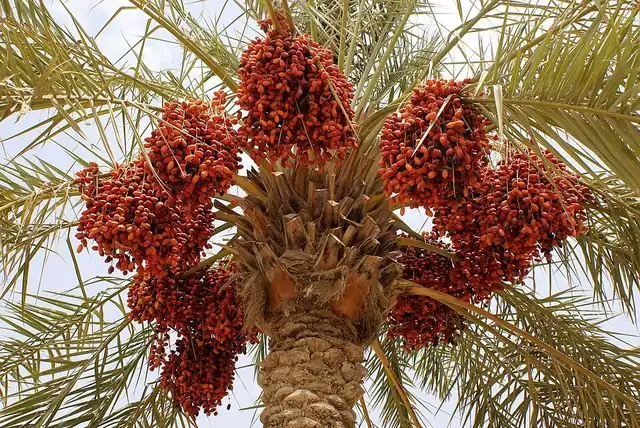
Phoenix dactylifera, commonly known as the date palm, is a flowering-plant species in the palm family Arecaceae, native to the region from the Gulf States and Iraq to Pakistan and India. It is cultivated for its edible sweet fruit called dates. The species is widely cultivated across northern Africa, the Middle East, Australia, South and Southeast Asia, the coastal Mediterranean basin, and Southern California. It is naturalised in many tropical and subtropical regions worldwide. P. dactylifera is the type species of genus Phoenix, which contains 12–19 species of wild date palms.
Date palms reach up to 30 m in height, growing singly or in clumps with several stems from a single root system. Slow-growing, they can reach over 100years of age when maintained properly. Their fruits are oval-cylindrical, 3 to 7 cm long, and about 2.5 cm in diameter, with colour ranging from dark brown to bright red or yellow, depending on variety. Containing 63–64% sugar by mass when dried, dates are consumed as sweet snacks on their own or with confections.
There is archaeological evidence of date cultivation in Arabia since the 6thmillennium BCE. Dates are "emblematic of oasis agriculture and highly symbolic in Christian and Jewish religions".
Description
Date palms reach up to 30 m in height, growing singly or forming a clump with several stems from a single root system. Date palms grow from average temperature range of 12.7 to 27.5 °C and are slow-growing. They can reach over 100 years of age when maintained properly. The roots have pneumatodes. The leaves are 4 - 6 m long, with spines on the petiole, and pinnate, with about 150 leaflets. The leaflets are 30 cm long and 2 cm wide. The full span of the crown ranges from 6 - 10 m.
The date palm is dioecious, having separate male and female plants. Like all members of genus Phoenix, sex determination occurs through an XY sex-determination system, where three genes that are conserved in all males and absent in all females have been identified. They can be easily grown from seed, but only 50% of seedlings will be female and hence fruit-bearing, and dates from seedling plants are often smaller and of poorer quality. Most commercial plantations thus use cuttings of heavily cropping cultivars. Plants grown from cuttings will fruit 2–3 years earlier than seedling plants.
Dates are naturally wind-pollinated, but in traditional oasis horticulture and modern commercial orchards, they are entirely hand-pollinated. Natural pollination occurs with about an equal number of male and female plants. With assistance, one male can pollinate up to 100 females. Since the males are of value only as pollinators, they are usually pruned in favor of fruit-producing female plants. Some growers do not maintain male plants, as male flowers become available at local markets at pollination time. Manual pollination is done by skilled labourers on ladders, or by use of a wind machine. In some areas, such as Iraq, the pollinator climbs the tree using a special climbing tool that wraps around the tree trunk and the climber's back (called تبلية in Arabic) to keep him attached to the trunk while climbing.
Genome
A draft genome of P. dactylifera (Khalas variety) was published in 2011 followed by more complete genome assemblies in 2013 and 2019. The later study used long-read sequencing technology. With the release of this improved genome assembly, the researchers were able to map genes for fruit color and sugar content. Researchers had also re-sequenced the genomes of several date varieties to develop the first single nucleotide polymorphism map of the date palm genome in 2015.
Distribution
The place and timeline of origin of the date palm is uncertain because of long cultivation. According to some sources it probably originated from the Fertile Crescent region straddling Egypt and Mesopotamia while others state that they are native to the Persian Gulf area or derived from wild date palm from western India. Fossil records show that the date palm has existed for at least 50 million years.
Production
In 2024, world production of dates was 9.9 million tonnes, led by Saudi Arabia, Egypt, Algeria, and Iran, together accounting for 63% of the total (table).
Fruit
Dry or soft dates are eaten in-the-hand, or may be stoned and stuffed with fillings such as almonds, walnuts, pecans, candied orange and lemon peel, tahini, marzipan or cream cheese. Stoned dates are also referred to as pitted dates. Partially dried stoned dates may be glazed with glucose syrup for use as a snack food. Dates can also be chopped and used in a range of sweet and savory dishes, from tajines (tagines) in Morocco to puddings, ka'ak (types of Arab cookies) and other dessert items. Date nut bread, a type of cake, is very popular in the United States, especially around holidays. Dates are also processed into cubes, paste called 'ajwa, spread, date syrup or "honey" called "dibs" or rub in Libya, powder (date sugar), vinegar or alcohol.
Vinegar made from dates was a traditional product of the Middle East. Recent innovations include chocolate-covered dates and products such as sparkling date juice, used in some Islamic countries as a non-alcoholic version of champagne, for special occasions and religious times such as Ramadan. When Muslims break fast in the evening meal of Ramadan, it is traditional to eat a date first.
Imported chopped dates are added to, or form the main basis of, a variety of traditional English dessert recipes including sticky toffee pudding and Christmas pudding. They are particularly available to eat whole at Christmas time. Dates are one of the ingredients of HP Sauce, a popular English condiment.
In Southeast Spain (where a large date plantation exists including UNESCO-protected Palmeral of Elche) dates (usually stoned with fried almond) are served wrapped in bacon and shallow-fried. In Israel date syrup, termed silan, is used while cooking chicken and also for sweets and desserts, and as a honey substitute. Dates are one of the ingredients of jallab, a Middle Eastern fruit syrup. In Pakistan, a viscous, thick syrup made from the ripe fruit is used as a coating for leather bags and pipes to prevent leaking.
Fruit clusters
Stripped fruit clusters are used as brooms. Recently, the floral stalks have been found to be of ornamental value in households.
More to savor

Chicken Vindaloo

Stuffed Squash
Millet in the Kitchen: Exploring an Everyday Ingredient