This longer reference provides the background behind the topic. Read it alongside the recipe collection when you want to connect an ingredient or food idea with a dish to prepare.
In this story
OverviewDefinitionMiddle AgesEarly modern periodFunctionPreservative claimCommon spice mixturesOverview
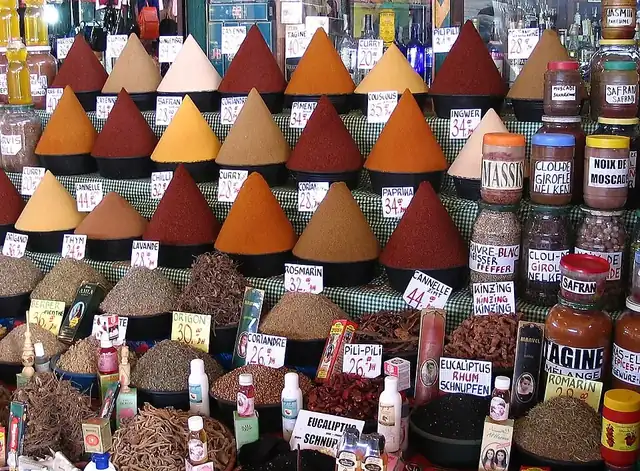
In the culinary arts, a spice is a seed, fruit, root, bark, or other plant substance primarily used for flavouring or colouring food. Spices are distinguished from herbs, which are the leaves, flowers, or stems of plants used for flavouring or as a garnish. Spices and herbs are both seasonings.
Spices are sometimes used in medicine, religious rituals, cosmetics, or perfume production. They are usually classified into spices, spice seeds, and herbal categories. For example, vanilla is commonly used as an ingredient in fragrance manufacturing. Plant-based sweeteners such as sugar are not considered spices.
Spices can be used in various forms, including fresh, whole, dried, grated, chopped, crushed, ground, or extracted into a tincture. These processes may occur before the spice is sold, during meal preparation in the kitchen, or even at the table when serving a dish, such as grinding peppercorns as a condiment. Certain spices are rarely available fresh or whole, and are typically purchased in ground form. Small seeds, such as fennel and mustard, can be used either in their whole form or as a powder.
Definition
Although defining spice is difficult, varying definitions cover several common aspects. One such aspect is the biological source of spices: the Oxford English Dictionary (OED) identifies the source as vegetables, while Redgrove (1933) is more specific as to the part of the plant, specifically the root, rhizome, flower, fruit, seed and bark when they are dried, in contrast with herbaceous parts which constitute herbs. The Oxford Companion to Food challenges the idea that spices sourced from plants are a hard rule, pointing to ambergris being often identified as a spice despite its animal origin.
Another aspect is the geographical source: The OED specifies spices are sourced from the tropics, while The Oxford Companion to Food gives the example of caraway seeds as demonstrating that spices can come from temperate climes. The notion that spices have a tropical origin is historic: originally "spice" was understood as a type of merchandise from the Orient. As Europeans encountered the Americas, beginning the Columbian exchange, the meaning expanded to capture new aromatics, and the meaning later shifted again to refer to culinary use. This historic development has led to some ingredients indigenous to European cooking such as garlic and horseradish not being considered spices despite sharing many attributes.
Middle Ages
Spices were among the most demanded and expensive products available in Europe in the Middle Ages, the most common being black pepper, cinnamon (and the cheaper alternative cassia), cumin, nutmeg, ginger, and cloves. Given medieval medicine's main theory of humorism, spices and herbs were indispensable to balance "humors" in food, on a daily basis for good health at a time of recurrent pandemics. In addition to being desired by those using medieval medicine, the European elite also craved spices in the Middle Ages, believing spices to be from and a connection to "paradise". An example of the European aristocracy's demand for spice comes from the King of Aragon, who invested substantial resources into importing spices to Spain in the 12th century.
He was specifically looking for spices to put in wine and was not alone among European monarchs at the time to have such a desire for spice.
Spices were all imported from plantations in Asia and Africa, which made them expensive. From the 8th until the 15th century, the Republic of Venice held a monopoly on the spice trade with the Middle East, using this position to dominate the neighbouring Italian maritime republics and city-states. The trade made the region rich. It has been estimated that around 1,000 tons of pepper and 1,000 tons of other common spices were imported into Western Europe each year during the Late Middle Ages. The value of these goods was the equivalent of a yearly supply of grain for 1.5 million people. The most exclusive was saffron, used as much for its vivid yellow-red color as for its flavor.
Early modern period
Voyagers from Spain and Portugal were interested in seeking new routes to trade in spices and other valuable products from Asia. The control of trade routes and the spice-producing regions were the main reasons that Portuguese navigator Vasco da Gama sailed to India in 1499. When da Gama discovered the pepper market in India, he was able to secure peppers for a much lower cost than demanded by Venice. At around the same time, Christopher Columbus returned from the New World. He described to investors the new spices available there.
Another source of competition in the spice trade during the 15th and 16th centuries was the Ragusans from the maritime republic of Dubrovnik in southern Croatia. The military prowess of Afonso de Albuquerque (1453–1515) allowed the Portuguese to take control of the sea routes to India. In 1506, he took the island of Socotra in the mouth of the Red Sea and, in 1507, Ormuz in the Persian Gulf. Since becoming the viceroy of the Indies, he took Goa in India in 1510, and Malacca on the Malay Peninsula in 1511. The Portuguese could now trade directly with Siam, China, and the Maluku Islands.
Function
Spices are primarily used as food flavouring or to create variety. They are also used to perfume cosmetics and incense. At various periods, many spices were used in herbal medicine. Finally, since they can be expensive, rare and exotic commodities, their conspicuous consumption has often been a symbol of wealth and social class.
Preservative claim
It is often claimed that spices were used either as food preservatives or to mask the taste of spoiled meat, especially in the European Middle Ages. This is false. In fact, spices are rather ineffective as preservatives as compared to salting, smoking, pickling, or drying, and are ineffective in covering the taste of spoiled meat. Moreover, spices have always been comparatively expensive: in 15th-century Oxford, a whole pig cost about the same as a pound of the cheapest spice, pepper. There is also no evidence of such use from contemporary cookbooks: "Old cookbooks make it clear that spices weren't used as a preservative.
They typically suggest adding spices toward the end of the cooking process, where they could have no preservative effect whatsoever." Indeed, Cristoforo di Messisbugo suggested in the 16th century that pepper may speed up spoilage.
Common spice mixtures
Advieh (Iran)
Baharat (Arab world, and the Middle East in general)
Berbere (Ethiopia and Eritrea)
Yaji (spice blend) (Nigeria)
Bumbu (Indonesia)
More to savor

Chicken Vindaloo
Homemade Wheat Tortillas
Potato in the Kitchen: Exploring an Everyday Ingredient