This longer reference provides the background behind the topic. Read it alongside the recipe collection when you want to connect an ingredient or food idea with a dish to prepare.
In this story
OverviewDescriptionEggplant-type namesAubergine-type namesFrom Dravidian to ArabicVarietiesCulinaryProductionOverview
Solanum melongena is a plant species in the nightshade family Solanaceae, grown worldwide for its edible fruit, typically used as a vegetable in cooking. It is known by a number of names, including eggplant, aubergine, and brinjal.
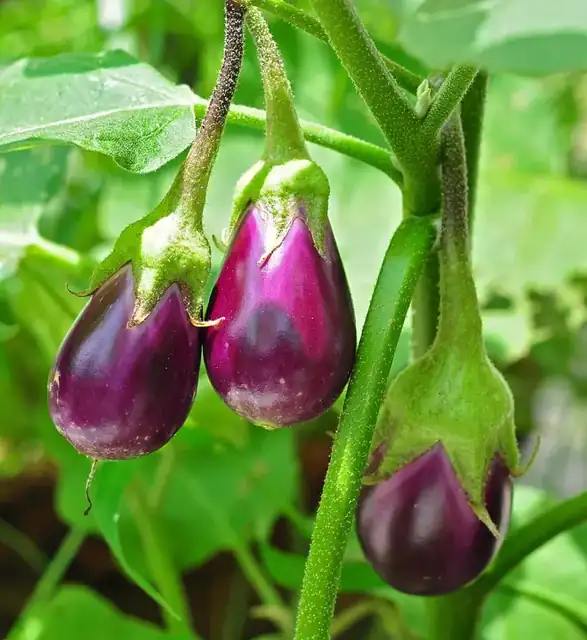
Most commonly purple, the spongy, absorbent fruit is used in several cuisines. It is a berry by botanical definition. As a member of the genus Solanum, it is related to the tomato, chili pepper, and potato, although those are of the Americas region while the eggplant is of the Eurasia region. Like the tomato, its skin and seeds can be eaten, but it is usually eaten cooked. Eggplant is nutritionally low in macronutrient and micronutrient content, but the capability of the fruit to absorb oils and flavors into its flesh through cooking expands its use in the culinary arts.
It was originally domesticated from the wild nightshade species thorn or bitter apple, S. incanum, probably with two independent domestications: one in South Asia, and one in East Asia. In 2023, world production of eggplants was 61 e6t, with China and India combining for 85% of the total.
Description
The eggplant is a delicate, tropical perennial plant often cultivated as a tender or half-hardy annual in temperate climates. The stem is often spiny. It grows 40 to 150 cm tall, with large, coarsely lobed leaves that are 10 to 20 cm long and 5 to 10 cm broad. Semiwild types can grow much larger, to 225 cm, with large leaves over 30 cm long and 15 cm broad.
The flowers are white to purple in color, with a five-lobed corolla and yellow stamens.
Botanically classified as a berry, the fruit contains numerous small, soft, edible seeds that taste bitter because they contain or are covered in nicotinoid alkaloids, like the related tobacco. Some common cultivars have fruit that is egg-shaped, glossy, and purple with white flesh and a spongy, "meaty" texture. Some other cultivars are white and longer in shape. Wild eggplant fruits measure less than 3 cm in diameter. The fruit flesh rapidly turns brown when in contact with the oxygen in the air.
Eggplant-type names
The name eggplant is usual in North American English, Australian English, and First recorded in 1763, the word "eggplant" was originally applied to white cultivars, which look very much like hen's eggs (see image). Similar names are widespread in other languages, such as the Icelandic term eggaldin or the Welsh planhigyn ŵy.
The white, egg-shaped varieties of the eggplant's fruits are also known as garden eggs, a term first attested in 1811. The Oxford English Dictionary records that between 1797 and 1888, the name vegetable egg was also used.
Aubergine-type names
Whereas eggplant was coined in some variations of English, any other European names for the plant derive from the Arabic باذنجان (romanized ). is itself a loan-word in Arabic, whose earliest traceable origins lie in the Dravidian languages. The Hobson-Jobson dictionary comments that "probably there is no word of the kind which has undergone such extraordinary variety of modifications, whilst retaining the same meaning, as this".
In English usage, modern names deriving from Arabic include:
Aubergine, usual in British English, Irish English, and New Zealand English (as well as German, French and Dutch)
Brinjal or brinjaul, usual in Indian English and South African English, as well as Pakistani, Bangladeshi, Sri Lankan, Singaporean, and Malaysian English
Solanum melongena, the Linnaean name
Caribbean English baigan or melongene
From Dravidian to Arabic
All the aubergine-type names have the same origin, in the Dravidian languages. Modern descendants of this ancient Dravidian word include Malayalam and Tamil .
The Dravidian word was borrowed into the Indo-Aryan languages, giving ancient forms such as Sanskrit and Pali (alongside Sanskrit ) and Prakrit . According to the entry brinjal in the Oxford English Dictionary, the Sanskrit word denoted 'the class (that removes) the wind-disorder (windy humour)': that is, it came to be the name for eggplants because they were thought to cure flatulence. The modern Hindustani word descending directly from the Sanskrit name is .
The Indic word was then borrowed into Persian as , which was borrowed in turn into Arabic as (or, with the definite article). From Arabic, the word was borrowed into European languages.
Varieties
S. m. var. esculentum – common aubergine, including white varieties, with many cultivars
S. m. var. depressum – dwarf aubergine
S. m. var. serpentium – snake aubergine
Culinary
Raw eggplant can have a bitter taste, with an astringent quality, but it becomes tender when cooked and develops a rich, complex flavor. Rinsing, draining, and salting the sliced fruit before cooking may remove the bitterness. The fruit is capable of absorbing cooking fats and sauces, which may enhance the flavor of eggplant dishes.
Eggplant is used in the cuisines of many countries. Due to its texture and bulk, it is sometimes used as a meat substitute in vegan and vegetarian cuisines. Eggplant flesh is smooth. Its numerous seeds are small, soft and edible, along with the rest of the fruit, and do not have to be removed. Its thin skin is also edible, and so it does not have to be peeled. However, the green part at the top, the calyx, does have to be removed when preparing an eggplant for cooking.
Eggplant can be steamed, stir-fried, pan fried, deep fried, barbecued, roasted, stewed, curried, or pickled. Many eggplant dishes are sauces made by mashing the cooked fruit. It can be stuffed. It is frequently, but not always, cooked with oil or fat.
Production
In 2024, world production of eggplants was 57.5 million tonnes, led by China with 61% and India with 23% of the total (table).
More to savor

Chicken Vindaloo

White Fish Ceviche (Cebiche de Pescado)

Balsamic vinegar at the Table: The Food Behind the Name