Use the regional background below as a starting point for exploring the food, rather than expecting one dish to represent every household. Food traditions differ within a country and continue to change through travel, migration, and everyday cooking.
Overview
Egyptian cuisine makes heavy use of poultry, legumes, vegetables and fruit from Egypt's rich Nile Valley and Delta. Examples of Egyptian dishes include rice-stuffed vegetables and grape leaves, hummus, falafel, shawarma, kebab and kofta. Others include ful medames, mashed fava beans; koshary, lentils and pasta; and molokhiyya, jute leaf stew.
A local type of pita known as eish baladi is a staple of Egyptian cuisine, and cheesemaking in Egypt dates back to the First Dynasty of Egypt, with Domiati being the most popular type of cheese consumed today.
Egyptian cuisine relies heavily on vegetables and legumes, but can also feature meats, most commonly rabbit and poultry such as squab, chicken, duck, quail and goose. Lamb and beef are commonly used in Egyptian cuisine, particularly for grilling and in a variety of stews and traditional dishes. Goat and camel are also eaten but are not as readily available nationwide. Offal is also a popular street food, often served in sandwiches. Fish and seafood are widely consumed across Egypt, with coastal regions such as Alexandria, Suez and Port Said being especially known for their seafood cuisine. Freshwater tilapia and mullet are the most popular types of fish in the country.
Customs
Egyptian dining customs are characterized by several important social and cultural practices. It is considered improper to use the left hand for eating, as the left hand is associated with hygienic functions. When dining, it is customary to sit next to someone of the same sex unless the host suggests otherwise. During the month of Ramadan, eating, drinking, or smoking around others during the daytime is generally shunned. However, leniency is often shown towards foreigners, who are not expected to be privy to such cultural sensitivities, and most food establishments remain open during the day throughout Ramadan.
Meals are typically served later than in Western cultures, with diners often arriving at restaurants around 10 pm or later, particularly in the summer. The main meal of the day is usually lunch, which is served during standard restaurant and café hours. In the evening, Egyptians tend to have lighter meals or snacks rather than a large dinner, except for special occasions. Family gatherings are common, and meals tend to be lengthy, with smoking frequently occurring during dining. Portion sizes are typically large, and food wastage is frowned upon.
Cheeses
Cheese is thought to have originated in the Middle East. Two alabaster jars found at Saqqara, dating from the First Dynasty of Egypt, contained cheese. These were placed in the tomb about 3,000 BC. They were likely fresh cheeses coagulated with acid or a combination of acid and heat. An earlier tomb, that of King Hor-Aha, may also have contained cheese which, based on the hieroglyphic inscriptions on the two jars, appears to be from Upper and Lower Egypt. The pots are similar to those used today when preparing mish.
Cheeses include domiati (جبنة دمياطي), the most widely-eaten in Egypt; Areesh cheese (جبنة اريش) made from laban rayeb; Rumi cheese (جبنه رومي), a hard, salty, ripened variety of cheese that belongs to the same family as Pecorino Romano and Manchego.
Cured meats
Bastirma (بسطرمة) and sogoq (سجق, ALA), also called sodoq (سدق, ALA) in parts of Egypt, are two traditional Egyptian cured meats that feature prominently in the country's culinary heritage. They are commonly enjoyed on their own or incorporated into various dishes.
Bastirma is typically prepared using lean cuts of beef or water buffalo, such as the eye of round or tenderloin, which are cured with salt to draw out moisture. After curing, the meat is coated with a wet paste made from a spice mixture that includes fenugreek, paprika, cumin, black pepper, and garlic, forming a distinctive crust that imparts strong flavors. The meat is air-dried for a period until firm, which can differ depending on its size. It is served in thin slices.
Sogoq, is a spicy sausage made from ground beef mixed with spices such as cumin, garlic, paprika, and chili powder. The mixture is stuffed into sheep intestines and left to dry and ferment, resulting in a flavorful and aromatic sausage. The spice mix may differ depending on the house-blend of the butcher.
While pastirma and sujuk are their regional namesakes, the Egyptian versions are distinguished by specific spice blends and preparation techniques that reflect local tastes and traditions. Egyptian sogoq is closer to sausages like merguez and makanek than it is to the sujuk eaten in other parts of the region.
Bread
Bread made from a simple recipe forms the backbone of Egyptian cuisine. It is consumed at almost all Egyptian meals; a working-class or rural Egyptian meal might consist of little more than bread and beans. The Atlas of Egyptian Popular Heritage, published by the Ministry of Culture, lists more than 60 different types of bread in Egypt, while the Agricultural Museum in Cairo has documented over 40 distinct varieties. While many traditional recipes have endured, numerous others have been replaced by industrialized varieties, predominantly made with bleached wheat flour.
Bread-making in Egypt dates back nearly 5,800 years, with early evidence of bread made from emmer wheat, a low-gluten grain that was manually ground and leavened using natural yeast and lactic acid bacteria. Archaeological findings reveal various bread types, including those made with barley, chickpea flour, and breads incorporating fig paste, coriander seeds, and nabq fruits. Wall inscriptions and tomb scenes from the Old Kingdom depict detailed bread production processes, including grinding wheat, mixing dough, and baking in mudbrick ovens.
Dishes
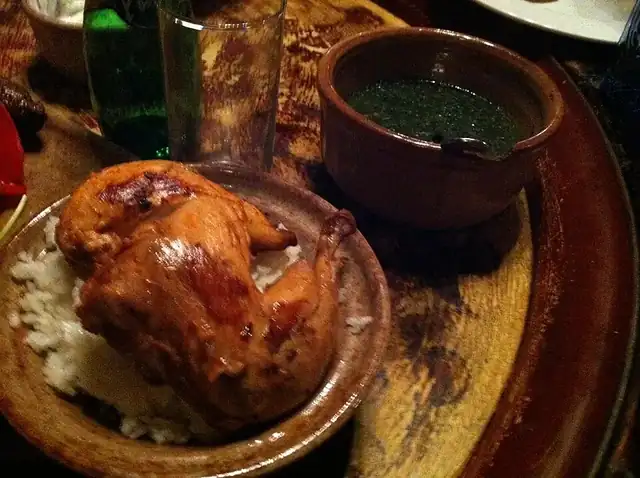
Egyptian cuisine is characterized by dishes such as ful medames, mashed fava beans; koshary, a mixture of lentils, rice, pasta, and other ingredients; molokhiya, chopped and cooked jute leaf with garlic and coriander sauce; and feteer meshaltet.
Egyptian cuisine shares similarities with food of the Eastern Mediterranean region, such as rice-stuffed vegetables, grape leaves, shawerma, kabab and kofta, with some variation and differences in preparation.
Some consider koshary, a mixture of rice, lentils, and macaroni, to be the national dish. Ful medames is also one of the most popular dishes. Fava bean is also used in making falafel (most commonly referred to as ta‘ameya in Egypt, and served with fresh tomatoes, tahina sauce and arugula).
Food establishments
Egypt has a variety of traditional food and drink establishments serving unique specialties, from casual coffeehouses and dive bars to bakeries, fruit vendors, and modern cafés.
More to savor

Chicken Vindaloo
Egyptian Okra Stew
A Taste of Korea: Dishes and the Culture Around a Meal