Use the regional background below as a starting point for exploring the food, rather than expecting one dish to represent every household. Food traditions differ within a country and continue to change through travel, migration, and everyday cooking.
In this story
OverviewFish and seafoodMedicinal foodsDishesAnju (side dishes accompanying alcoholic beverages)Regional and variant cuisinesBuddhist cuisineOverview
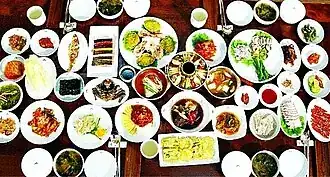
Korean cuisine is the set of foods and culinary styles which are associated with Korean culture. This cuisine has evolved through centuries of social and political change. Originating from ancient agricultural and nomadic traditions in Korea and southern Manchuria, Korean cuisine reflects a complex interaction of the natural environment and different cultural trends.
Korean cuisine is largely based on rice, vegetables, seafood and (at least in South Korea) meats. Dairy is largely absent from the traditional Korean diet. Traditional Korean meals are named for the number of side dishes that accompany steam-cooked short-grain rice. Kimchi is served at nearly every meal. Commonly used ingredients include sesame oil, doenjang (fermented bean paste), soy sauce, salt, garlic, ginger, gochugaru (pepper flakes), gochujang (fermented red chili paste) and napa cabbage.
Ingredients and dishes vary by province. Many regional dishes have become national. Korean royal court cuisine once brought all of the unique regional specialties together for the royal family. Foods are regulated by Korean cultural etiquette.
Kimjang, which refers to the process of making kimchi, is listed on the UNESCO Intangible Heritage List.
Fish and seafood
Fish and shellfish have been a major part of Korean cuisine because of the oceans bordering the peninsula. Evidence from the 12th century illustrates commoners consumed a diet mostly of fish and shellfish, such as shrimp, clams, oysters, abalone, and loach, while sheep and hogs were reserved for the upper class.
Both fresh and saltwater fish are popular, and are served raw, grilled, broiled, dried or served in soups and stews. Common grilled fish include mackerel, hairtail, croaker and Pacific herring. Smaller fish, shrimp, squid, mollusks and countless other seafood can be salted and fermented as jeotgal. Fish can also be grilled either whole or in fillets as banchan. Fish is often dried naturally to prolong storing periods and enable shipping over long distances. Fish commonly dried include yellow corvina, anchovies (myeolchi) and croaker. Dried anchovies, along with kelp, form the basis of common soup stocks.
Medicinal foods
Medicinal food (boyangshik) is a wide variety of specialty foods prepared and eaten for their purported medicinal purposes, especially during the hottest 30-day period in the lunar calendar, called sambok. Hot foods consumed are believed to restore ki, as well as sexual and physical stamina lost in the summer heat. Commonly eaten boyangshik include ginseng, chicken, black goat, abalone, eel, carp, beef bone soups, pig kidneys.
Dishes
Korean foods can be largely categorized into groups of "main staple foods" , "subsidiary dishes" , and "dessert" . The main dishes are made from grains such as bap (a bowl of rice), juk (porridge), and guksu (noodles).
Many Korean banchan rely on fermentation for flavor and preservation, resulting in a tangy, salty, and spicy taste. Certain regions are especially associated with some dishes (for example, the city of Jeonju with bibimbap) either as a place of origin or for a famous regional variety. Restaurants will often use these famous names on their signs or menus (e.g. "Suwon galbi").
Anju (side dishes accompanying alcoholic beverages)
Anju is a general term for a Korean side dish consumed with alcohol. It matches well with Korean traditional alcohol such as soju or makgeolli and helps people to enjoy their drinking more. Some examples of anju include steamed squid with gochujang, assorted fruit, dubu kimchi (tofu with kimchi), peanuts, odeng/ohmuk, sora (a kind of shellfish popular in street food tents), nakji (small octopus), and Jokbal (pig's leg served with salted shrimp sauce). Samgyupsal (pork belly) is also considered anju with soju. Most Korean foods can be considered anju, as the food consumed alongside the alcohol depends on the diner's taste and preferences.
Regional and variant cuisines
Korean regional cuisines are characterized by local specialties and distinctive styles within Korean cuisine. The divisions reflected historical boundaries of the provinces where these food and culinary traditions were preserved until modern times.
Although Korea has been divided into two nation-states since 1948 (North Korea and South Korea), it was once divided into eight provinces (paldo) according to the Joseon administrative districts. The northern region consisted of Hamgyeong Province, Pyeongan Province and Hwanghae Province. The central region comprised Gyeonggi Province, Chungcheong Province, and Gangwon Province. Gyeongsang Province and Jeolla Province made up the southern region.
Until the late 19th century, transportation networks were not well developed, and each provincial region preserved its own characteristic tastes and cooking methods. Geographic differences are also reflected by the local specialty foodstuffs depending on the climate and types of agriculture, as well as the natural foods available. With the modern development of transportation and the introduction of foreign foods, Korean regional cuisines have tended to overlap and integrate. However, many unique traditional dishes in Korean regional cuisine have been handed down through the generations.
Buddhist cuisine
Korean temple cuisine originated in Buddhist temples of Korea. Since Buddhism was introduced into Korea, Buddhist traditions have strongly influenced Korean cuisine, as well. During the Silla period (57 BCE – 935 CE), chalbap (찰밥, a bowl of cooked glutinous rice) yakgwa (a fried dessert) and yumilgwa (a fried and puffed rice snack) were served for Buddhist altars and have been developed into types of hangwa, Korean traditional confectionery. During the Goryeo period, sangchu ssam (wraps made with lettuce), yaksik, and yakgwa were developed, and since spread to China and other countries. Since the Joseon dynasty, Buddhist cuisine has been established in Korea according to regions and temples.
On the other hand, royal court cuisine is closely related to Korean temple cuisine. In the past, when the royal court maids, sanggung, who were assigned to Suragan (the name of the royal kitchen), where they prepared the king's meals, became old, they had to leave the royal palace. Therefore, many of them entered Buddhist temples to become nuns. As a result, culinary techniques and recipes of the royal cuisine were integrated into Buddhist cuisine.
More to savor

English Breakfast

Pan-Fried White Brined Cheese (Saganaki)
A Taste of Taiwan: Exploring the Food Behind the Table