Use the regional background below as a starting point for exploring the food, rather than expecting one dish to represent every household. Food traditions differ within a country and continue to change through travel, migration, and everyday cooking.
Overview
Spanish cuisine (cocina española) consists of the traditions and practices of Spanish cooking. It features considerable regional diversity, with significant differences in different parts of the country. The different culinary traditions in the Iberian Peninsula can be roughly categorized within the Mediterranean diet or the Atlantic diet.
Olive oil (of which Spain is the world's largest producer) is extensively used in Spanish cuisine. It forms the base of many vegetable sauces (known in Spanish as sofritos). Herbs most commonly used include parsley, oregano, rosemary and thyme. The use of garlic has been noted as common in Spanish cooking. The most-used meats in Spanish cuisine include chicken, pork, lamb and veal. Fish and seafood are also consumed on a regular basis. Tapas and pinchos are snacks and appetizers commonly served in bars and cafes.
Antiquity
Authors such as Strabo wrote about the aboriginal people of Spain using nuts and acorns as staple foods. The extension of vineyards along the Mediterranean seemed to be due to the colonization of Greeks and Phoenicians, who also introduced the production of olive oil. Spain became the largest producer of olive oil in the world. The growing of crops of the so-called tríada mediterránea (the "Mediterranean triad": wheat, grapes, and olives) underpinned the staple meal products for the inhabitants of the south of the Iberian Peninsula during the Roman Era (bread, wine and oil).
Middle Ages
The Visigoths' limited but lasting contributions to Spanish cuisine included the consumption of fermented milk products.
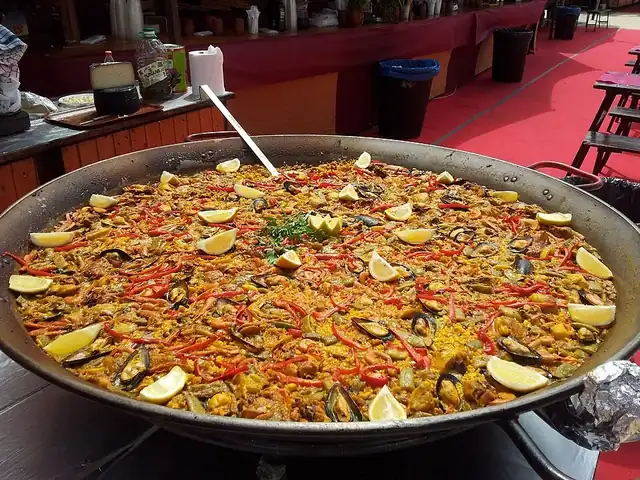
It is believed rice was introduced in the 6th century by the Byzantines. After the Muslim conquest of the Iberian peninsula in the 8th century, rice cultivation was expanded by the Arabs. New irrigation techniques were brought from the Indian subcontinent led to the cultivation of crops such as sugar cane, watermelon, lemon and oranges. Other ingredients believed to have been introduced in the Iberian Peninsula during the Hispano-Muslim period include sorghum, spinach, eggplant, peach, apricot and saffron. The most famous Spanish dish, paella, uses two ingredients that were probably popularized during the Al-Andalus period: rice and saffron.
The Moors also developed the basis for the art of pastry-making and introduced escabeche, a food preservation technique relying on vinegar. Dishes like ajo blanco, alboronía, alajú, hallulla, albóndigas, mojama, arrope, were some of the many legacies of Moorish cuisine. Although Muslim religion did not allow alcoholic drinks, the consumption of wine was widespread as the Qur'anic precepts never got to overrule the preexisting traditions. There are many accounts of the "drinking chats" of Abd al-Rahman II, Abd al-Rahman III and Almanzor.
Modern era
The arrival of Europeans in the Americas in 1492 initiated the advent of new culinary elements, such as tomatoes, potatoes, maize, bell peppers, spicy peppers, paprika, vanilla and cocoa. Spain was where chocolate was first mixed with sugar to temper its natural bitterness. Other ingredients traveled to the Americas, such as rice, grapes, olives, and many types of cereals.
Influenced by Arabic harisa, grain-based soups such as farinetes (along the Mediterranean coast) and, similarly, gachas (in the Central Plateau) were customary in Early Modern Spain.
Foreign visitors noted with disdain the Spaniards' use of olive oil and lard for cooking rather than their preferred butter. The latter was barely available and, according to the 17th-century account of Madame d'Aulnoy, on the rare occasions that it was, would come "from afar, preserved in pig's tripes and full of worms". Butter was only produced locally in places such as Galicia, Asturias and Soria, or was imported, preserved in potassium nitrate, (the so-called "Flanders' butter").
Meal routines
A continental-style breakfast (desayuno) may be eaten just after waking up, or before entering the workplace. Common breakfast items include coffee, milk, chocolate drink, biscuits (most notably Marie biscuits), magdalenas, toast (featuring ingredients such as oil, tomato and butter), and churros.
Due to the large time span between breakfast and lunch, it is not uncommon to halt the working schedule to take a mid-morning snack.
Lunch (el almuerzo or la comida, literally meaning "the meal"), the large midday meal in Spain, contains several courses, especially in restaurants. In some regions of Spain, the word almuerzo refers to the mid-morning snack, instead of lunch. Lunch usually starts around 2:00–2:30 p.m. and finishes around 3:00–3:30 p.m., and is usually followed by sobremesa, which refers to the table talk that Spanish people undertake. Menus are organized according to these courses and include five or six choices in each course. At home, Spanish meals contain one or two courses and a dessert. The content of this meal is usually a soup dish, salad, a meat or a fish dish, and a dessert such as fruit, yoghurt or something sweet. Tapas may also be typically served before or during lunch.
Andalusia
Andalusian cuisine is twofold: rural and coastal. Of all the Spanish regions, this region uses the most olive oil in its cuisine. The Andalusian dish that has possibly achieved the most international fame is gazpacho, a cold soup made with chopped vegetables, such as tomatoes and green peppers, vinegar, water, salt, olive oil, and bread (crumbs). Other cold soups include poleá, zoque and salmorejo.
Eating olives as a snack is common. Meat dishes include flamenquín, pringá, oxtail stew, and menudo gitano (also called Andalusian tripe). Hot soups include sopa de gato (made with bread), caldillo de perro (fish soup with orange juice) and migas canas. Fish dishes include pescaíto frito, soldaditos de Pavía, and parpandúa.
Aragon
Aragonese cuisine has a rural origin. One of its most famous dishes is asado de ternasco (roast lamb), in which lamb is cooked with garlic, salt, olive oil, laurel leaves, thyme, and parsley. Pork dishes are also very popular, among them, magras con tomate. Popular Aragonese recipes made with bread are migas de Pastor, migas con chocolate, regañaos, and goguera.
Legumes are very important to Aragonese dishes, but the most popular vegetables are borage and thistle, as well as the famed tomate rosa de Barbastro. Jamón de Teruel and ham from Huesca are frequently used cured meats. Among the cheeses, queso de Tronchón is notable. Fruit-based cuisine includes frutas de Aragón (English: 'fruits of Aragon', candied fruits covered in chocolate) and maraschino cherries. Melocotón con vino consists of melocotón de Calanda, a regional peach variant, infused in red wine with sugar and cinnamon.
More to savor

Chicken Vindaloo

Austrian Napkin Dumpling (Serviettenknödel)
A Taste of Brazil: Many Influences, Many Ways to Eat