This longer reference provides the background behind the topic. Read it alongside the recipe collection when you want to connect an ingredient or food idea with a dish to prepare.
In this story
OverviewNamingDescriptionProductionGeographical indicationEffect of certificationSimilar cheesesOverview
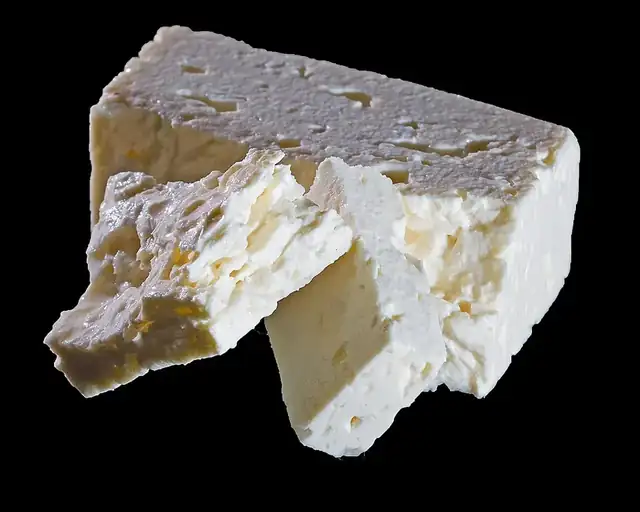
Feta (φέτα ) is a Greek white brined cheese made from sheep's milk or from a mixture of sheep and goat's milk. It is soft, with small or no holes, and no skin. Crumbly with a slightly grainy texture, it is formed into large blocks and aged in brine. Its flavour is tangy and salty, ranging from mild to sharp. Feta is used in salads, such as Greek salad, and in pastries, notably the filo-based Greek dishes spanakopita , and tyropita . It is often served with olive oil or olives, and sprinkled with aromatic herbs such as oregano. It can also be served cooked (often grilled), as part of a sandwich, in omelettes, and many other dishes.
Since 2002, feta has been a protected designation of origin (PDO) in the European Union. EU legislation and similar legislation in 25 other countries limits the name feta to cheeses produced in the traditional way in mainland Greece and Lesbos Prefecture, which are made from sheep milk, or from a mixture of sheep milk and up to 30% goat milk from the same area.
Naming
The Greek word féta (φέτα) comes from the Italian fetta , which in turn is derived from the Latin offa . The word feta became widespread as a name for the cheese only in the 19th century; probably referring to the cheese being cut to pack it in barrels. The same cheese can be referred to differently within Greece itself. In Thessaloniki, for example, it is referred to as tyrí (τυρί), which is the general word for in the south of the country.
For many consumers outside Greece, the word feta is a generic term for a white, crumbly cheese aged in brine. Production of the cheese first began in the Eastern Mediterranean and around the Black Sea. Over time, production expanded to countries including Denmark, France, Germany, Italy, the United Kingdom and the United States, often partly or wholly of cow milk, and is (or was) sometimes also called feta. In the United States, most cheese sold under the name feta is American and made from cow milk.
Description
The EU PDO for feta requires a maximum moisture of 56%, a minimum fat content in dry matter of 43%, and a pH that usually ranges from 4.4 to 4.6. Production of the EU PDO feta is traditionally categorized into firm and soft varieties. The firm variety is tangier and considered higher in quality. The soft variety is almost soft enough to be spreadable, mostly used in pies and sold at a cheaper price. Slicing feta produces some amount of trímma, "crumble", which is also used for pies (not being sellable, trímma is usually given away for free upon request).
High-quality feta should have a creamy texture when sampled, and aromas of ewe's milk, butter, and yoghurt. In the mouth it is tangy, slightly salty, and mildly sour, with a spicy finish that recalls pepper and ginger, as well as a hint of sweetness. According to the specification of the Geographical Indication, the biodiversity of the land coupled with the special breeds of sheep and goats used for milk is what gives feta cheese a specific aroma and flavor.
Production
Traditionally (and legally within the EU and other territories where it is protected), feta is produced using only whole sheep milk, or a blend of sheep and goat milk (with a maximum of 30% goat milk). The milk may be pasteurized or not, but most producers now use pasteurized milk. If pasteurized milk is used, a starter culture of micro-organisms is added to replace those naturally present in raw milk that are killed in pasteurization. These organisms are required for acidity and flavour development.
When the pasteurized milk has cooled to approximately 35 C, rennet is added and the casein is left to coagulate. The compacted curds are then chopped up and placed in a special mould or a cloth bag that allows the whey to drain. After several hours, the curd is firm enough to cut up and salt; salinity will eventually reach approximately 3%, when the salted curds are placed (depending on the producer and the area of Greece) in metal vessels or wooden barrels and allowed to infuse for several days.
Geographical indication
Since 2002, feta/φέτα has been a protected designation of origin (PDO) product within the European Union. According to the relevant EU legislation (applicable within the EU and Northern Ireland), as well as similar UK legislation only those cheeses produced in a traditional way in particular areas of Greece, which are made from sheep milk, or from a mixture of sheep milk and up to 30% of goat milk from the same area, can be called feta. In several other countries, the term feta has since been protected. An overview is shown in the table below.
Effect of certification
Prior to Greece's pursuit of a PDO for its feta, there was long-standing production outside of Greece in three member states: Germany, Denmark and France, and in certain countries (e.g., Denmark) feta was perceived as a generic term, while it was perceived as a designation of origin in others (e.g., Greece), with the centre of production and consumption taking place in Greece. Greece first requested the registration of feta as a designation of origin in the EU in 1994, which was approved in 1996 by commission regulation (EC) No 1107/96 The decision was appealed to the Court of Justice of the European Union (CJEU) by Denmark, France and Germany, which annulled the decision as the Commission did not evaluate sufficiently whether or not Feta had become a generic term.
After that decision, the European Commission reevaluated registering feta as a PDO, taking into account production in other EU countries and re-registered feta as a PDO in Commission Regulation (EC) No 1829/2002. This decision was appealed again at CJEU by Denmark and Germany. In 2005, the CJEU upheld the Commission Regulation. It indicated that indeed the term was generic in some EU countries and that production also took place outside Greece, but that on the other hand the geographical region in Greece was well defined and that even non-Greek producers often appealed to the status of Feta as a Greek product through the choice of packaging.
Similar cheeses
Similar cheeses can be found in other countries, such as:
Albania (Urdha or djathë i bardhë)
Armenia (Չանախ chanakh - cheese made in a chan, a type of crock)
Azerbaijan (ağ pendir)
Bosnia (Travnički/Vlašićki sir, lit. "cheese from Vlašić/Travnik")
More to savor

Chicken Vindaloo
Baklava I
A Closer Look at Peanut: From Ingredient to Meal