This longer reference provides the background behind the topic. Read it alongside the recipe collection when you want to connect an ingredient or food idea with a dish to prepare.
Overview
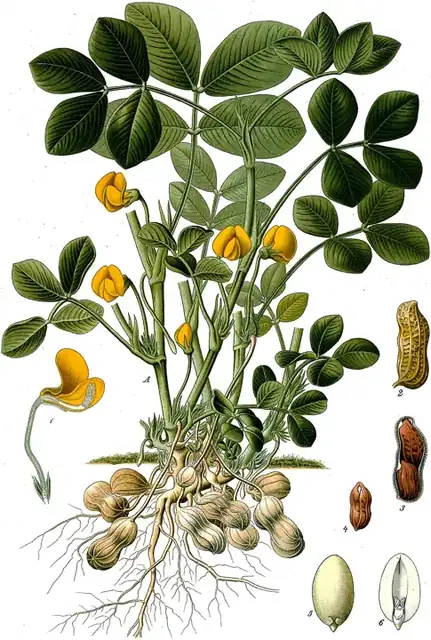
The peanut (Arachis hypogaea), also known as the groundnut, goober (US, via Kikongo), goober pea, pindar (US, via Kikongo) or monkey nut (UK), is a legume crop grown mainly for its edible seeds, contained in underground pods. It is widely grown in the tropics and subtropics by small and large commercial producers, both as a grain legume and as an oil crop. Underground fruiting (geocarpy) is atypical among legumes, which led botanist Carl Linnaeus to name the species hypogaea, from Greek 'under the earth'.
The peanut belongs to the flowering plant family Fabaceae (or Leguminosae), commonly known as the pea family, and is native to South America. Like most other legumes, peanuts harbor symbiotic nitrogen-fixing bacteria in root nodules, which improve soil fertility, making them valuable in crop rotations.
Edible products include peanut oil and peanut butter. Peanut sauces are used in Latin America, West Africa, and Southeast Asia, while in the Indian subcontinent, they are added to salads and stews. In North America, peanuts are used in candies, cakes, and cookies, while peanut butter is widely eaten. Some people are allergic to peanuts and can have a fatal reaction.
Agronomy
Peanuts grow best in light, sandy loam soil with a pH of 5.9–7. Their capacity to fix nitrogen means that providing they nodulate properly, peanuts benefit little or not at all from nitrogen-containing fertilizer, and they improve soil fertility. Therefore, they are valuable in crop rotations. Also, the yield of the peanut crop itself is increased in rotations through reduced diseases, pests, and weeds. For example, in Texas, peanuts in a three-year rotation with corn yield 50% more than non-rotated peanuts. Adequate levels of phosphorus, potassium, calcium, magnesium, and micronutrients are also necessary for good yields. Peanuts need warm weather throughout the growing season to develop well. They can be grown with as little as 350 mm of water, but for best yields need at least 500 mm.
Depending on growing conditions and the cultivar of peanut, harvest is usually 90 to 130 days after planting for subspecies A. h. fastigiata types, and 120 to 150 days after planting for subspecies A. h. hypogaea types.
Peanut plants continue to produce flowers when pods are developing; therefore, some pods are immature even when they are ready for harvest. To maximize yield, the timing of harvest is important. If it is too early, too many pods will be unripe; if too late, the pods will snap off at the stalk and remain in the soil. For harvesting, the entire plant, including most of the roots, is removed from the soil.
Varieties
There are many peanut cultivars grown around the world. The market classes grown in the United States are Spanish, Runner, Virginia, and Valencia. Peanuts are produced in three major areas of the U.S.: the southeastern region which includes Alabama, Georgia, and Florida; the southwestern region which includes New Mexico, Oklahoma, and Texas; and in the general eastern U.S. which includes Virginia, North Carolina, and South Carolina. In Georgia, Naomi Chapman Woodroof is responsible for developing the breeding program of peanuts, resulting in a harvest almost five times greater.
The small Spanish types are grown in South Africa and the southwestern and southeastern United States. Until 1940, 90% of the peanuts grown in the U.S. state of Georgia were Spanish types, but the trend since then has been larger-seeded, higher-yielding, more disease-resistant cultivars. Spanish peanuts have a higher oil content than other types of peanuts. In the U.S., the Spanish group is primarily grown in New Mexico, Oklahoma, and Texas.
Production
In 2023, world production of peanuts (reported as groundnuts excluding shelled) was 54 million tonnes, led by China with 36% of the total and India with 19% (table).
Allergies
Some people (1.4–2% in Europe and the United States) experience allergic reactions to peanut exposure; symptoms range from watery eyes to anaphylactic shock. The hygiene hypothesis of allergy states that a lack of early childhood exposure to infectious agents like germs and parasites could be causing the increase in food allergies. Delaying exposure to peanuts in childhood can greatly increase the risk of developing allergy. Peanut allergy has been associated with the use of skin preparations containing peanut oil among children, but the evidence is inconclusive. Peanut allergies are associated with family history and intake of soy products. Refined peanut oil does not cause allergic reactions in most people with peanut allergies. However, crude (unrefined) peanut oils contain protein, which may cause allergic reactions.
Some school districts in the U.S. and elsewhere have banned peanuts and products containing them. However, a 2015 study in Canada found no difference in the percentage of accidental exposures occurring in schools prohibiting peanuts compared to schools allowing them.
Animal feed
Peanut plant tops and crop residues can be used for silage. Industrial peanut processing removes the fiber-rich hulls in large amounts; these can feed livestock, particularly ruminants. The oilcake residue from oil processing is used as animal feed and soil fertilizer, usually in meal (powdered) form. It concentrates the non-oil components of peanut seeds and contains some residue oil. Groundnut cake is a livestock feed, mostly used by cattle as protein supplements. It is one of the most important and valuable feeds for all types of livestock and one of the most active ingredients for poultry rations. Poor storage of the cake may sometimes result in its contamination by aflatoxin, a naturally occurring mycotoxin that is produced by Aspergillus flavus and Aspergillus parasiticus.
Some peanuts (seeds) can be fed whole to livestock, for example, those over the production quota (such as in the US) or those with a higher aflatoxin content than that permitted by the food regulations but still within the level permitted by animal feed regulations.
Whole peanuts
Dry roasting is a common method of preparation, though the roast flavor is lost more quickly than with oil roasting or blister frying (oil roasting after soaking in water).
Boiled peanuts are a popular snack in India, China, West Africa, and the southern United States. In the U.S. South, boiled peanuts are often prepared in briny water and sold in streetside stands. Fresh "green" peanuts (not dehydrated) are ready for boiling; raw dehydrated peanuts must be rehydrated before boiling (usually in a bowl full of water overnight).
More to savor

Chicken Vindaloo

Koko da Kosai (Fermented Corn Porridge and Bean Fritters)
A Closer Look at Turmeric: From Ingredient to Meal