Use the regional background below as a starting point for exploring the food, rather than expecting one dish to represent every household. Food traditions differ within a country and continue to change through travel, migration, and everyday cooking.
In this story
OverviewCooking, serving and consumptionMeals of the dayFiesta foodMain dishesSide dishesRegional dishesOverview
Filipino cuisine includes the food traditions of more than a hundred ethnolinguistic groups across the Philippine archipelago. Most widely known Filipino dishes come from the culinary practices of groups such as the Ilocano, Pangasinan, Kapampangan, Tagalog, Bicolano, Visayan, Chavacano, and Maranao communities. The dishes associated with these groups evolved over the centuries from a largely indigenous (largely Austronesian) base shared with maritime Southeast Asia with varied influences from Chinese, Spanish, and American cuisines, in line with the major waves of influence that had enriched the cultures of the archipelago, and adapted using indigenous ingredients to meet local preferences.
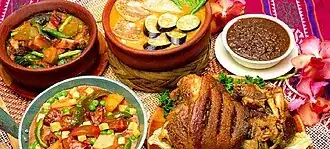
Dishes range from a simple meal of fried salted fish and rice to curries, paellas, and cozidos of Iberian origin made for fiestas. Popular dishes include lechón (whole roasted pig), longganisa (Philippine sausage), tapa (cured beef), torta (omelette), adobo (vinegar and soy sauce-based stew), kaldereta (meat stewed in tomato sauce and liver paste), mechado (larded beef in soy and tomato sauce), pochero (beef and bananas in tomato sauce), afritada (chicken or beef and vegetables simmered in tomato sauce), kare-kare (oxtail and vegetables cooked in peanut sauce), pinakbet (kabocha squash, eggplant, beans, okra, bitter melon, and tomato stew flavored with shrimp paste), sinigang (meat or seafood with vegetables in sour broth), pancit (noodles), and lumpia (fresh or fried spring rolls).
Cooking, serving and consumption
Cooking and eating in the Philippines has traditionally been an informal and communal affair centered around the family kitchen. Food tends to be served all at once and not in courses.
Like many of their Southeast Asian counterparts Filipinos do not eat with chopsticks. The traditional way of eating is with the hands, especially dry dishes such as inihaw or prito. The diner will take a bite of the main dish, then eat rice pressed together with their fingers. This practice, known as kamayan (using the washed left hand for picking the centralized food and the right hand for bringing food to the mouth), is rarely seen in urbanized areas. However, Filipinos tend to feel the spirit of kamayan when eating amidst nature during out-of-town trips, beach vacations, and town fiestas.
During the Spanish occupation, Filipinos ate with the paired utensils of spoon and fork. The knife was not used as in other countries, because Spanish colonizers prohibited Filipinos from owning knives. Filipinos typically use the side of the spoon to cut their food. Due to Western influence, food is often eaten using flatware—forks, knives, spoons—but the primary pairing of utensils used at a Filipino dining table is that of spoon and fork, not knife and fork.
Meals of the day
Filipinos traditionally eat three main meals a day: almusal or agahan (breakfast), tanghalían (lunch), and hapunan (dinner) plus morning and an afternoon snack called meryenda (also called minandál or minindál).
A traditional Filipino breakfast (almusal) might include pandesal (small bread rolls), kesong puti (fresh, unripened, white Filipino cheese, traditionally made from carabao's milk) champorado (chocolate rice porridge), silog which is sinangag (garlic fried rice) or sinaing, with fried egg and meat—such as tapa, longganisa, tocino, karne norte (corned beef), or fish such as daing na bangus (salted and dried milkfish)—or itlog na pula (salted duck eggs). Coffee is also commonly served, particularly kapeng barako, a variety of coffee produced in the mountains of Batangas noted for having a strong flavor.
Certain portmanteaus in Filipino have come into use to describe popular combinations of items in a Filipino breakfast. An example of such a combination order is kankamtuy: an order of kanin (rice), kamatis (tomatoes) and tuyo (dried fish). Another is tapsi: an order of tapa and sinangág or sinaing. Other examples include variations using a silog suffix, usually some kind of meat served with sinangág or sinaing, and itlog (egg). The three most commonly seen silogs are tapsilog (having tapa as the meat portion), tocilog (having tocino as the meat portion), and longsilog (having longganisa as the meat portion).
Fiesta food
For festive occasions, people band together and prepare more sophisticated dishes. Tables are often laden with expensive and labor-intensive treats requiring hours of preparation. In Filipino celebrations, lechon (less commonly spelled litson) serves as the centerpiece of the dinner table. It is usually a whole roasted pig, but suckling pigs (lechonillo, or lechon de leche) or cattle calves (lechong baka) can also be prepared in place of the popular adult pig. It is typically served with lechon sauce, which is traditionally made from the roasted pig's liver.
Other dishes include hamonado (honey-cured beef, pork or chicken), relleno (stuffed chicken or milkfish), mechado, afritada, caldereta, puchero, paella, menudo, morcon, embutido (referring to a meatloaf dish, not a sausage as understood elsewhere), suman (a savory rice and coconut milk concoction steamed in leaves such as banana), and pancit canton.
Main dishes
Adobo is one of the most popular Filipino dishes and is considered by many to be the national dish. It usually consists of pork or chicken, sometimes both, stewed or braised in a sauce usually made from vinegar, cooking oil, garlic, bay leaf, peppercorns, and soy sauce. It can also be prepared "dry" by cooking out the liquid and concentrating the flavor. Bistek, also known as "Filipino beef steak", consists of thinly sliced beef marinated in soy sauce and calamansi and then fried in a skillet that is typically served with onions.
Some well-known stews are kare-kare and dinuguan. In kare-kare, also known as "peanut stew", oxtail or ox tripe is the main ingredient and is cooked with vegetables in a peanut-based preparation. It is typically served with bagoong (fermented shrimp paste). In dinuguan, pig's blood, entrails, and meat are cooked with vinegar and seasoned with chili peppers, usually siling mahaba.
Side dishes
Itlog na pula (red eggs) are duck eggs that have been cured in brine or a mixture of clay and salt for a few weeks, making them salty. They are later hard-boiled and dyed with red food coloring (hence the name) to distinguish them from chicken eggs before they are sold over the shelves. They are often served mixed in with diced tomatoes.
Atchara is a side dish of pickled papaya strips similar to sauerkraut. It is a frequent accompaniment to fried dishes like tapa or daing.
Regional dishes
The Philippine islands are home to various ethnic groups resulting in varied regional cuisines.
More to savor
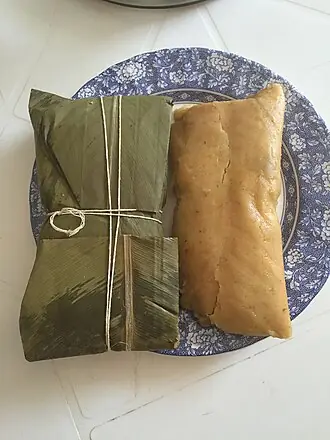
Hallaca (Venezuelan Stuffed Corn Dough)
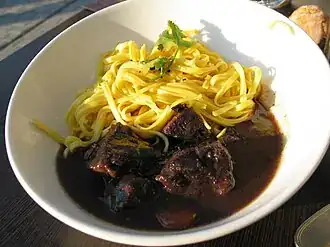
Boeuf Bourguignon
A Taste of South Africa: Many Communities, Many Food Stories