Use the regional background below as a starting point for exploring the food, rather than expecting one dish to represent every household. Food traditions differ within a country and continue to change through travel, migration, and everyday cooking.
In this story
OverviewCharacteristicsMeats from FinlandBreadExamples of Finnish dishesTypical Finnish dishesMealsOverview
Finnish cuisine is notable for generally combining traditional country fare and haute cuisine with contemporary continental-style cooking. Fish and meat (usually pork, beef or reindeer) play a prominent role in traditional Finnish dishes in some parts of the country, while the dishes elsewhere have traditionally included various vegetables and mushrooms. Evacuees from Karelia contributed to foods in other parts of Finland in the aftermath of the Continuation War.
Finnish foods often use wholemeal products (rye, barley, oats) and berries (such as bilberries, lingonberries, cloudberries, and sea buckthorn). Milk and its derivatives like buttermilk are commonly used as food, drink or in various recipes. Various turnips were common in traditional cooking, but were replaced with the potato after its introduction in the 18th century.
Characteristics
The way of life and culture of Finns was mainly based on agriculture already at prehistoric times. However, in the harsh and cold environment, agriculture was neither a very effective nor secure way of life, so getting food from nature has often been an important secondary livelihood. When crops failed, it might have been the only way to survive. Also, while farms mainly produced crops like turnips, and often families had only some farm animals to get milk products and meat, hunting and especially fishing were important ways to get more protein. Large-scale meat production and therefore meat as a daily food started to emerge only at the beginning of the 20th century, after periods of malnutrition in the 19th century caused by failed crops.
In former times, the country's harsh climate meant that fresh fruit and vegetables were largely unavailable for at least nine months of the year, leading to a heavy reliance on staple tubers (initially turnip, later potato), dark rye bread and fermented dairy products, occasionally enlivened with preserved fish and meat. Traditionally, very few spices other than salt were available, and fresh herbs like dill and chives were limited to the summer months. Many Finnish traditional dishes are prepared by stewing them for a long time in an oven, which produces hearty but bland fare. Forests and lakes were historically a major source of food, and produce from forests currently accounts for the distinctive traits in Finnish cuisine. The simplicity of traditional Finnish food has been turned into an advantage by shifting the emphasis to freshness.
Meats from Finland
The most popular meats in Finland are pork (33.5 kg/year/person in 2005), beef (18.6 kg), and chicken (13.3 kg). Approximately one third of this is eaten as sausage (makkara), which is mostly made from pork but often mixes in other meats as well. Horse meat, lamb and reindeer make up a small portion of the total meat consumption, but they are widely available.
In addition to domesticated animals, there are long traditions of hunting and fishing in Finland. The hunters focus on deer, moose and bear, but small game such as hare, duck and grouse are popular. Approximately 70,000–80,000 moose are culled yearly, producing significant amounts of meat. Due to very strict food hygiene regulations, moose meat is mainly consumed within households and is rarely obtainable in restaurants.
Bread
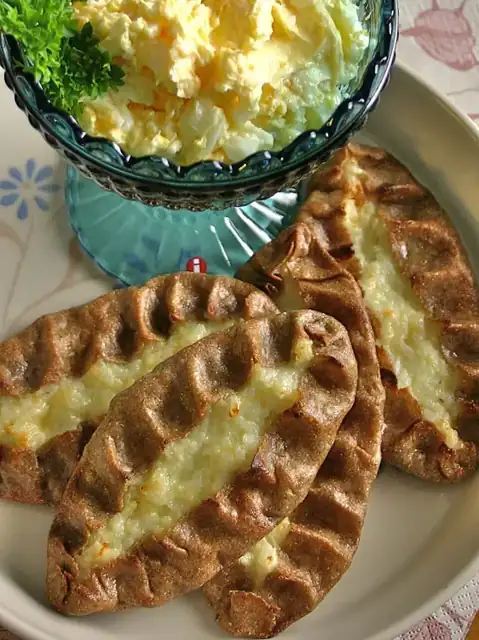
Dark and fiber-rich ruisleipä, rye bread, is a staple of the Finnish diet. Breads are made from grains like barley, oat, rye and wheat, or by mixing different grits and flours. For example, sihtileipä is made of a combination of rye and wheat. There is also a variety of flat breads called rieska, like maitorieska (milk flatbread), ryynirieska with barley grits from Savonia, läskirieska (lard flatbread) a somewhat flat barley bread with pieces of lard from Western coast, and perunarieska (potato flatbread). In Kainuu, North Finland, the flatbreads are very flat and baked on naked flame. Näkkileipä, crisp rye bread, is also common.
Famines caused by crop failures in the 19th century caused Finns to improvise pettuleipä or bark bread, bread made from rye flour and the soft phloem layer of pine bark, which is nutritious, but rock-hard, bitter and poorly digestible. It was eaten also during the Second World War, and the tradition of making this bread has had a minor come-back with claims of health benefits.
Examples of Finnish dishes
The term perinneruoka ("traditional dish") is often applied to specialties that are rarely eaten on a daily basis. These are often regional, associated with the older generations or specific holidays—for example, mämmi on Easter—and most people eat these dishes rarely, or not at all. In contrast, with perinneruoka, the term kotiruoka ("home-made food") is applied to daily staple dishes. Meatballs, pea soup and rye bread are examples of such staples.
The following list is a sample of typical dishes traditionally consumed in Finland.
Typical Finnish dishes
Kaalikääryleet – cabbage rolls
Game – moose, deer, grouse, duck, hare, and other wild meats. Rarely attainable in restaurants, except the finest ones. Common amongst those whose hobby is hunting.
Hernekeitto – pea soup, usually served on Thursdays, along with pancakes for dessert.
Meals
Common meals are breakfast (aamupala), lunch (lounas), dinner (päivällinen) and supper (iltapala). Sometimes there is also an afternoon snack (välipala) or a coffee break where a light snack is served. In all primary and secondary schools, including high school, a hot free lunch is served as part of Finland's welfare state system. Lunch, eaten around noon, is usually a warm meal, although some people may select a lighter meal such as a sandwich or a salad. Taking a lunchbox is not as common as elsewhere in Europe. Universities also provide lunch for students, but contrary to primary and secondary schools, lunch in universities is not free of charge but subsidized.
Lunch typically consists of a single course with optional side salad, bread and dessert. Many workplaces have a lunch restaurant, and if not, employers often give lunch vouchers. Restaurants often have a separate lunch menu for this purpose. In the evening, the dinner is usually a hot meal, again with side dishes. Meals are usually single-course, commonly consisting of meat of some sort (pork, lamb, chicken, beef) and potatoes, rice or pasta with the meat. Soups, such as pea soup or fish soup, are not considered appetizers only, but may be served as lunch or dinner, and they are correspondingly heavier and come in larger portions.
Dinner is typically the most substantial meal of the day. However, it is served rather early at 5 pm, so that there is often a separate supper at 8-9 pm. This supper (iltapala) is a light snack.
More to savor

English Breakfast

Toast
A Taste of Taiwan: Exploring the Food Behind the Table