The dish is a starting point for exploring a wider food story. The guide below looks more closely at its background and different forms. When you want to cook, visit the recipe collection for ingredient quantities and step-by-step methods.
Overview
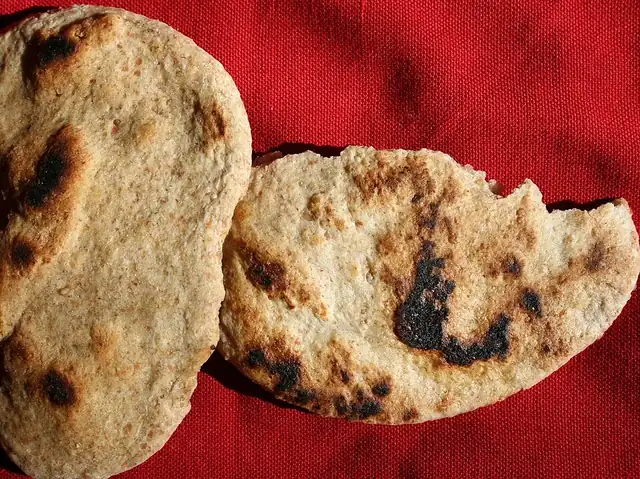
A flatbread is bread typically made with flour, water, and salt, with or without leavening, which are mixed and rolled into flattened dough. They are usually baked quickly at high temperatures and range from below one millimeter to a few centimeters in thickness. Flatbreads are distinguished from other flour-based foods such as loaf breads, which have lower proportions of crust relative to crumb; pancakes, which use liquid batter rather than firm dough; and crackers, which are dry and crisp. Flatbreads are the oldest and most common type of bread, and are often staple foods. Many types of flatbread are eaten globally.
Flatbreads may use flour from cereal grains, commonly wheat, as well as pseudocereals, pulses, or tubers. Fat may be used as shortening, while other ingredients may provide nutrition or flavor. Depending on water content, the mixture is either a dough or a batter; the latter results in a pancake-like bread. The dough is rested, during which it may undergo fermentation. Fermentation is driven by a leavening agent, most commonly sourdough. Fillings or toppings are sometimes added. Flatbreads are commonly baked against a griddle or the walls of a vertical oven (such as a tandoor). Other methods include being baked in domed ovens, covered in embers, or fried in oil. Some flatbreads puff up as steam forms while baking, while others are pressed or stamped to avoid this.
Flatbreads are divided into double-layered flatbreads, which contain leavening and puff up while baking, and single-layered flatbreads, which include thick, leavened varieties and thin, unleavened varieties.
Characteristics
Flatbreads are a very diverse category of breads characterized by being flat. They are distinguished from loaf breads as flatbreads have higher density and a higher proportion of crust relative to crumb. Some, such as tortillas, essentially have no crumb. Pancakes may be considered a type of flatbread or a distinct category. Flatbreads and pancakes use the same ingredients of flour and water, which are turned into a fluid batter for pancakes or a firm dough for flatbreads. Crackers are similar to flatbreads but with less water, making them crisp. Although they are related to several types of flatbreads, crackers are considered a separate category.
There are many types of flatbreads, which vary based on ingredients, baking methods, size, shape, and moisture. Some are paper-thin and translucent, while others are a few centimeters thick, bordering on loaf breads and able to be sliced. They may weigh between 20 grams and 1 kilogram, with a diameter between 5 and 70 centimeters. Most are round, but some are triangular or rectangular. In appearance, they are light with dark spots. Some types have fillings or toppings, such as pizza. According to food scientist Jalal Qarooni, flatbreads are possibly the most diverse and most popular type of food product.
Ingredients
The basic ingredients of flatbreads, like other baked goods, are flour, water, and salt, with optional ingredients including fat and yeast. Water is necessary to form a homogenous dough. Flatbreads usually have less water than loaf breads, but the amount varies. A soft, light flatbread can be made with 50% water (relative to flour), while some types contain 60–75%. This proportion is subjective and may vary based on the flour's ability to absorb it. If the flour contains gluten, water helps its development. Salt is necessary for a good-quality product as it strengthens flour and improves texture. The salt content is typically 0.5–3% of the flour, though salt is sometimes excluded from varieties like chapati or maize tortillas. Fat or oil is used as shortening. It increases shelf life, eases dough handling, and makes the bread softer.
Examples of shortening include lard in wheat tortillas and butter in naan.
Flour
Flatbreads can use flour from various cereal grains, pseudocereals, or pulses. This differs from loaf breads, which are generally made only of wheat flour, because flatbreads do not require gluten. Gluten is necessary for viscoelastic doughs, so these are usually made of wheat, but thin batters can use gluten-free flours. Flour is sometimes prepared the same day it is baked; this is common among rural residents of North India including Rajasthan.
Additional ingredients
Additional ingredients are used for flavor, nutrition, or other properties. Sweet flatbreads use sugar or honey for flavor. Salty flatbreads use salt for flavor, though a little sugar may be used for yeast growth. In addition, sweet flatbreads sometimes use fruits, while salty flatbreads sometimes use vegetables or spices. Seeds can be placed on the surface of dough, such as sesame seeds on shaobing.
Flatbread ingredients include both plant and animal products. Animal products such as milk, butter, yogurt, whey, or eggs are used for nutrition and texture. Their high protein content contributes to dough stability. Whey is a common source of protein fortification, especially in gluten-free flatbreads. Eggs increase protein and micronutrients and also act as a leavening agent. Aside from flour, plant-based products include extracted starch, protein, and fiber. Plant starches are added for texture and appearance, especially in gluten-free flatbreads. Plant proteins, mostly gluten, improve texture when the flour used is not optimal. Fibers also improve texture as they increase water absorption. Flours made of vegetables, fruits, or seeds can be used for nutrition and other properties.
Process
Flatbreads, like other breads, are made by mixing ingredients, shaping, and baking. The ingredients are mixed into either a firm dough, using more flour than water, or a thin batter, using more water. The processing of dough into flatbread takes between 45 minutes and 3 hours. The timing of each step has a significant influence on the final product.
Consumption
Flatbreads are the most common type of bread, with over one billion consumers. They are often staple foods, with the average person consuming over 130 kg annually in countries including Egypt, Kuwait, Iran, Azerbaijan, and Kazakhstan. Requiring only flour and water with no specialized tools, flatbreads are simple to make and eat. They can be an efficient way to utilize available ingredients, so they contribute to subsistence economies and food security. In some remote areas, they comprise 90% of food consumption, causing undernutrition. Government subsidies for flatbreads are common. While some types of flatbread are important parts of their cultures' diets, others are eaten on special occasions. They may hold ceremonial significance, being baked as part of a religious, cultural, or harvest festival.
More to savor

English Breakfast

Stuffed Duck Breast with Cabbage and Dumplings
Pancakes Around the Table: One Idea, Many Delicious Forms