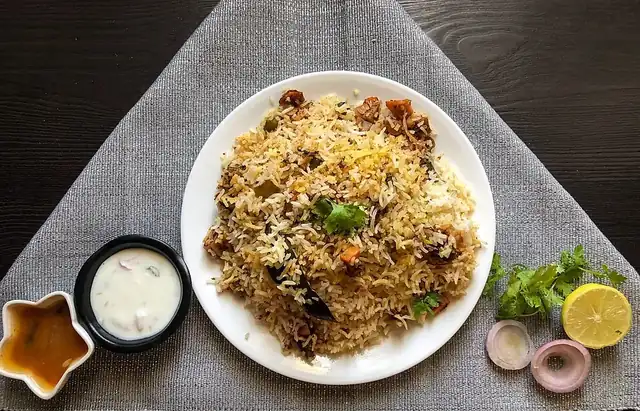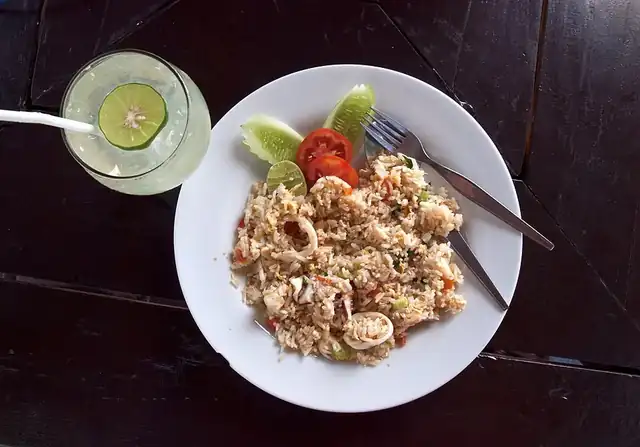
The dish is a starting point for exploring a wider food story. The guide below looks more closely at its background and different forms. When you want to cook, visit the recipe collection for ingredient quantities and step-by-step methods.
In this story
OverviewPreparationLocalisationChinaJapanKoreaBrunei, Indonesia, Malaysia and SingaporeOverview
Fried rice is a dish of cooked rice that has been stir-fried in a wok or a frying pan and is usually mixed with other ingredients such as eggs, vegetables, seafood, or meat. It is often eaten as a main dish or as an accompaniment to another dish. Fried rice is a popular component of East Asian, Southeast Asian and South Asian cuisines. As a homemade dish, fried rice is typically made with ingredients left over from other dishes, leading to countless variations. Fried rice first developed during the Sui dynasty in China and later spread across the world through the migration of the Chinese diaspora.
Many varieties of fried rice have their own specific list of ingredients. In China, common varieties include Yangzhou fried rice and Hokkien fried rice. Japanese chāhan is considered a Japanese Chinese dish, having derived from Chinese fried rice dishes. In Southeast Asia, similarly constructed Indonesian, Malaysian, and Singaporean nasi goreng and Thai khao phat are popular dishes. In the West, most restaurants catering to vegetarians have invented their own varieties of fried rice, including egg fried rice. Fried rice is also seen on the menus of non-Asian countries’ restaurants offering cuisines with no native tradition of the dish. Additionally, the cuisine of some Latin American countries includes variations on fried rice, including Ecuadorian chaulafan, Peruvian arroz chaufa, Cuban arroz frito, and Puerto Rican arroz mampostea(d)o.
Fried rice is a common street food in Asia and other parts of the world. In some Asian countries, small restaurants, street vendors and traveling hawkers specialise in serving fried rice. In Bhutanese cities it is common to find fried rice street vendors stationing their food carts in busy streets or residential areas. Many Southeast Asian street food stands offer fried rice with a selection of optional garnishes and side dishes.
Preparation
Cooked rice is the primary ingredient, with a wide variety of additional ingredients, such as vegetables, eggs, meat (chicken, beef, pork, lamb, mutton), preserved meat (bacon, ham, sausage), seafood (fish, shrimp, crab), and mushrooms. Aromatics, such as onions, shallots, scallions, leeks, ginger and garlic, are often added for extra flavor. Cooking oils, such as vegetable oil, sesame oil, clarified butter, or lard, can be used to grease the wok or frying pan to prevent sticking, as well as for flavor. Fried rice dishes can be seasoned with salt, different types of soy sauce, oyster sauce, teriyaki sauce and many other sauces and spices.
Popular garnishes include chopped scallions, sliced chili, fried shallots, sprigs of parsley or coriander leaves, mint leaves, sliced boiled eggs, toasted sesame seeds, seaweed flakes (gim or nori), sliced cucumber, tomato, lime, or pickled vegetables.
Making fried rice with fresh rice can prevent it from frying properly, leading to an undesirably soft texture.
Localisation
As fried rice spread across South-East Asia, it was gradually localised into distinctive regional styles. Within the Malay Archipelago, it evolved into nasi goreng, which diverged from its Chinese antecedent through the use of local flavourings. Seasonings such as kecap manis (sweet soy sauce), sambal, terasi or belacan (shrimp paste), shallots and garlic gave the dish a darker colour, more pronounced aroma and a balance of sweet, savoury and spicy flavours. Variants developed in present-day Indonesia, Malaysia, Singapore, Brunei and southern Thailand, each incorporating regional ingredients and tastes while sharing a common identity under the name nasi goreng.
Elsewhere in South-East Asia, parallel adaptations developed. In Thailand, fried rice became khao phat, seasoned with fish sauce and served with accompaniments such as lime and cucumber. In the Philippines, it appeared as sinangag, a garlic-based fried rice commonly eaten at breakfast alongside eggs and cured meats. In Vietnam, cơm chiên often featured Chinese sausage and local herbs. While each variation reflected local tastes, in Indonesia and Malaysia nasi goreng became the most widespread and distinctive form, cutting across ethnic and social boundaries.
China
Hokkien (or Fujian) fried rice (福建炒飯), a variation of Chinese fried rice, is from the Fujian region of China; it has a thick sauce poured and mixed over it which can include mushrooms, meat, vegetables, and other ingredients.
Sichuan fried rice (四川炒飯) is a spicy stir-fried rice from Sichuan which uses doubanjiang chili sauce with garlic, green onions, and red onion.
Yin-yang fried rice (鴛鴦炒飯) is topped with two different types of sauce, typically a savory white sauce on one half and a red tomato-based sauce on the other half. Elaborate versions use the sauces to create a yin-yang symbol.
Japan
Chāhan (チャーハン) or yakimeshi (焼飯) is a Chinese-derived fried rice suited to Japanese tastes by the addition of katsuobushi for flavor, prepared with a variety of ingredients.
Omurice is fried rice wrapped inside an egg omelette. The fried rice is generally mixed with a variety of vegetables and meat. Often a variant called "chicken rice" (チキンライス chikinraisu) is used. Ketchup or some other tomato sauce is added to make this.
Korea
Bokkeum-bap is made by stir-frying bap (cooked rice) with other ingredients in oil. A wide range of fried rice dishes are common in Korean cuisine, often made with whichever ingredients are handy. In Korean restaurants, fried rice is a popular end-of-meal add-on. After eating the main dishes cooked on a tabletop stove, cooked rice along with gimgaru (seaweed flakes) and sesame oil is often added directly into the remains of the main dishes, stir-fried, and browned.
Kimchi-bokkeum-bap is a popular variety of bokkeum-bap, prepared with kimchi and a variable list of other ingredients.
Brunei, Indonesia, Malaysia and Singapore
Nasi goreng means fried rice in Indonesian and Malay languages. It is one of five national dishes of Indonesia. It is distinguished from other Asian fried rice recipes through the widespread use of sweet soy sauce (kecap manis) and ground shrimp paste. It is often accompanied by additional items such as a fried egg, fried chicken, satay, and condiments such as sambal, acar, and krupuk. It is endemic to Indonesia, Brunei, Malaysia, Singapore, and is also popular in the Netherlands.
Nasi goreng jawa, which means "Javanese fried rice", commonly includes sambal ulek as a seasoning and has a spicy flavor.
Nasi goreng pattaya is Malaysian-style nasi goreng wrapped inside an egg omelette. The fried rice is generally mixed with a variety of vegetables and meat and garnished with tomato sauce. In Indonesia, the dish is called nasi goreng amplop.
More to savor
Hallaca (Venezuelan Stuffed Corn Dough)
Tonkotsu Ramen
At the Japanese Table: Everyday Meals Beyond Sushi