The dish is a starting point for exploring a wider food story. The guide below looks more closely at its background and different forms. When you want to cook, visit the recipe collection for ingredient quantities and step-by-step methods.
Overview
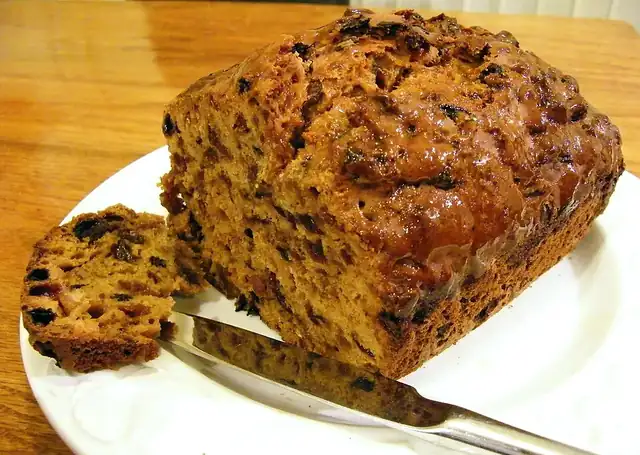
Fruitcake or fruit cake is a cake made with candied or dried fruit, nuts, and spices, and optionally soaked in spirits. In the United Kingdom, certain rich versions may be iced and decorated.
Fruitcakes are usually served in celebration of weddings and Christmas. Given their rich nature, fruitcakes are most often consumed on their own, as opposed to with condiments (such as butter or cream). Fruit cake is different to fruit bread, but may share similar toppings and mixtures.
Australia
In Australia, fruitcake is consumed throughout the year, but most commonly at Christmas, and is available at most major retail outlets. The cake is rarely given icing; often it is consumed with butter or margarine, or custard.
Bahamas
In the Bahamas, not only is the fruitcake drenched with rum, but the ingredients are as well. All of the candied fruits, walnuts, and raisins are placed in an enclosed container and are soaked with the darkest variety of rum, anywhere from 2 weeks to 3 months in advance. The cake ingredients are mixed, and once the cake has finished baking, rum is poured onto it while it is still hot.
Bulgaria
In Bulgaria, the common fruitcake is known as keks (кекс ), is home-made and is consumed throughout the year. Recipes for keks vary, but commonly it contains flour, butter and/or cooking oil, milk, yeast, yoghurt, eggs, cocoa, walnuts, and raisins. It is usually baked in Bundt-style pans.
There is also another specific type of fruitcake prepared for Easter, which is known as kozunak (козунак ).
Canada
The fruitcake is commonly eaten during the Christmas season in Canada. Rarely is it seen during other times of the year. The Canadian fruitcake is similar in style to the UK version. However, there is rarely icing on the cake, and alcohol is not commonly put into Christmas cakes that are sold. The cakes are shaped like a small loaf of bread, and often covered in marzipan.
Dark, moist and rich Christmas fruitcakes are the most frequently consumed, with white Christmas fruitcake less common. These cakes tend to be made in mid-November to early December when the weather starts to cool down. They also can be a gift generally exchanged between business associates and close friends/family.
It is called gâteau aux fruits in Quebec and New-Brunswick.
Chile
Pan de Pascua is a fruitcake traditionally eaten around Christmas and Epiphany.
France
In France, fruitcake is called cake aux fruits confits.
Germany
In German, fruitcake means Früchtebrot, which is used both as a general and as specific name. In Germany, baked goods which fit the description of fruitcake are not usually regarded as cake but rather as sweet breads.
Stollen is loaf-shaped and often powdered with icing sugar on the outside. It is usually made with yeast, butter, water, and flour, with the addition of citrus zest, candied citrus peel, raisins, and almonds.
The most famous Stollen is the Dresdner Stollen, sold at the Dresden Christmas market, the Striezelmarkt.
Official Dresden Stollen, produced by only 150 bakers in Dresden and some adjacent settlements, bears a special seal depicting Elector Augustus II the Strong. Typically, it is covered with a crust of compacted powdered sugar around 1 cm thick, but it is actually defined by its richness in butter and certain fruit and nuts: Per kilogram flour, Dresdner Stollen is mandated by law to contain at least 650 grams sultanas, 500 grams of butter, 200 grams succade, and 150 grams of almonds. The recipe originated in 1491, when after several generations of lobbying by Elector Ernest, Duke Albert III, and their ancestors, Pope Innocent VIII gave an exemption to the Roman Catholic ban on using butter during Lent to Saxon bakers.
In Bremen, the local fruitcake called Klaben is traditionally sold and eaten during the Christmas season. Bremer Klaben is a kind of stollen which is not dusted with powdered sugar after baking. Both Dresdner Stollen and Bremen Klaben are protected geographical indications.
In Southern Germany and the Alpine region, Früchtebrot (also called Berewecke, Birnenbrot, Hutzenbrot, Hutzelbrot, Kletzenbrot, Schnitzbrot, or Zelten) is a sweet, dark bread baked with nuts and dried fruit, e.g. apricots, figs, dates, plums, etc.
India
In India, fruitcake is found everywhere during the Christmas season, although it is also available commonly throughout the year.
Ireland
In Ireland, a type of sweetbread called barmbrack is eaten at Halloween. The cake contains different objects such as a ring or small coin, each signifying a different fortune for the person who finds it.
Italy
Panforte is a chewy, dense Tuscan fruitcake dating back to 13th-century Siena. Panforte is strongly flavored with spices (panforte means "strong bread") and baked in a shallow form. Genoa's fruitcake, a lower, denser but still crumbly variety, is called pandolce ("sweet bread").
There are various types of fruitcakes from the Emilia-Romagna region, most being dark and heavily spiced with an abundance of candied fruit and nuts. The certosino from Bologna is a round cake similar to panforte but with aromatic spices and a variety of whole-halved candied fruit decorating the top; dark chocolate is often added to the dough for a richer flavour. The certosino is low and very dense. Panone, produced in much of Emilia, is similar to the certosino, but with a lighter, fluffier dough and candied fruit inside the cake rather than used as decoration. Panpepato from Ferrara has a dough similar to panone but has a higher ginger content.
Candied fruit is not often found and instead there is a high concentration of nuts within the dough; the entire cake is often coated in dark chocolate.
Gubana is a Christmas/holiday cake from the Friuli-Venezia Giulia region, specifically from the area around Cividale del Friuli. It is a leavened dough cake with a filling of nuts, dried fruit, sugar, and grappa which is rolled into a spiral filled tube which is then twisted into the shape of a rose or snail's shell. Gubana is often eaten with alcohol (slivovitz or grappa) around the holiday season. It combines Italian, Friulan, and Slovenian tastes and cooking styles to create a unique sweet.
Panettone is a Milanese sweet bread (widely available throughout Italy and in many other countries), served around Christmas, which is traditionally filled with dried and candied fruits, with a bread-like consistency.
More to savor
Welsh Fruit Bread (Bara Brith) I
Apple Crisp I
Cake: A Slice of Celebration, a World of Possibilities