The dish is a starting point for exploring a wider food story. The guide below looks more closely at its background and different forms. When you want to cook, visit the recipe collection for ingredient quantities and step-by-step methods.
In this story
OverviewDefinitionCake mixesCooking techniquesIngredients and mixing techniquesBatter cakeCooking techniquesFood safetyOverview
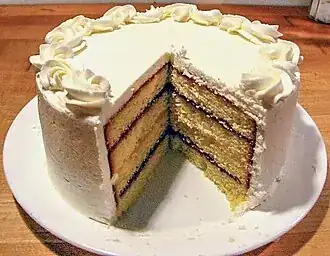
Cake is a baker's confectionery made by combining flour with a liquid, a fat or both, and usually with a leavening agent. Cakes are usually baked, but can be griddled. In their oldest forms, cakes were modifications of bread, but cakes now cover a wide range of preparations that can be simple or elaborate and which share features with other desserts such as pastries, meringues, custards, and pies.
The most common ingredients include flour, sugar, eggs, fat (such as butter, oil, or shortening), and a leavening agent (such as baking soda or baking powder). Common additional ingredients include dried, candied, preserved or fresh fruit, nuts, cocoa, and flavor extracts such as vanilla, with numerous substitutions possible. Cakes can also be flavored with fruit preserves, nuts, or dessert sauces (like custard, jelly, cooked fruit, whipped cream, or syrups), covered with icing or frosting, and decorated with marzipan, piped borders, or candied fruit.
Cake is often served as a celebratory dish on ceremonial occasions, such as weddings, anniversaries, and birthdays. There are countless cake recipes; some are bread-like, some are rich and elaborate, and many are centuries old. Cake making is no longer a complicated procedure; while at one time considerable labor went into cake making (particularly the whisking of egg foams), baking equipment and directions have been simplified so that even the most amateur of cooks may bake a cake.
Definition
The precise definition of "cake" has always been elusive. The oldest cakes were essentially breads with sweet ingredients added. Throughout much of history, terms for "bread" and "cake" were used interchangeably. Some define cake as a subtype of bread. Other foods that contain none of the properties traditionally associated with cake may be referred to, or translated, as "cake" because of their appearance or function as a dessert—for example, cheesecakes and icebox cakes. Cake, however, is normally defined as being made with a batter and not a dough mixture.
Cake mixes
During the Great Depression, there was a surplus of molasses and the need to provide easily made food to millions of economically depressed people in the United States. One company patented a cake-bread mix to deal with this economic situation and thereby established the first line of cake in a box. In doing so, cake, as it is known today, became a mass-produced good rather than a home- or bakery-made specialty.
Later, during the post-war boom, other American companies (notably General Mills) developed this idea further, marketing cake mix on the principle of convenience, especially to housewives. When sales dropped heavily in the 1950s, marketers discovered that baking cakes, once a task at which housewives could exercise skill and creativity, had become dispiriting. This was a period in American ideological history when women, retired from the war-time labor force, were confined to the domestic sphere while still exposed to the blossoming consumerism in the US. This inspired psychologist Ernest Dichter to find a solution to the cake mix problem in the frosting. Since making the cake was so simple, housewives and other in-home cake makers could expend their creative energy on cake decorating inspired by, among other things, photographs in magazines of elaborately decorated cakes.
Cooking techniques
Cake varieties are often distinguished by their ingredients and mixing techniques, both of which influence the texture of the finished cake. They may also be cooked through methods other than baking.
Ingredients and mixing techniques
The ingredients of a cake— in particular, leavening agents and fat—determine the texture and size of the finished cake.
Batter cake
Batter cakes are made from a liquid batter made of creamed butter, sugar, eggs, and flour. They get their structure from beating certain ingredients (typically butter and sugar) for an extended period of time to incorporate air into the batter. They typically incorporate a leavening agent.
Varieties include:
Butter cake (high butter content)
Pound cake (equal parts butter, sugar, flour, and eggs)
Cooking techniques
While most cakes are baked, some varieties are fried (like pancakes) or steamed.
Baked cakes rely on a correct temperature to keep the ingredients stable while rising and keep the cake from falling in on itself. In a cake that "falls", parts may sink or flatten, because it was baked at a temperature that is too low or too hot, when it has been underbaked and when placed in an oven that is too hot at the beginning of the baking process. An incorrect ratio of fat or leavening to other ingredients can also cause a cake to fall.
Food safety
The shelf life of cakes packaged for commercial sale depends on several factors. Cakes are intermediate moisture products prone to mold growth. Commercial cakes are commonly exposed to different mold varieties before they are packaged for sale, including Aspergillus flavus and various penicillins, and Aspergillus niger. Preservatives and oxygen absorbents are currently used to control and inhibit mold growth.
In the US, the CDC has recommended not to eat raw cake batter because it can contain pathogens like Salmonella and E. coli. Cake batter uses raw flour, which can contain live bacteria and present a hazard if consumed.
More to savor

English Breakfast
Fried Bananas
Ice Cream: The Frozen Treat with a World of Flavors