The dish is a starting point for exploring a wider food story. The guide below looks more closely at its background and different forms. When you want to cook, visit the recipe collection for ingredient quantities and step-by-step methods.
In this story
OverviewPreparation and fillingShapes and cooking methodsCuisineCantonese cuisineSichuan cuisineShanghai cuisineNingbo cuisineJiangzhe cuisineOverview
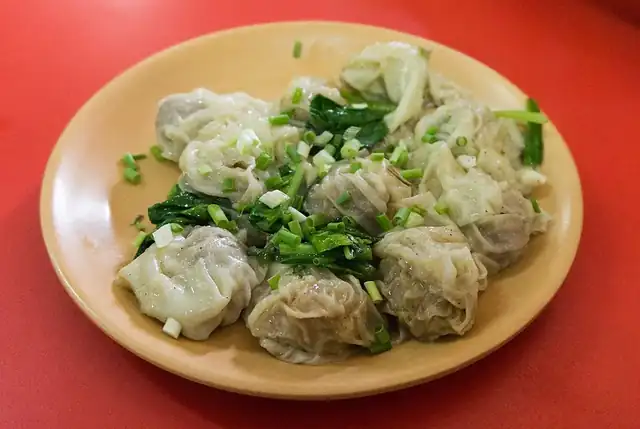
A wonton is a type of Chinese dumpling commonly found across regional styles of Chinese cuisine. It is also spelled wantan or wuntun, a transliteration from Cantonese (/), and wenden from Shanghainese hhun den (/). Even though there are many different styles of wonton served throughout China, Cantonese wontons are the most popular in the West due to the predominance of Cantonese restaurants overseas.
Wontons, which have their origins in China, have achieved significant popularity in East Asian cuisine, as well as across various Southeast Asian culinary traditions.
Preparation and filling
Wontons are made by spreading a square wrapper (a dough skin made of flour, egg, water, and salt) flat in the palm of one's hand, placing a small amount of filling in the center and sealing the wonton into the desired shape by compressing the wrapper's edges together with the fingers. Adhesion may be improved by moistening the wrapper's inner edges, dipping a fingertip into water, and running it across the dry dough to dissolve the extra flour. As part of the sealing process, the air is pressed out of the interior to avoid rupturing the wonton from internal pressure when cooked.
The most common filling is ground pork or chicken and shrimp with a small amount of flour added as a binder. The mixture is seasoned with salt, spices, and often garlic or finely chopped green onion. Factory-made, frozen varieties are sold in supermarkets. Commonly, they are handmade at the point of sale in markets or small restaurants by the proprietor while awaiting customers. In markets, they are sold by the unit without being pre-cooked.
Shapes and cooking methods
Wontons are commonly boiled and served in soup or sometimes deep-fried. There are several common regional variations of shape.
The most versatile shape is a simple right triangle, made by folding the square wrapper in half by pulling together two diagonally opposite corners. Its flat profile allows it to be pan-fried like a guotie (pot sticker) in addition to being boiled or deep-fried.
A more globular wonton can be formed by folding all four corners together, resulting in a shape reminiscent of a stereotypical hobo's bindle made by tying all four corners of a cloth together.
A related kind of wonton is made by using the same kind of wrapper but applying only a minute amount of filling (frequently meat) and quickly closing the wrapper-holding hand, sealing the wonton into an unevenly squashed shape. These are called xiao huntun (literally "little wonton") and are invariably served in a soup, often with condiments such as pickles, ginger, sesame oil, and cilantro (coriander leaves).
Cuisine
Each region of China has its own variations of wonton; examples include Beijing, Sichuan, Hubei, Jiangnan, Jiangxi, Guangdong (Canton), and Fujian.
Dumplings and wontons from the 7th and 8th centuries CE were found in Turpan.
Cantonese cuisine
In Cantonese cuisine, shrimp-filled wontons within minced pork are most commonly served with thin noodles in a steaming hot soup to make wonton noodles. It may also be consumed with red vinegar. The soup is made from boiling shrimp shells, pork bones, and dried flounder to give it a distinct taste. Wontons are served in a variety of sizes, with the smallest being two wontons and noodles called sai yung.
Sichuan cuisine
In Sichuan, semi-pentagonal wontons are known as "folded arms" since after initially folding the wonton skin into a right triangle, each end of the hypotenuse is pressed against the middle of opposite sides, creating an impression of crossed arms/hands. These are often served in a sesame paste and chili oil sauce as a dish called "red oil wonton" .
Shanghai cuisine
In Shanghai and its surrounding area (Jiangnan, nowadays Yangtze River Delta), wonton filling is most often made with minced meat (usually pork) and shepherd's purse served in chicken soup; however, Shanghai cuisine makes a clear distinction between small wontons and large wontons. The former are casually wrapped by closing the palm on a wrapper with a dab of pork filling as if crumpling a sheet of paper. These are popular accompaniments to breakfast or brunch fare. The "large" wontons are carefully wrapped in a shape similar to tortellini, and a single bowl can serve as lunch or a light dinner. They are available with a large variety of fillings; a popular Shanghai fast-food chain offers more than 50 varieties.
One popular variety in Shanghai that originated in Suzhou is "three delicacies wonton" (san xian hun tun), which contains pork, shrimp, and beef liver as primary ingredients.
Ningbo cuisine
Ningbo wontons come in two types: steamed wontons and wonton soup. Both are filled with pork and shrimp.
These wontons became popular at many Chinese-American restaurants due to their traditional preparation.
Jiangzhe cuisine
In the Jiangzhe area, they are often called "wonton". Wontons have two types: small wontons and big wontons. Big wontons are a large ingot shape. Generally boiled, the soup will usually be matched with a thin egg omelette, seaweed, mustard greens, and shrimp.
More to savor
Tattie Scones
Daifuku (Sweet Filled Mochi)
Fufu: A Starchy Staple with Many Regional Forms