The dish is a starting point for exploring a wider food story. The guide below looks more closely at its background and different forms. When you want to cook, visit the recipe collection for ingredient quantities and step-by-step methods.
In this story
OverviewRegionIndonesian word "digado"Tugu villageGado-gado BetawiVegetablesGarnishes and riceServingOverview
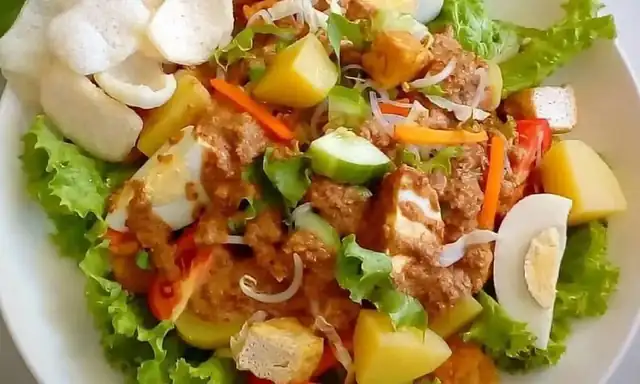
Gado-gado (Indonesian or Betawi) is an Indonesian salad of raw, slightly boiled, blanched or steamed vegetables and hard-boiled eggs, boiled potato, fried tofu and tempeh, and sliced lontong (compressed cylinder rice cake wrapped in a banana leaf), served with a peanut sauce dressing.
In 2018, gado-gado was promoted as one of five national dishes of Indonesia; the others are soto, sate, nasi goreng, and rendang.
Region
Gado-gado is widely sold in almost every part of Indonesia, each with its own regional variations. It is thought to have originally been a Sundanese dish, as it is most prevalent in Western parts of Java (which includes Jakarta, Banten, and West Java provinces). The Javanese have their own slightly similar version of a vegetables-in-peanut-sauce dish called pecel which is more prevalent in Central and East Java. Gado-gado is widely available at hawkers' carts, stalls (warung) and restaurants and hotels throughout Indonesia; it is also served in Indonesian-style restaurants worldwide. Although it is customarily called a salad, the peanut sauce is a larger component of gado-gado than is usual for the dressings in Western-style salads; the vegetables should be well-coated with it.
Some eating establishments use different mixtures of peanut sauce or add other ingredients for taste, such as cashew nuts. In Jakarta, several eating establishments boast gado-gado as their signature dish, some of which have been in business for decades and have developed faithful clientele. For example, Gado-Gado Boplo restaurant chain has been around since 1970, while Gado-Gado Bonbin in Cikini has been around since 1960.
The peanut sauce is made of ground fried peanuts, sweet palm sugar, garlic, chillies, salt, tamarind, and a squeeze of lime. Gado-gado is generally freshly made, sometimes in front of the customers to suit their preferred degree of spiciness, which corresponds to the amount of chili pepper included. However, particularly in the West, gado-gado sauce is often prepared ahead of time and in bulk. Gado-gado sauce is also available in dried form, which is simply rehydrated by adding hot water.
Gado-gado sauce is not to be confused with satay sauce, which is also a peanut sauce.
Indonesian word "digado"
Gado-gado comes from the Indonesian word "digado". However, the word "digado" does not exist in the Indonesian dictionary. The word "digado" originates from a specific Indonesian culture, Java. In the Betawi language, the word means “to not be eaten with rice”, which is why rice is not included as one of the key ingredients of gado-gado. Rather, a substitute of rice is used, which is known as lontong, otherwise known as Indonesian rice cake.
Tugu village
Another theory is that gado-gado originated from the Tugu village. In the early 1700s, when the Europeans arrived in Indonesia, a number of Portuguese people started a village currently known as the Tugu village. It is said that these Portuguese people brought their local cuisine to Indonesia. Through the introduction of the Portuguese culture, the dish gado-gado was first introduced to Indonesia.
Gado-gado Betawi
This variation of gado-gado originates from Betawi in Jakarta and is known for being prepared differently as compared to the other variations. Based on a recipe book "Resep Gado-Gado Betawi" by Sasongko Iswandaru , the dish consists of boiled vegetables, including long bean, bean sprout and cabbage, mixed with fried tofu, tempeh and boiled egg, served with peanut sauce.
Vegetables
The composition of the vegetable salad varies greatly, but usually comprises a mixture of some of the following:
blanched - shredded, chopped, or sliced green vegetables such as cabbage, kangkung, spinach, bean sprouts, boiled young jackfruit, chayote, string bean, green bean, bitter melon, and corn.
sliced - boiled potatoes
uncooked - sliced cucumber, tomato, and lettuce.
peeled and sliced boiled eggs
sliced - fried tofu and tempeh
Outside Indonesia, it is usual to improvise with whatever vegetables are available.
All the ingredients are blanched or lightly boiled, including vegetables, potatoes and bean sprouts, except for the tempeh and tofu, which are fried, and the cucumber, which is sliced and served fresh. The blanched vegetables and other ingredients are mixed well with the dressing.
Garnishes and rice
In Indonesia gado-gado is commonly served mixed with chopped lontong or ketupat (glutinous rice cake), or with steamed rice served separately. It is nearly always served with krupuk, tapioca crackers, or emping, Indonesian-style fried crackers made from melinjo. A common garnish is bawang goreng, a sprinkle of finely-chopped fried shallot.
Serving
There are three common ways of serving the gado-gado dish in Indonesia. Firstly, gado-gado is sometimes prepared at home as a traditional Indonesian dish. It is relatively easy to prepare and cook, which is part of the reason why gado-gado can be commonly found in Indonesian households. Secondly, some street vendors and warungs in Indonesia are known to sell gado-gado. However, different cities may serve different variations of gado-gado depending on the region. Thirdly, gado-gado can also be found in restaurants that serve Indonesian cuisine. Amongst many Indonesian restaurants, gado-gado is a relatively common dish, because it is popular in Indonesia.
More to savor

Basic Omelet
Egyptian Okra Stew
Congee: The Rice Porridge That Makes Room for a Meal