The dish is a starting point for exploring a wider food story. The guide below looks more closely at its background and different forms. When you want to cook, visit the recipe collection for ingredient quantities and step-by-step methods.
In this story
OverviewTerminologyIngredientsFermentationCookingClassification and similar breadsServingOverview
Injera, also known as taita (እንጀራ, ; ጣይታ; buddeena), is a sour fermented pancake-like flatbread with a slightly spongy texture, traditionally made of teff flour. In Ethiopia, injera is a staple. Injera is central to the dining process in Amhara society, like bread or rice elsewhere, and is usually stored in the mesob.
Terminology
The word injera is from Amharic. It is also spelled enjera, ingera, or aenjera.
Ingredients
Injera is usually made of teff, a cereal crop that originated in Ethiopia and is mostly consumed in Ethiopia and Eritrea. Teff is sifted and milled into a fine flour. It is kneaded with water into a dough, usually by hand. The ratio of flour to water ranges from equal parts to two-thirds. The ingredients are kneaded in a container called a bohaka to form a watery dough.
Teff is the preferred grain for making injera, because of its sensory attributes (color and flavor) as well as its long shelf life. Teff seeds are graded according to color, used to make different kinds of injera: nech (white), quey (red), and sergegna (mixed). The primary use of teff is injera.
Injera is made with a variety of different grains, including barley, finger millet, sorghum, wheat, maize, and rice, which may or may not be mixed with teff. The grains are milled into flour, often with disc mills. The proportions of grains vary based on local and family traditions as well as financial considerations. In the lowlands, injera is often made with sorghum, and in the highlands, it is more commonly made with barley. Rice flour is sometimes used in commercially produced injera as it is cheaper and more common than teff. Among the Ethiopian diaspora, injera is made of rice flour or a mix of rice and wheat flour.
Fermentation
The dough is fermented by adding a starter known as ersho, a clear, yellow liquid that accumulates on the surface of fermenting teff flour batter and is collected from previous fermentations. It contains about 96% water, along with nutrients and microbes that cause fermentation. The amount of ersho may be about 16% of the flour. Even without ersho, fermentation occurs from the contact between flour and water. Commercial yeast is less commonly used, which is faster but results in inoptimal flavor and texture.
The dough undergoes a primary fermentation for 24 to 72 hours. The time depends on the microbial content—which is impacted by the dough's pH and amount of damaged starch—as well as the amount of ersho, altitude, temperature, type of container, and cleanliness. During the primary fermentation, the level of gas formation decreases for about 31 hours, the volume increases for about 48 hours, and acidity increases to a pH below 5.8. The first 18–24 hours involves the highest expansion of the dough as gases rapidly form. Liquids and solids separate, with a yellow liquid surfacing after 30–33 hours of fermentation, which is discarded.
Cooking
After fermentation, more water is added to turn the dough into a batter. Injera is cooked by pouring the mixture onto a large, smooth, circular griddle, known as a mitad. The mitad is heated to 90–95°C (90 to 95 C); lower temperatures would cause the dough to stick to the surface. It is greased, often with canola oil or animal fat. About 2/3 liter of batter is poured onto the griddle in a spiral from the outside inwards. It is covered with a lid. It is cooked for 2–4 minutes, with the cooking time depending on thickness, temperature, and amount of steam. It is covered while cooking, causing it to be leavened by steam due to the high moisture content. Steam formation increases starch gelatinization, resulting in visible bubbles known as "eyes".
Injera is not flipped while cooking, causing the bottom to be smooth while the top forms bubbles.
Mitads are made of clay. They are not typically made of metal as it does not allow adequate temperature control. The most common type of mitad is electric, using an aluminium lid connected with a hinge to the clay griddle.
Machines for mass production of foods like injera typically pour batter onto a rotating heat element, then put the cooked injeras onto a conveyor belt on which they are cooled.
Injera is large and very thin, with a diameter of about 50–60 cm (60 cm) and a thickness of about 6–7 mm.
Classification and similar breads
Injera may be classified as a pancake as it is made of batter, or it may be described as a pancake-like flatbread. It is classified as a fermented pancake, like the crumpet in English cuisine, which similarly has air bubbles.
Lahoh is similar to injera but is thicker and uses sorghum as the main ingredient. A similar bread is kisra, which is thinner than injera and cooked uncovered. The similarity between kisra and injera suggests that they may be related, though food scholar Hamid A. Dihar believes that they are not. Like injera, lahoh and kisra become puffy due to fermentation. The Ethiopian flatbread kitcha is made of teff but is unfermented and thicker than injera. The Oromo flatbread cumboo is made of the same dough as aflegna injera.
Dosa is a similar fermented batter bread from southern India. However, it uses black gram and rice, is only fermented overnight, and can be prepared thinner and crispier.
Serving
Injera is stored in a cylindrical straw basket called a mesob, in which it may be covered in plastic. However, aflegna injera does not last as long in a mesob. Dried injera, or dirkosh, can be stored in a dry place for up to a year and rehydrated. Fit-fit is a dish consisting of dried injera in tomato sauce.
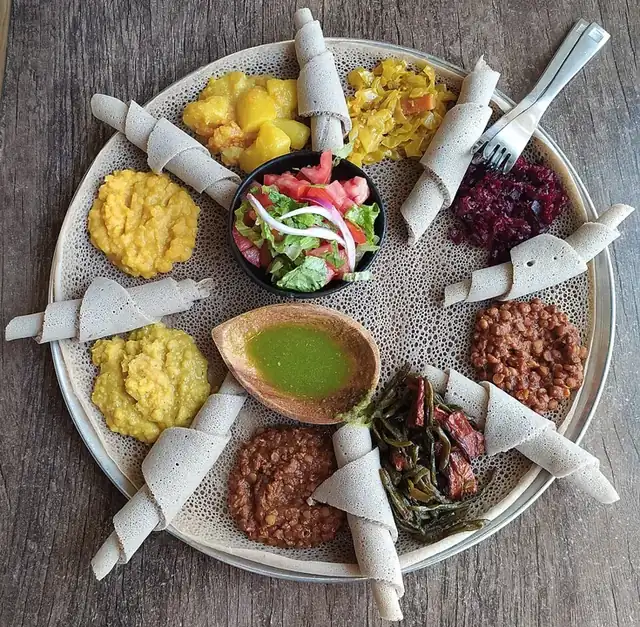
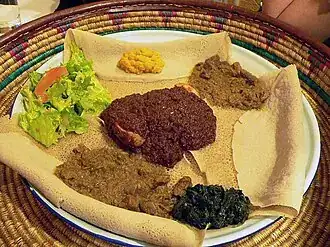
The most common pairing with injera is wat, a stew of meat and vegetables. This includes doro wat, made with chicken, and shiro, made of pulses without meat. Other foods eaten with injera include meat or boiled vegetables. Using one's hand (traditionally only the right one), small pieces of injera are torn and used to grasp the stews and salads for eating. The eyes of injera help to pick up stews as they soak into the bread.
More to savor
Injera (Ethiopian Teff Flatbread)
Reindling (Austrian Yeasted Easter Cake)
Bibimbap: The Korean Rice Bowl That Brings It All Together