A drink can be an everyday routine, something shared with company, or a way to explore a food tradition. The background below looks more closely at the preparation and story behind the cup or glass.
In this story
OverviewSteeping, brewing and servingProductionGrowing, harvesting and processingImport of radioactive Japanese teaMainland China and TaiwanJapanOverview
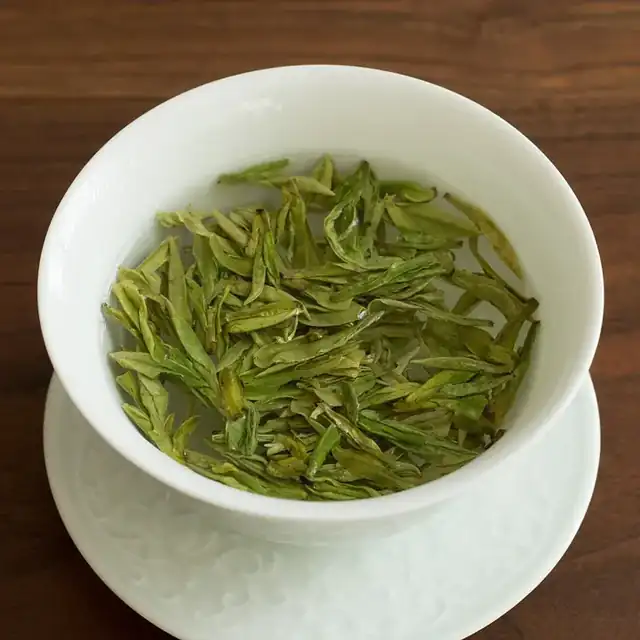
Green tea is a type of tea made from the leaves and buds of the Camellia sinensis that have not undergone the withering and oxidation process that creates oolong teas and black teas. Green tea originated in China in the late 1st millennium BC, and since then its production and manufacture has spread to other countries in East Asia.
Several varieties of green tea exist, which differ substantially based on the variety of C. sinensis used, growing conditions, horticultural methods, production processing, and time of harvest. While it may slightly lower blood pressure and improve alertness, consuming green tea does not provide health effects. Excessive intake of green tea extracts can cause liver damage, interfere with prescription drugs, and produce gastrointestinal discomfort.
Steeping, brewing and serving
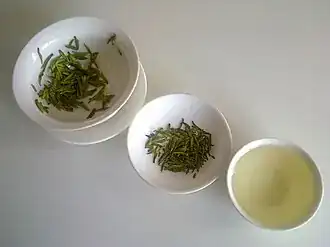
Steeping, or brewing, is the process of making tea from leaves and hot water, generally using 2 g of tea per 100 mL of water or about of green tea per 150 mL cup. Steeping temperatures range from 61 C to 87 C and steeping times from 30 seconds to three minutes.
Generally, lower-quality green teas are steeped hotter and longer while higher-quality teas are steeped cooler and shorter, but usually multiple times (2–3 typically). Higher-quality teas like gyokuro use more tea leaves and are steeped multiple times for short durations. Steeping too hot or too long results in the release of excessive amounts of tannins, leading to a bitter, astringent brew, regardless of initial quality. The brew's taste is also affected by the steeping technique; two important techniques are to warm the steeping container beforehand to prevent the tea from immediately cooling down, and to leave the tea leaves in the pot and gradually add more hot water during consumption.
Production
In 2013, global production of green tea was approximately 1.7 million tonnes, with a forecast to double in volume by 2023. As of 2015, China provided 80% of the world's green tea market, leading to its green tea exports rising by 9% annually, while exporting 325,000 tonnes in 2015. In 2015, the US was the largest importer of Chinese green tea (6,800 tonnes), an increase of 10% over 2014, and Britain imported 1,900 tonnes, 15% more than in 2014.
Growing, harvesting and processing
Green tea is processed and grown in a variety of ways, depending on the type of green tea desired. As a result of these methods, maximum amounts of polyphenols and volatile organic compounds are retained, affecting aroma and taste. The growing conditions can be broken down into two basic types − those grown in the sun and those grown under the shade. The green tea plants are grown in rows that are pruned to produce shoots in a regular manner, and in general are harvested three times per year. The first flush takes place in late April to early May. The second harvest usually takes place from June through July, and the third picking takes place in late July to early August. Sometimes, there will also be a fourth harvest.
The first flush in the spring brings the best-quality leaves, with higher prices to match.
Import of radioactive Japanese tea
On 17 June 2011, at Charles de Gaulle airport in Paris, France, radioactive caesium of 1,038 becquerels per kilogram was measured in tea leaves imported from Shizuoka Prefecture, Japan as a result of the Fukushima Daiichi nuclear disaster on 11 March, which was more than twice the restricted amount in the European Union of 500 becquerels per kilogram. The government of France announced that they rejected the leaves, which totalled 162 kg.
In response, the governor of Shizuoka Prefecture, Heita Kawakatsu, stated: "there is absolutely no problem when they [people] drink them because it will be diluted to about 10 becquerels per kilogram when they steep them even if the leaves have 1,000 becquerels per kilogram;" a statement backed by tests done in Shizuoka. Japanese Minister for Consumer Affairs and Food Safety Renhō stated on 3 June 2011 that "there are cases in which aracha are sold as furikake and so on and they are eaten as they are, therefore we think that it is important to inspect tea leaves including aracha from the viewpoint of consumers' safety."
In 2018, the US Food and Drug Administration updated its import status on Japanese products deemed to be contaminated by radionuclides, indicating that tea from the Ibaraki prefecture had been removed from the list by the Government of Japan in 2015.
Mainland China and Taiwan
Loose leaf green tea has been the most popular form of tea in China since at least the Southern Song dynasty. While Chinese green tea was originally steamed, as it still is in Japan, after the early Ming dynasty it has typically been processed by being pan-fired in a dry wok. Other processes employed in China today include oven-firing, basket-firing, tumble-drying and sun-drying. Green tea is the most widely produced form of tea in China, with 1.42 million tons grown in 2014.
Popular green teas produced in China today include:
Green snail spring Produced in Jiangsu, this tea is named after the shape of the leaves, which are curled like snails.
Japan
Tea seeds were first brought to Japan in the early 9th century by the Buddhist monks Saicho and Kūkai. During the Heian period (794–1185), Emperor Saga introduced the practice of drinking tea to the imperial family. The Zen Buddhist priest Eisai (1141–1215), founder of the Rinzai school of Buddhism, brought tea seeds from China to plant in various places in Japan. Eisai advocated that all people, not just Buddhist monks and the elite, drink tea for its health benefits.
The oldest tea-producing region in Japan is Uji, located near the former capital of Kyoto. It is thought that seeds sent by Eisai were planted in Uji, becoming the basis of the tea industry there. Today, Japan's most expensive premium teas are still grown in Uji. The largest tea-producing area today is Shizuoka Prefecture, which accounts for 40% of total Japanese sencha production. Other major tea-producing regions include the island of Kyushu and the prefectures of Shiga, Gifu, and Saitama in central Honshu.
All commercial tea produced in Japan today is green tea, though for a brief period black tea was also produced in the late 19th and early 20th centuries. Japanese tea production is heavily mechanized, and is characterized by the use of modern technology and processes to improve yields and reduce labour. Because of the high cost of labour in Japan, only the highest quality teas are plucked and processed by hand in the traditional fashion.
More to savor

Algerian Mint Tea

Austrian Napkin Dumpling (Serviettenknödel)

Black Tea: The Leaves Behind a Familiar Daily Cup