A cooking method is easier to appreciate when you connect it with the food on the plate. The background below explains the subject in more detail; for a complete method and ingredient quantities, explore the recipe collection.
In this story
OverviewGrid ironingCharcoal kettle-grillingGrill-bakingGrill-braisingIndoor grillingSear grillingOverview
Grilling is a form of cooking that involves heat applied to the surface of food, commonly from above, below or from the side. Grilling usually involves a significant amount of direct, radiant heat, and tends to be used for cooking meat and vegetables quickly. Food to be grilled is cooked on a grill (an open wire grid such as a gridiron with a heat source above or below), using a cast iron/frying pan, or a grill pan (similar to a frying pan, but with raised ridges to mimic the wires of an open grill).
Heat transfer to the food when using a grill is primarily through thermal radiation. Heat transfer when using a grill pan or griddle is by direct conduction. In the United States, when the heat source for grilling comes from above, grilling is called broiling. In this case, the pan that holds the food is called a broiler pan, and heat transfer is through thermal radiation.
Direct heat grilling can expose food to temperatures often in excess of 260 °C. Grilled meat acquires a distinctive roast aroma and flavor from a chemical process called the Maillard reaction. The Maillard reaction only occurs when foods reach temperatures in excess of 155 °C.
Not all foods are suitable for grilling. Grilling is an inappropriate treatment for large, tough cuts of meat as this fast technique would not allow the meat to cook slowly and tenderise. When using the grilling method, food is usually placed on a heat-resistant wire rack. This allows the fat, excess oils or juices to drain away.
Studies have shown that cooking beef, pork, poultry, and fish at high temperatures can lead to the formation of heterocyclic amines, benzopyrenes, and polycyclic aromatic hydrocarbons, which are carcinogens.
Marination may reduce the formation of these compounds. Grilling is often presented as a healthy alternative to cooking with oils, although the fat and juices lost by grilling can contribute to drier food.
Grid ironing
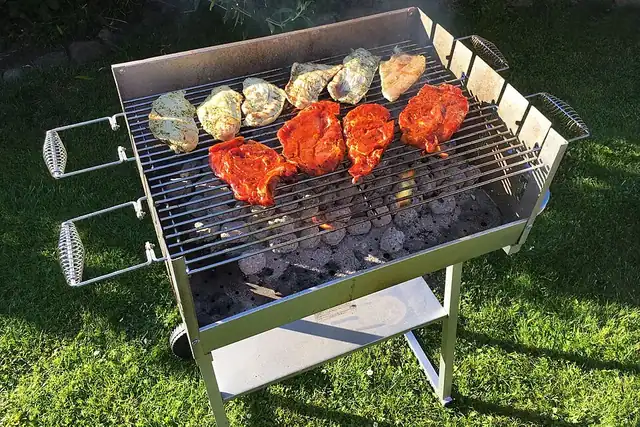
Grid ironing is the cooking of meats or other foods using a grill suspended above a heat source. Grilling is often performed outdoors using charcoal (real wood or preformed briquettes), wood, or propane gas. Food is cooked using direct radiant heat. Some outdoor grills include a cover so they can be used as smokers or for grill-roasting/barbecue. The suspended metal grate is often referred to as a gridiron.
Outdoor grilling on a gridiron may be referred to as "barbecue", though in US usage, the term barbecue refers to the cooking of meat through indirect heat and smoke. Barbecue may refer to the grilled food itself, to a distinct type of cooked meat called Southern barbecue, to the grilling device used to cook the food (a barbecue grill), or to the social event of cooking and eating such food (which may also be called a cook-out or braai).
Charcoal kettle-grilling
Charcoal kettle-grilling refers to the process of grilling over a charcoal fire in a kettle, to the point that the edges are charred, or charred grill marks are visible. Some restaurants seek to re-create the charcoal-grilled experience via the use of ceramic lava rocks or infrared heat sources, offering meats that are cooked in this manner as "charcoal-cooked" or "charcoal-grilled".
Grill-baking
By using a baking sheet pan placed above the grill surface, as well as a drip pan below the surface, it is possible to combine grilling and roasting to cook meats that are stuffed or coated with breadcrumbs or batter, and to bake breads and even casseroles and desserts. When cooking stuffed or coated meats, the foods can be baked first on the sheet pan, and then placed directly on the grilling surface for char marks, effectively cooking twice; the drip pan will be used to capture any crumbs that fall off from the coating or stuffing.
Grill-braising
It is possible to braise meats and vegetables in a pot on top of a grill. A gas or electric grill would be the best choices for what is known as "barbecue-braising" or "grill-braising", or combining grilling directly on the surface and braising in a pot. To braise on a grill, put a pot on top of the grill, cover it, and let it simmer for a few hours. There are two advantages to barbecue-braising.
The first is that this method allows for browning the meat directly on the grill before the braising, and the second is that it also allows for glazing the meat with sauce and finishing it directly over the fire after the braising, effectively cooking the meat three times, which results in a soft textured product that falls right off the bone. This method of cooking is slower than regular grilling but faster than pit-smoking, starting out fast, slowing down, and then speeding up again to finish. If a pressure cooker is used, the cooking time will be much faster.
Indoor grilling
Many restaurants incorporate an indoor grill as part of their cooking apparatus. These grills resemble outdoor grills, in that they are made up of a grid suspended over a heat source. However, indoor grills are more likely to use electric or gas-based heating elements. Some manufacturers of residential cooking appliances now offer indoor grills for home use, either incorporated into a stove top or as a standalone electric device.
Sear grilling
Sear-grill and gear grilling is a process of searing food items over high temperatures. Sear grilling can be achieved using a gas grill, charcoal grill, hybrid grill, or infrared grill where the below flame heats the grill grates to temperatures over 480 °C (900 °F).
Sear-grilling instantly sears the outside of meat to make the food more flavorful. Commonly, grilling heats the surrounding air to cook food. In this method, the grill directly heats the food, not the air.
More to savor
Spaghetti alla Puttanesca
Papadam (Black Gram Flatbread)
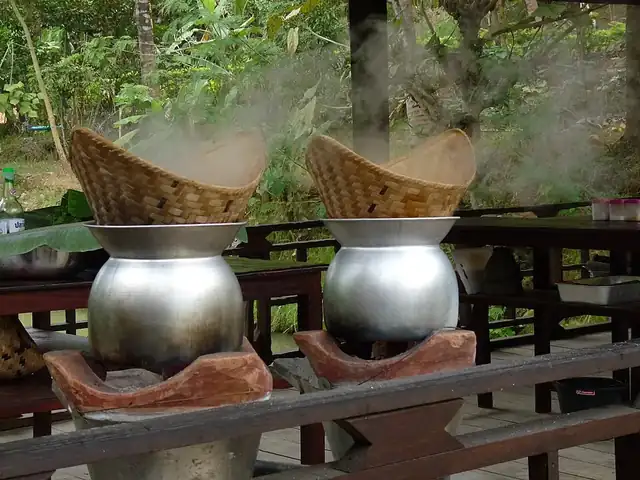
Steaming: The Gentle Heat Behind Buns, Cakes and More