This longer reference provides the background behind the topic. Read it alongside the recipe collection when you want to connect an ingredient or food idea with a dish to prepare.
Overview
Herbs are a widely distributed and widespread group of plants, excluding vegetables, with savory or aromatic properties that are used for flavoring and garnishing food, for medicinal purposes, or for fragrances. Culinary use typically distinguishes herbs from spices. Herbs generally refers to the leafy green or flowering parts of a plant (either fresh or dried), while spices are usually dried and produced from other parts of the plant, including seeds, bark, roots and fruits.
Herbs have a variety of uses including culinary, medicinal, aromatic and in some cases, spiritual. General usage of the term "herb" differs between culinary herbs and medicinal herbs; in medicinal or spiritual use, any parts of the plant might be considered "herbs", including leaves, roots, flowers, seeds, root bark, inner bark (and cambium), resin and pericarp.
The word "herb" is pronounced in Commonwealth English, but is standard among American English speakers as well as those from regions where h-dropping occurs. In Canadian English, both pronunciations are common. In botany, the noun "herb" refers to a "plant that does not produce a woody stem", and the adjective "herbaceous" means "herb-like", referring to parts of the plant that are "green and soft in texture".
Definition
In botany, the term herb refers to a herbaceous plant, defined as a small, seed-bearing plant without a woody stem in which all aerial parts (i.e. above ground) die back to the ground at the end of each growing season. Usually the term refers to perennials, although herbaceous plants can also be annuals (plants that die at the end of the growing season and grow back from seed next year), or biennials. This term is in contrast to shrubs and trees which possess a woody stem. Shrubs and trees are also defined in terms of size, where shrubs are less than ten meters tall, and trees may grow over ten meters. The word herbaceous is derived from Latin herbāceus meaning "grassy", from herba "grass, herb".
Another sense of the term herb can refer to a much larger range of plants, with culinary, therapeutic or other uses. For example, some of the most commonly described herbs such as sage, rosemary and lavender would be excluded from the botanical definition of an herb as they do not die down each year, and they possess woody stems. In the wider sense, herbs may be herbaceous perennials but also trees, subshrubs, shrubs, annuals, lianas, ferns, mosses, algae, lichens, and fungi. Herbalism can utilize not just stems and leaves but also fruit, roots, bark and gums. Therefore, one suggested definition of an herb is a plant which is of use to humans, although this definition is problematic since it could cover a great many plants that are not commonly described as herbs.
Reproduction
Perennial herbs are usually reproduced by stem cuttings, either softwood cuttings of immature growth, or hardwood cuttings where the bark has been scraped to expose the cambium layer. A cutting is usually approximately 3 to 4 in in length. Plant roots can grow from the stems. Leaves are stripped from the lower portion up to one half before the cutting is placed in growth medium or rooted in a glass of water. This process requires high humidity in the environment, sufficient light, and root zone heat.
Culinary
Culinary herbs are distinguished from vegetables in that, like spices, they are used in small amounts and provide flavor rather than substance to food.
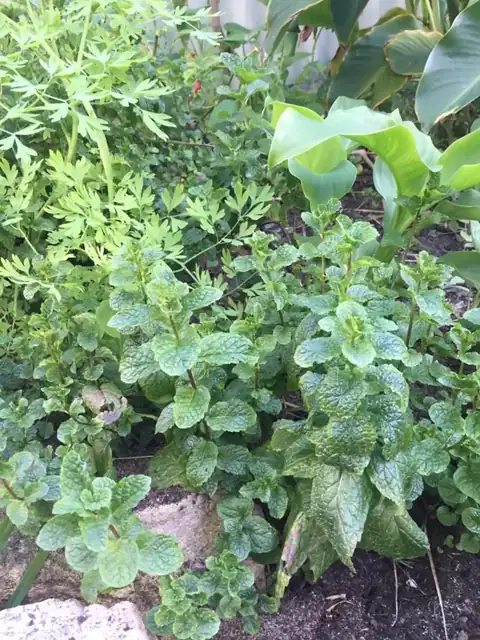
Herbs can be perennials such as thyme, oregano, sage or lavender, biennials such as parsley, or annuals like basil. Perennial herbs can be shrubs such as rosemary (Rosmarinus officinalis), or trees such as bay laurel (Laurus nobilis) – this contrasts with botanical herbs, which by definition cannot be woody plants. Some plants are used as both herbs and spices, such as dill weed and dill seed or coriander leaves and seeds. There are also some herbs, such as those in the mint family, that are used for both culinary and medicinal purposes.
Teas
Some herbs can be infused in boiling water to make herbal teas (also termed tisanes). Typically the dried leaves, flowers or seeds are used, or fresh herbs are used. Herbal teas tend to be made from aromatic herbs, may not contain tannins or caffeine, and are not typically mixed with milk. Common examples include chamomile tea, or mint tea. Herbal teas are often used as a source of relaxation or can be associated with rituals.
Medicine
Herbs were used in prehistoric medicine. As far back as 5000 BCE, evidence that Sumerians used herbs in medicine was inscribed on cuneiform. In 162 CE, the physician Galen was known for concocting complicated herbal remedies that contained up to 100 ingredients.
Some plants contain phytochemicals that have effects on the body. There may be some effects when consumed in the small levels that typify culinary "spicing", and some herbs are toxic in larger quantities. For instance, some types of herbal extract, such as the extract of St. John's-wort (Hypericum perforatum) or of kava (Piper methysticum) can be used for medical purposes to relieve depression and stress. However, large amounts of these herbs may lead to toxic overload that may involve complications, some of a serious nature, and should be used with caution. Complications can also arise when taken with some prescription medicines.
Ritual
Herbs are used in many religions. During the monastic era, monks would cultivate herbs alongside vegetables, while others would be set aside in a physic garden for specific purposes. For example, myrrh (Commiphora myrrha) and frankincense (Boswellia species) in Hellenistic religion, the nine herbs charm in Anglo-Saxon paganism, neem (Azadirachta indica) leaves, bael (Aegele marmelos) leaves, holy basil or tulsi (Ocimum tenuiflorum), turmeric or "haldi" (Curcuma longa), cannabis in Hinduism, and white sage in Wicca. Rastafari also consider cannabis to be a holy plant.
Siberian shamans also used herbs for spiritual purposes. Plants may be used to induce spiritual experiences for rites of passage, such as vision quests in some Native American cultures. The Cherokee use both white sage and cedar for spiritual cleansing and smudging.
More to savor

Chicken Vindaloo
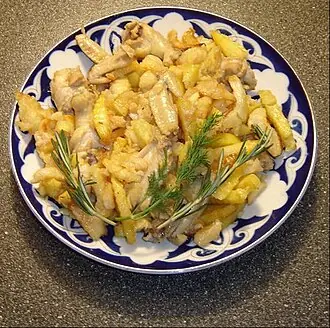
Fried Chicken and Fried Potatoes
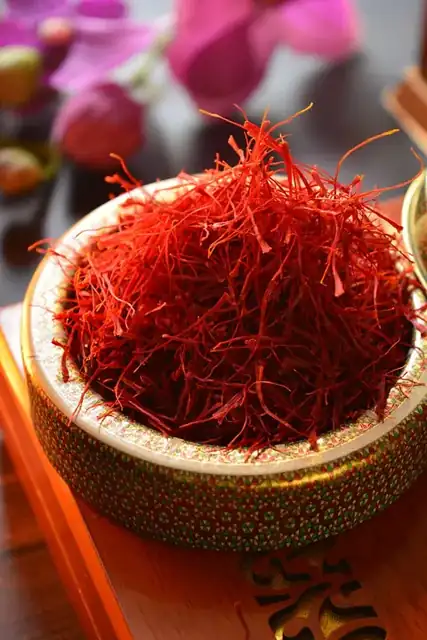
Beyond the Shopping List: The Story of Saffron