This longer reference provides the background behind the topic. Read it alongside the recipe collection when you want to connect an ingredient or food idea with a dish to prepare.
In this story
OverviewDescriptionHarvestingPhytochemistry and sensory propertiesTypesWorld productionConsumptionOverview
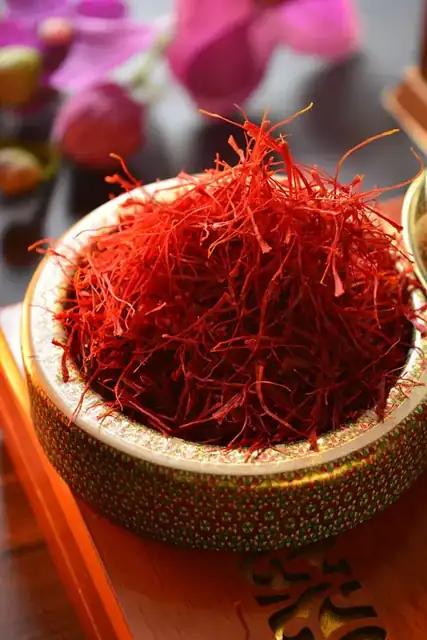
Saffron (زعفران) is a spice derived from the sterile autumn-blooming flower of Crocus sativus, commonly known as the "saffron crocus". The vivid crimson stigma and styles (in industry jargon: 'threads') are collected and dried for use mainly as a food seasoning and colourant. Saffron crocus was slowly propagated throughout much of Eurasia and later brought to parts of North Africa, North America, even as far as Fiji in Oceania by its Indian migrant descendant population.
Saffron's taste and iodoformic or hay-like fragrance result from the phytochemicals picrocrocin and safranal. It also contains a carotenoid pigment, crocin, which imparts a rich golden-yellow hue to dishes and textiles. Saffron quality is objectively measured under the ISO 3632 standard, which evaluates the concentration of active phytochemicals—specifically crocin (color), picrocrocin (taste), and safranal (aroma) via spectrophotometric laboratory analysis. The grading depends largely on the ratio of dark red stigmas to yellow styles, with higher concentrations of red parts yielding premium-grade products. Although market prices fluctuate, premium saffron regularly exceeds US$5,000 per kilogram, sustained by its labor-intensive hand-harvesting process.
Description
The domesticated saffron crocus, Crocus sativus, is an autumn-flowering perennial plant unknown in the wild. It possibly descends from the eastern Mediterranean autumn-flowering Crocus cartwrightianus which is also known as "wild saffron" and is native to mainland Greece, Euboea, Crete, Skyros and some islands of the Cyclades. The similar species C. thomasii and C. pallasii were considered as other possible ancestors. As a genetically monomorphic clone incapable of seed production, it was slowly propagated by humans throughout much of Eurasia. Various origins have been suggested for saffron, including Iran, Mesopotamia, Kashmir and Greece.
It is a sterile triploid form, which means that three homologous sets of chromosomes make up each specimen's genetic complement; C. sativus bears eight chromosomal bodies per set, making for 24 in total. Being sterile, the purple flowers of C. sativus fail to produce viable seeds; reproduction hinges on human assistance: clusters of corms, underground, bulb-like, starch-storing organs, must be dug up, divided, and replanted. A corm survives for one season, producing via vegetative division up to ten "cormlets" that can grow into new plants in the next season. The compact corms are small, brown globules that can measure as large as 5 cm in diameter, have a flat base, and are shrouded in a dense mat of parallel fibres; this coat is referred to as the "corm tunic".
Corms also bear vertical fibres, thin and net-like, that grow up to 5 cm above the plant's neck.
Harvesting
The high retail value of saffron is maintained on world markets because of labour-intensive harvesting methods, which require some 200000 /lb – equivalently, 70000 /lb. Forty hours of labour are needed to pick 150,000 flowers.
One freshly picked crocus flower yields on average 30 mg of fresh saffron or 7 mg dried; roughly 150 flowers yield 1 g of dry saffron threads; to produce 12 g of dried saffron, 1 lb of flowers are needed; the yield of dried spice from fresh saffron is only 0.2 oz/lb.
Phytochemistry and sensory properties
Saffron contains some 28 volatile and aroma-yielding compounds, dominated by ketones and aldehydes. Its main aroma-active compounds are safranal – the main compound responsible for saffron aroma – 4-ketoisophorone, and dihydrooxophorone. Saffron also contains nonvolatile phytochemicals, including the carotenoids zeaxanthin, lycopene, various α- and β-carotenes, as well as crocetin and its glycoside crocein, which are the most biologically active components. Because crocetin is smaller and more water-soluble than the other carotenoids, it is more rapidly absorbed.
Types
The various saffron crocus cultivars give rise to thread types that are often regionally distributed and characteristically distinct. Varieties (not varieties in the botanical sense) from Spain, including the tradenames "Spanish Superior" and "Creme", are generally mellower in colour, flavour, and aroma; they are graded by government-imposed standards. Italian varieties are slightly more potent than Spanish. Greek saffron produced in the town of Krokos is PDO protected due to its particularly high-quality colour and strong flavour. Various "boutique" crops are available from New Zealand, France, Switzerland, England, the United States, and other countries—some of them organically grown. In the US, Pennsylvania Dutch saffron—known for its "earthy" notes—is produced in small quantities.
Consumers may regard certain cultivars as "premium" quality. The "Aquila" saffron, or zafferano dell'Aquila, is defined by high safranal and crocin content, distinctive thread shape, unusually pungent aroma, and intense colour; it is grown exclusively on eight hectares in the Navelli Valley of Italy's Abruzzo region, near L'Aquila. It was first introduced to Italy by a Dominican friar from inquisition-era Spain. But the biggest saffron cultivation in Italy is in San Gavino Monreale, Sardinia, where it is grown on 40 hectares, representing 60% of Italian production; it too has unusually high crocin, picrocrocin, and safranal content.
World production
Almost all saffron grows in a belt stretching from Spain in the west to India in the east. Iran is responsible for around 90% of global production, and in 2024 was the largest producer, followed by Afghanistan. Saffron is cultivated in 26 of Afghanistan's 34 provinces, with most production concentrated in Herat.
Greece is the third largest producer, followed by Spain, which was once the largest producer in the 19th century. Other producers include the United Arab Emirates, the Indian subcontinent (particularly Kashmir), and Morocco.
Consumption
Saffron's aroma is often described by connoisseurs as reminiscent of metallic honey with grassy or hay-like notes, while its taste has also been noted as hay-like and sweet. Consumed in large servings—more than a few threads per person per dish—saffron is experienced as bitter. Saffron also contributes a luminous yellow-orange colouring to foods. Saffron is widely used in Persian, Indian, European, and Arab cuisines. Confectioneries and liquors also often include saffron. Saffron is used in dishes ranging from the jewelled rice and khoresh of Iran, the Milanese risotto of Italy, the paella of Spain, the bouillabaisse of France, to the biryani with various meat accompaniments in South Asia. Saffron is also used in the preparation of the Golden Ham, a precious dry-cured ham made with saffron from San Gimignano in Tuscany.
Common saffron substitutes include safflower (Carthamus tinctorius, which is often sold as "Portuguese saffron" or "açafrão"), annatto, and turmeric (Curcuma longa). In Medieval Europe, turmeric was also known as "Indian saffron" because of its yellow-orange colour.
More to savor

Chicken Vindaloo
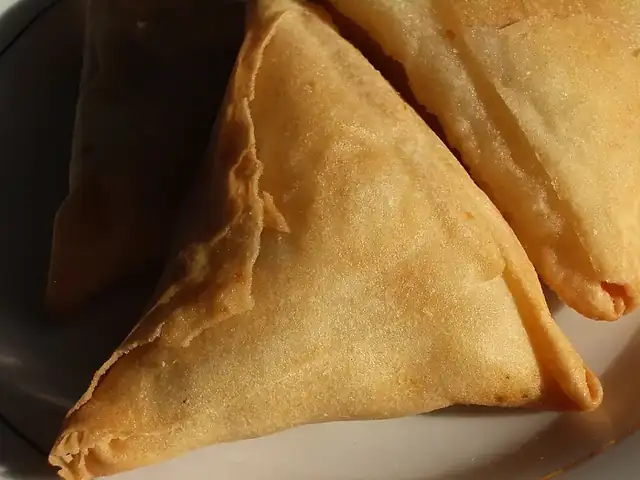
Samosa
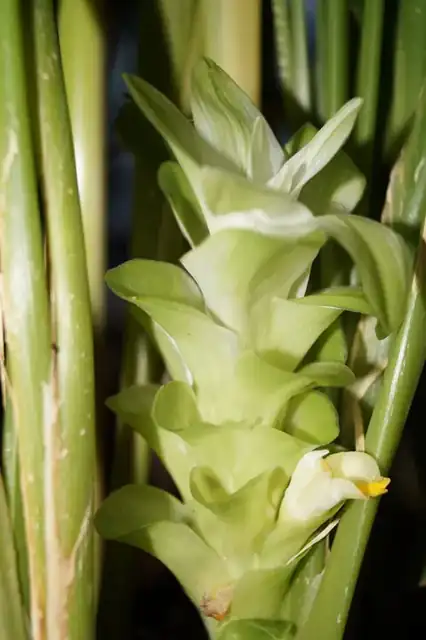
A Closer Look at Turmeric: From Ingredient to Meal