This longer reference provides the background behind the topic. Read it alongside the recipe collection when you want to connect an ingredient or food idea with a dish to prepare.
Overview
Horseradish (Armoracia rusticana, syn. Cochlearia armoracia) is a perennial plant of the family Brassicaceae (which also includes mustard, wasabi, broccoli, cabbage, and radish). It is a root vegetable, cultivated and used worldwide as a spice and as a condiment. The species is likely native to Southeastern Europe and Western Asia.
Description
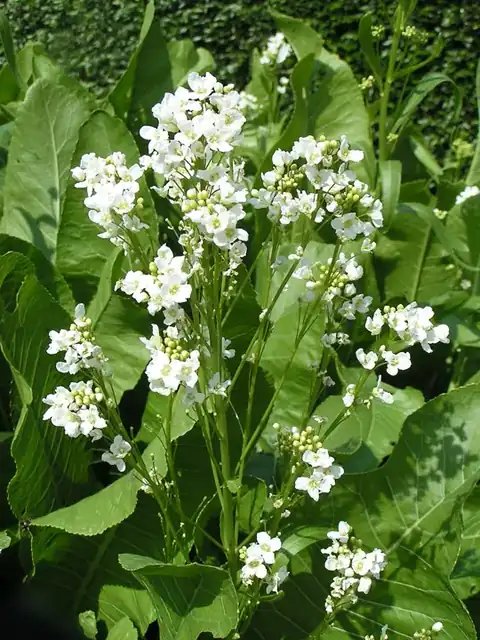
Horseradish grows up to 1.5 m tall, with hairless bright green unlobed leaves up to 1 m long that may be mistaken for docks (Rumex). It is cultivated primarily for its large, white, tapered root. The white four-petalled flowers are scented and are borne in dense panicles. Established plants may form extensive patches and may become invasive unless carefully managed.
Intact horseradish root has little aroma. When cut or grated, enzymes from within the plant cells digest sinigrin (a glucosinolate) to produce allyl isothiocyanate (mustard oil), which irritates the mucous membranes of the sinuses and eyes. Once exposed to air or heat, horseradish loses its pungency, darkens in color, and develops a bitter flavor.
Production
In the United States, horseradish is grown in several areas, such as Eau Claire, Wisconsin, and Tule Lake, California. The most concentrated growth occurs in the Collinsville, Illinois, region.
Thirty thousand metric tonnes of horseradish are produced in Europe annually, of which Hungary produces 12,000, making it the biggest single producer.
Culinary uses
The distinctive pungent taste of horseradish is from the compound allyl isothiocyanate. Upon crushing the flesh of horseradish, the enzyme myrosinase is released and acts on the glucosinolates sinigrin and gluconasturtiin, which are precursors to the allyl isothiocyanate. The allyl isothiocyanate serves the plant as a natural defense against herbivores. Since allyl isothiocyanate hurts the plant, it is stored in the harmless form of glucosinolate, separate from the enzyme myrosinase. When an animal chews the plant, the allyl isothiocyanate is released, repelling the animal. Allyl isothiocyanate is an unstable compound, degrading over days at 37 C. Because of this instability, horseradish sauces lack the pungency of freshly crushed roots.
Cooks may use the terms "horseradish" or "prepared horseradish" to refer to the mashed (or grated) root of the horseradish plant mixed with vinegar. Prepared horseradish is white to creamy beige. It can be stored for up to 3 months under refrigeration, but eventually will darken, indicating less flavour. The leaves of the plant are edible as well, either cooked or raw when young, with a similar but less pronounced flavor.
On Passover, many Ashkenazi Jews use grated horseradish as a choice for Maror (bitter herbs) at the Passover Seder.
Horseradish sauce
Horseradish sauce, a spicy paste made from grated horseradish root, is a common condiment in Europe. It is made with vinegar and found in the United Kingdom, in Denmark (with sugar added), in Poland, It is a common condiment for meat and fish dishes in Eastern and Central European cuisines (Slovene, northern Croatian, Belarusian, Czech, Slovak, German (especially Bavarian), Polish, Romanian, Latvian, Lithuanian, Russian, Ukrainian.
In the UK, it is usually served with roast beef, often as part of a traditional Sunday roast, but can be used in a number of other dishes, including sandwiches or salads. A variation of horseradish sauce, which in some cases may replace the vinegar with other products like lemon juice or citric acid, is known in Germany as Tafelmeerrettich. Also available in the UK is Tewkesbury mustard, a blend of mustard and grated horseradish originating in medieval times and mentioned by Shakespeare (Falstaff says: "his wit's as thick as Tewkesbury Mustard" in Henry IV Part II). A similar mustard, called Krensenf or Meerrettichsenf, is common in Austria and parts of Germany. In France, sauce au raifort is used in Alsatian cuisine.
In Russia, horseradish root is usually mixed with grated garlic and a small amount of tomatoes for color (Khrenovina sauce).
In the United States, the term "horseradish sauce" refers to grated horseradish combined with mayonnaise or salad dressing. In Denmark, it is mixed with whipping cream and as such used on top of traditional Danish open sandwiches with beef (boiled or steaked) slices. Prepared horseradish is a common ingredient in Bloody Mary cocktails and in cocktail sauce and is used as a sauce or sandwich spread. Horseradish cream is a mixture of horseradish and sour cream and is served au jus for a prime rib dinner.
Many Central European varieties include cream, while some Russian recipes call for khren with smetana (sour cream). There are also varieties including apples, lingonberry, cranberry and oranges. In Eastern and Central European cuisines, horseradish sauce is a typical condiment for various fish dishes, as well as for meat and fish zakuski, such as kholodets (aspic) and beef tongue.
Horseradish sauce is a part of Christian Easter traditions in Europe. It is eaten during Eastertide (Paschaltide) as "a reminder of the bitterness of Jesus' suffering" on Good Friday.
Chrain
Chrain is the name for horseradish sauce in Ashkenazi Jewish cuisine. Chrain comes from Yiddish כריין, which is in turn a loanword from Slavic languages.
There are two common forms of chrain in the Slavic and Ashkenazi Jewish cuisines. White chrain consists of grated horseradish and vinegar, and sometimes sugar and salt, while red chrain includes the addition of beetroot. These types of chrain are distinct from other horseradish-based condiments in that they are pareve (contain no dairy products), making it acceptable at both meat and dairy meals according to Jewish dietary law.
The use of chrain in Eastern and Central European Jewish communities is ancient, and is first attested in writing from the 12th century. Though it has had several historical uses, chrain is most commonly associated in modern times with gefilte fish, for which it is considered an essential condiment.
In Ashkenazi European Jewish cooking, beetroot horseradish is commonly served with gefilte fish.
Chrain is part of Jewish Passover tradition (as maror) in Eastern and Central Europe.
Relation to wasabi
Outside Japan, the Japanese condiment wasabi, although traditionally prepared from the true wasabi plant (Wasabia japonica), is now usually made with horseradish due to the scarcity of the wasabi plant. The Japanese botanical name for horseradish is seiyōwasabi, or "Western wasabi". Both plants are members of the family Brassicaceae.
More to savor

Chicken Vindaloo

Koko da Kosai (Fermented Corn Porridge and Bean Fritters)
A Closer Look at Buckwheat: From Ingredient to Meal