Use the regional background below as a starting point for exploring the food, rather than expecting one dish to represent every household. Food traditions differ within a country and continue to change through travel, migration, and everyday cooking.
In this story
OverviewTradition and characteristicsCustoms, serving and consumptionNational dishesMeal timesStreet foodTraditional crackersOverview
Indonesian cuisine is a collection of regional culinary traditions of the various ethnic groups that form the archipelagic nation of Indonesia. There are a wide variety of recipes and cuisines in part because Indonesia is composed of approximately 6,000 populated islands of the total 17,508 in the world's largest archipelago, with more than 600 ethnic groups.
There are many regional cuisines, often based upon indigenous cultures, with some foreign influences.
Tradition and characteristics
Indonesia has around 5,350 traditional recipes, with 30 of them considered the most important. Indonesia's cuisine ranges from rice, noodle and soup dishes in modest local eateries to street-side snacks to elaborate dishes in expensive restaurants.
Indonesian cuisine varies greatly by region and has many different influences. Sumatran cuisine, for example, has Middle Eastern and Indian influences, featuring curried meat and vegetables such as gulai and curry, while Javanese cuisine is mostly indigenous, with some hints of Chinese influence.
The cuisines of Eastern Indonesia are similar to Polynesian and Melanesian cuisine. Elements of Chinese cuisine can be seen throughout Indonesian cuisine: foods such as noodles, meat balls, spring rolls, and wontons have been completely assimilated.
Customs, serving and consumption
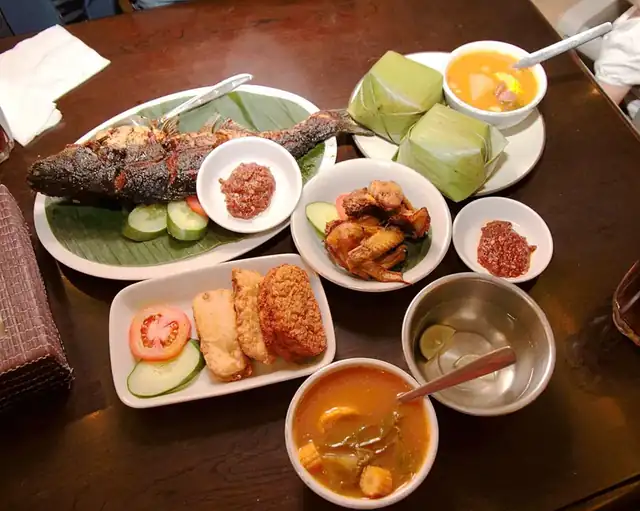
Indonesian traditional meals usually consists of steamed rice as staple, surrounded by vegetables and soup and meat or fish side dishes. In a typical family meal, the family members gather around the table filled with steamed rice and several other dishes. Each dish is placed in a large communal plate or in bowls. Each of these dishes has its own serving spoons, used only to move food from the communal plate to one's personal plate. Each of the family members has their own personal plate that is first filled with steamed rice. Usually the oldest family member or the husband has the right to initiate the meal, followed by the rest of the family to help themselves with the dishes.
Each of them take some portion of dishes from the communal plates into their own individual plates.
National dishes
Initially during the early years of Indonesian independence, the ubiquitous and highly popular nasi goreng was considered the national dish of the republic, albeit at that time was unofficial. Its simplicity and versatility has contributed to its popularity and made it as a staple among Indonesian households—colloquially considered the most "democratic" dish since the absence of an exact and rigid recipe has allowed people to do anything they want with it.
Nasi goreng that is commonly consumed daily in Indonesian households was considered the quintessential dish that represent an Indonesian family. It is in the menu, introduced, offered and served in Indonesian Theatre Restaurant within the Indonesian pavilion at the 1964 New York World's Fair. Howard Palfrey Jones, the US ambassador to Indonesia during the last years of Sukarno's reign in the mid 1960s, in his memoir "Indonesia: The Possible Dream", said that he likes nasi goreng. He described his fondness for nasi goreng cooked by Hartini, one of Sukarno's wives, and praised it as the most delicious nasi goreng he ever tasted. Nevertheless, other widely popular Indonesian dishes, such as satay, soto and gado-gado are also considered strong contenders. Soto is ubiquitous in Indonesia and considered one of Indonesia's national dishes.
Meal times
Indonesians might consume snacks or varieties of small dishes throughout the day. If separate scheduled larger meal is observed, they usually consists of sarapan or makan pagi (breakfast), makan siang (lunch) is often the main meal of the day, followed by makan malam (dinner). Mealtime is typically a casual and solitary affair, and might be observed differently across region.
In western and central Indonesia, the main meal is usually cooked in the late morning, and consumed around midday. In many families there is no set meal time when all members are expected to attend. For this reason, most of the dishes are made so that they can remain edible even if left on the table at room temperature for many hours. The same dishes are then re-heated for the final meal in the evening. Most meals are built around a cone-shaped pile of long-grain, highly polished rice. A meal may include a soup, salad (or more commonly vegetables sautéed with garlic), and another main dish. Whatever the meal, it is accompanied by at least one, and often several, relishes called sambals.
Especially for Javanese family, on the table, it is also common to always have chips, that can be kerupuk, rempeyek, or any other chips to accompany the meal.
Street food
Indonesian street food are usually cheap, offer a great variety of food of different tastes, and can be found on every corner of the city.
Street and street-side vendors are common, in addition to hawkers peddling their goods on bicycles or carts. These carts are known as pedagang kaki lima. These food hawkers on carts or bicycles might be travelling on streets, approaching potential buyers through residential areas whilst announcing their presence, or stationing themselves on a packed and busy street side, setting simple seating under a small tent and waiting for customers. Many of these have their own distinctive call, tune, or noise to announce their presence. For example, bakso sellers will hit the side of a soup bowl using a spoon, whereas nasi goreng sellers announce themselves by hitting their wok.
Traditional crackers
Traditional crackers are called krupuk, made from bits of shrimp, fish, vegetables or nuts, which are usually consumed as a crunchy snack or to accompany main meals. These crispy snacks sometimes are added upon the main meal to provide crunchy texture; several Indonesian dishes such as gado-gado, karedok, ketoprak, lontong sayur, nasi uduk, asinan and bubur ayam are known to require specific type of krupuk as toppings. There are wide variations of krupuk available across Indonesia. The most popular ones would be krupuk udang (prawn crackers) and krupuk kampung or krupuk putih (cassava crackers).
Other popular types include krupuk kulit (dried buffalo-skin crackers), emping melinjo (gnetum gnemon crackers), and kripik (chips or crisps), such as kripik pisang (banana chips) and keripik singkong (Cassava chips), rempeyek, is a flour-based cracker with brittle of peanuts, anchovies or shrimp bound by crispy flour cracker, rengginang or intip (Javanese) is rice cracker made from sun-dried and deep fried leftover rice.
More to savor

Chicken Vindaloo

South Indian Millet Swallow (Mudde)
A Taste of Nepal: Food Across Regions and Communities