Use the regional background below as a starting point for exploring the food, rather than expecting one dish to represent every household. Food traditions differ within a country and continue to change through travel, migration, and everyday cooking.
In this story
OverviewTypical food and drinksIranian Azerbaijani cuisineBalochi cuisineCaspian cuisineKurdish cuisineTraditional table setting and etiquetteOverview
Iranian cuisine comprises the culinary traditions of Iran. Due to the historically common usage of the term "Persia" to refer to Iran in the Western world, it is alternatively known as Persian cuisine, despite Persians being only one of a multitude of Iranian ethnic groups who have contributed to Iran's culinary traditions.
Iran has a rich variety of traditional dishes, and has influenced many other cuisines over the ages, among them Caucasian cuisine, Central Asian cuisine, Greek cuisine, Levantine cuisine, Mesopotamian cuisine, Russian cuisine and Turkish cuisine. Aspects of Iranian cuisine have also been significantly adopted by Indian cuisine and Pakistani cuisine through various historical Persianate sultanates that flourished during Muslim rule on the Indian subcontinent, most significantly the Mughal Empire.
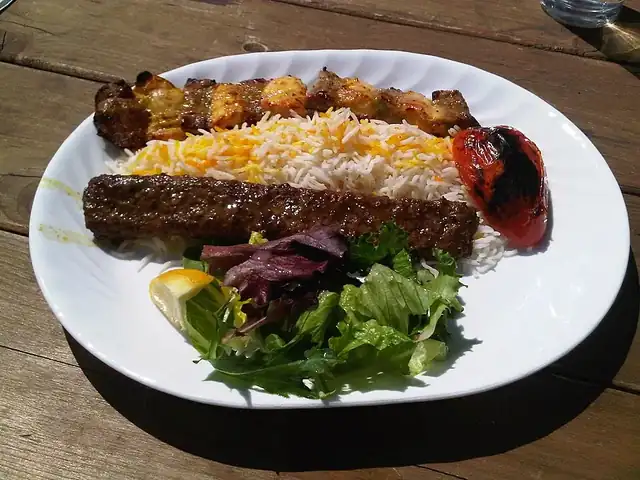
Typical Iranian main dishes are combinations of rice with meat, vegetables and nuts. Herbs are frequently used, such as parsley, fenugreek, chives, mint, savory and coriander, in their fresh and dried forms. Another consistent feature of Persian cuisine is the abundant use of fruits, in combination with various meats as well as in rice dishes; the most commonly used fruits include plums, pomegranates, quince, prunes, apricots, barberries, and raisins. Characteristic Iranian spices and flavourings such as saffron, cardamom, and dried lime and other sources of sour flavoring, cinnamon, turmeric and parsley are mixed and used in various dishes.
Outside of Iran, Iranian cuisine can be found in cities with significant Iranian diaspora populations, namely London, the San Francisco Bay Area, the Washington metropolitan area, Vancouver, Toronto, Houston and especially Los Angeles and its environs.
Typical food and drinks
Typical Iranian cuisine includes a wide variety of dishes, including several forms of kebab, stew, soup, and pilaf dishes, as well as various salads, desserts, pastries, and drinks.
Iranian Azerbaijani cuisine
The Iranian Azerbaijani people, living primarily in the region of Azerbaijan in northwestern Iran, have a number of local dishes that include the dumpling dish of joshpara (جوُشپَرا), an offal-based dish named jaqul baqul typically containing liver and heart, a variation of qeyme called pichagh (پیچاققیمه), and a variation of kufte called Tabriz meatballs. The pastry shekerbura (شَکَربورا) is identical to Khorasan's shekarpare (šekarpāre). The food tastes noticeably Iranian, though also with its own unique features, such as using more lemon juice and butter than other groups of Iranians.
Balochi cuisine
Meat and dates are the main ingredients in the cuisine of Iran's southeastern region of Baluchistan. Rice is primarily cultivated in the region of Makran. Foods specific to Baluchistan include tanurche (tarōnča; tanurče), a local variety of grilled meat prepared in a tanur; doogh-pa (dōq-pâ), a type of khoresh that contains doogh; and tabahag (tabâhag), meat prepared with pomegranate powder. Baluchi cuisine also includes several date-based dishes, as well as various types of bread.
Caspian cuisine
The southern coast of the Caspian Sea, which consists of the Iranian provinces of Gilan, Mazanderan, Alborz, and Golestan, has a fertile environment that is also reflected in its cuisine. Kateh is a method of cooking rice that originates from this region. This type of rice dish is also eaten there as a breakfast meal, either heated with milk and jam or cold with cheese and garlic. Caviar fish roes also hail from this region, and are typically served with eggs in frittatas and omelettes or eaten simply with lavash and butter. Fish is commonly eaten in the Gilan province, where Caspian kutum is a staple and usually served fried along with rice. Smoked fish (Persian: ماهی دودی, Romanized: Mahi doodi) is also popular in Gilan and usually incorporated into rice by steaming the two together.
Local cookies (koluče) of the region are popular desert items, particularly those from the region of Fuman. Another notable dessert from this region is Reshteh khoshkar (Persian: رشتهخشکار), consisting of fried rice flour dough filled with sugar and nuts. Medlar is also commonly eaten in Gilan and locally referred to as "konos" (Persian: کونوس).
Kurdish cuisine
The region of Kurdistan in western Iran is home to a variety of local āsh, pilaf, and stew dishes. Some local Kurdish dishes include a traditional grilled rib meat that is called dande kabāb, a type of khoresh made of chives that is called xoreš-e tare, and a dish of rice and potatoes that is called sib polow.
Traditional table setting and etiquette
Traditional Iranian table setting firstly involves the tablecloth, called sofre, and is spread out over either a table or a rug. Main dishes are concentrated in the middle, surrounded by smaller dishes containing appetizers, condiments, and side dishes, all of which are nearest to the diners. When the food is perfectly served, an invitation is made to seat at the sofre and start having the meal.
In Persian culture, guests are considered divine and so are served first and abundantly so, the host serving themselves last. Taarof, the Persian art of etiquette, dictates that guests do not help themselves to any food or drink unless offered to do so, and even having been offered must decline until having received at least a third offer, lest they appear greedy. This demonstration of restraint and good manners is met with the generosity of the host, who will insist on multiple servings for their guests. In certain circles, it may be considered polite to leave a tiny amount of food or drink behind, lest the host interpret an empty plate or cup as suggestive of the meagreness of their hospitality.
More to savor

Chicken Vindaloo

Austrian Napkin Dumpling (Serviettenknödel)
A Taste of Tunisia: The Traditions Behind Its Dishes