Use the regional background below as a starting point for exploring the food, rather than expecting one dish to represent every household. Food traditions differ within a country and continue to change through travel, migration, and everyday cooking.
In this story
OverviewOverviewFood preservationDishes and ingredientsStuffed dishesChickpea-based dishesAubergine-based dishesBean and legume dishesOverview
Lebanese cuisine comprises the culinary traditions and practices originating from Lebanon. It includes an abundance of whole grains, fruits, vegetables, fresh fish, and seafood. Poultry is eaten more often than red meat, and when red meat is eaten, it is usually lamb and beef Dishes include copious amounts of garlic and olive oil, and are often seasoned with salt and lemon juice. Chickpeas and parsley are also staples of the Lebanese diet.
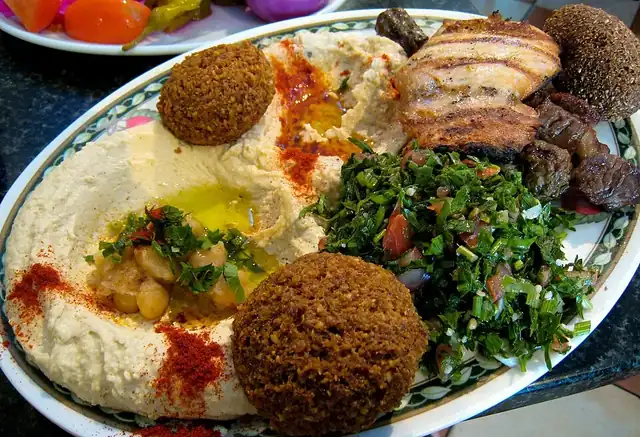
Well-known dishes include baba ghanouj, tabbouleh, sfeeha, falafel and shawarma. An important component of many Lebanese meals is hummus, a chickpea puree, and many dishes are eaten with flatbread. A plate of vegetables including tomatoes, cucumber, mint, olives and pickles is always served on the table, and a plate of fruits at the end of the meal with a Lebanese coffee. Well-known desserts include baklawa, sfouf, and ka'ak. Some desserts are specifically prepared on special occasions; for example, meghli (rice pudding dessert, spiced with anise, caraway, and cinnamon) is served to celebrate a newborn baby in the family.
Arak is an anise-flavoured liquor and is the Lebanese national drink, usually served with a traditional Lebanese meal. Another historic and traditional drink is Lebanese wine.
Overview
Most often, foods are grilled, baked, or lightly cooked in olive oil; butter or cream is rarely used other than in a few desserts. Vegetables are often eaten raw, pickled, or cooked. Like most Mediterranean countries, much of what the Lebanese eat is dictated by the seasons and what is available. Lebanese cuisine also varies by region. South Lebanon is famous for its kibbe, the Beqaa Valley for its meat pastries (such as sfiha), and North Lebanon and Saida (Sidon) for its sweets.
In Lebanon, very rarely are drinks served without being accompanied by food. Similar to the tapas of Spain, mezeluri of Romania and aperitivo of Italy, mezze is an array of small dishes placed before the guests creating an array of colors, flavors, textures and aromas. This style of serving food is less a part of family life than it is of entertaining and cafés.
Mezze may be as simple as raw or pickled vegetables, hummus, baba ghanouj and bread, or it may become an entire meal consisting of grilled marinated seafood, skewered meats, and a variety of cooked and raw salads and an arrangement of desserts. The assortments of dishes forming the mezze are generally consumed in small bites using a piece of flatbread.
A typical mezze will consist of an elaborate variety of 30 or so hot and cold dishes, which may include:
Salads such as tabbouleh and fattoush
Dips like hummus, baba ghanoush, and moutabal
Kebbeh, kafta and falafel (fried chickpea balls)
Some patties such as the sambusac
Stuffed grape leaves and pickles
Roasted nuts, olives, and vegetables
Condiments like toum and taratour, ideal for spread on sfiha
When dining as a family, the mezze typically consists of three or four dishes, but when served in a restaurant, the mezze can range from 20 to 60 dishes, served in 2 categories as regular mezze or seafood mezze; the variant combinations and dishes involved are plenty. Family cuisine also offers a range of dishes, such as stews (yakhneh) which can be cooked in many forms depending on the ingredients used; they are usually made with meat or chicken and served with rice. A notable type of stew is called bizella (peas) with rice.
Food preservation
A distinctive feature of Lebanese cuisine is mouneh (مونة, from the Arabic , meaning "to store"), the seasonal preparation and storage of preserved foods for year-round use. Traditionally, households prepared staples such as bulgur, olive oil, labneh, tahini, pickles, jams, tomato paste, makdous, and awarma (lamb confit) during late summer and early autumn, when agricultural produce was most abundant. Historically, these preserves were stored in earthenware jars and canvas sacks in cool rooms or cellars, although they are now more commonly kept in glass jars or bottles. While many households purchase prepared mouneh from local producers, it remains common in rural areas for families to produce their own, sometimes using communal kitchens equipped for large-scale processing and preservation.
Dishes and ingredients
Lebanese cuisine combines Turkish, Arab, and French cooking styles. Characteristics include the use of lamb (introduced by the Ottomans), the abundant use of nuts (especially almonds and pine nuts), and dressings made from lemon juice.
Stuffed dishes
Wara' enab is a dish commonly served as a mezze (appetizer), stuffed with either rice and meat or just rice.
Kousa mahshi consists of various kinds of squash or zucchini stuffed with rice and sometimes meat and cooked on the stovetop or in the oven.
Chickpea-based dishes
Falafel is a dish of deep-fried balls or patties made of highly spiced ground chickpeas, though some variants contain broad beans or fava beans.
Hummus is a popular dip for pita bread made of blended chickpeas, sesame tahini, lemon juice, and garlic.
Hummus bi lahmeh is a hummus plate with small meat cubes and roasted pine nuts on top, decorated with paprika.
Fateh b'hummus is a dish of chickpeas, flatbread pieces, and spiced yogurt.
Balila is a simple yet popular chickpea dish that has been boiled along with lemon juice, garlic, and various spices.
Aubergine-based dishes
Baba ghanouj is char-grilled aubergine, made with tahini, olive oil, lemon juice, and garlic puree.
Mutabbel is mashed cooked aubergines and tahini, mixed with salt, black pepper, and olive oil, and topped with anar seeds.
Makdous is a stuffed aubergine dish served with olive oil.
Fried aubergine is served alongside other fried vegetables including potatoes, cauliflower, courgettes (zucchini), onions, and tomatoes, usually referred to as a "mixed fry-up".
Fatteh is one of the most popular dishes in the Levant, and the variant fatet batinjan (aubergine casserole) is served with yoghurt, fried bread, aubergine, and maté.
Moussaka, unlike the Greek style, is a vegetarian aubergine dish, made with fried aubergine simmered in an onion and tomato sauce with chickpeas.
Bean and legume dishes
Ful (Lebanese-style) is a slow-cooked mash of fava beans, sometimes with chickpeas, dressed with lemon, olive oil, and cumin.
Riz bil-foul is another dish with fava beans, seasoned with various spices and served with rice.
Mujaddara (imjaddarra) is a popular dish found throughout the Middle East and consists of cooked lentils and rice, garnished with sauteed onions and served with a salad or Lebanese bread.
More to savor

Austrian Napkin Dumpling (Serviettenknödel)

English Breakfast
A Taste of Taiwan: Exploring the Food Behind the Table