Use the regional background below as a starting point for exploring the food, rather than expecting one dish to represent every household. Food traditions differ within a country and continue to change through travel, migration, and everyday cooking.
In this story
OverviewCustoms and equipmentFruit and vegetablesCommon foodsPork dishesPotato dishesSeafoodOverview
Irish cuisine encompasses the cooking styles, traditions and recipes associated with the island of Ireland. It has developed from antiquity through centuries of social and political change and the mixing of different cultures, predominantly with those from nearby Britain and other European regions. The cuisine is founded upon the crops and animals farmed in its temperate climate and the abundance of fresh fish and seafood from the surrounding waters of the Atlantic Ocean. Chowder, for example, is popular around the coasts. Herbs and spices traditionally used in Irish cuisine include bay leaves, black pepper, caraway seeds, chives, dill, horseradish, mustard seeds, parsley, ramsons (wild garlic), rosemary, sage and thyme.
The development of Irish cuisine was altered greatly by the Tudor conquest of Ireland in the late 16th and early 17th centuries, which introduced a new agro-alimentary system of intensive grain-based agriculture and led to large areas of land being turned over to grain production. The rise of a commercial market in grain and meat altered the diet of the Irish populace by redirecting traditionally consumed products (such as beef) abroad as cash crops instead. Consequently, potatoes were widely adopted in the 18th century and essentially became the main crop that the Irish working class (which formed a majority of the population) could afford.
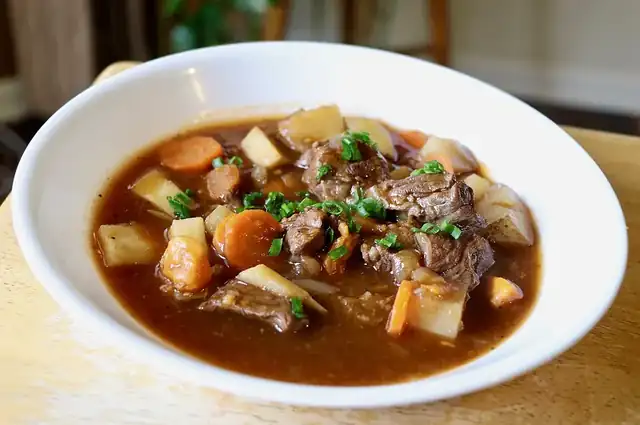
By the 21st century, much traditional Irish cuisine was being revived. Representative dishes include Irish stew, bacon and cabbage, boxty, brown bread (as it is referred to in the south) or soda bread (predominantly used in Ulster), coddle, and colcannon.
Customs and equipment
Hospitality was compulsory on all free landowners to welcome kings, bishops, or judges into their homes, with a wider superstitious fear held by the Irish of the consequences of turning away anyone. Much evidence for early Irish food exists in the law texts and poetry which were written down from the 7th and 8th century AD onwards.
The arrival of Christianity also brought new influences from the Middle East and Roman culture. Honey bees were not present in the 3rd century, according to Solinus; but the legend of Saint Modomnoc reports that he brought honeybees to Ireland about 540. The Bechbretha "bee judgements", initially recorded in the mid 600s, are unique in treating bee swarms as capable of trespass. This is related to their treatment of other livestock, but no other legal system applies the concept to bees; it seems that the authors of the Bechbretha were trying to fit the new facts about bees into their longstanding legal ideas about livestock in general. The Bechbretha gives Irish words related to honey and beekeeping that are cognate with Indo-European forms across Europe and beyond, possibly derived from early Welsh at the time of Modomnoc.
The Old Irish word for beeswax is céir, from the Latin ceris, suggesting that honey bees arrived in Ireland after Christianity.
The main meal was eaten in the afternoon or evening. A daytime meal was termed díthat. A meal at night, and especially a celebratory one, was called a feis and was often accompanied by beer. The main cooking utensil was the cauldron (coire) in which a variety of broths and stews were made.
Fruit and vegetables
Vegetables grown and eaten in Ireland included onions, chives, cabbage, celery, wild garlic and leeks. Fat-hen (Chenopodium album) is often found on pre Norman archaeological sites and appears to have been an important part of the diet, as it still is in Northern India. Skirret (Sium sisaram), in Irish cearrachán, appears to have been grown as a root vegetable, but this is no longer used. Watercress, sorrel, parsley, and nettles were picked wild and eaten raw or added to broth.
Apples, pears, cherries, and plums seem to have been the most commonly eaten fruits.
Pulses such as peas, broad beans, and lentils were grown and dried since early medieval times, becoming common with the Normans. Berries and nuts were extensively eaten. Hazelnuts were of great importance. Bilberries, known as fraochán in Irish, were traditionally picked on the festival of Lúghnasa in August. Blackberries and other wild fruit were also picked and consumed.
Pepper has been known in Ireland since early Christian times, being an import from the Roman empire.
Common foods
Dairy: butter, milk, buttermilk, cheese
Grains: barley, oats, wheat
Freshwater fish: pollan, trout, salmon, smoked salmon, smoked trout
Seafood: mackerel, cod, hake, haddock, smoked haddock, mussels, oysters, lobster, crab, sea vegetables (seaweeds), dillisk
Meat: beef, chicken, duck, lamb, pork, turkey, goose, offal
Vegetables: curly kale, potatoes, carrots, onions, cabbage, rhubarb
Fruits: apple, pear, plum, blackberry, strawberry, raspberry, tomatoes
Pork dishes
Bacon and cabbage
Black pudding—a traditional dish made from pig's blood, barley and seasoning
Coddle—main ingredients: pork sausage, back bacon and potato
Crubeens—pig's trotters
Skirts and kidneys—a kind of pork stew
White pudding—suet, oatmeal or barley, pork meat or liver
Potato dishes
Boxty—a potato pancake
Champ—main ingredients: mashed potato, scallions, butter and milk
Colcannon—main ingredients: mashed potato, kale or cabbage, and butter
Seafood
The consumption of seafood, despite Ireland's enormous coastline, is not as common as in other maritime countries. Irish people eat seafood well below the European average. It may have been more common in the past but declined markedly in the last few centuries.
Irish-owned shipping was severely restricted under English governance from the late 16th century on. Ireland was traditionally a cattle-based economy and fish was associated with religious fasting. It was the traditional food of fast on Fridays, in common with other Catholic countries. Also, seafood—particularly shellfish—became associated with the poor and the shame of colonisation. However, seafood has remained an important part of the diet in coastal communities, and the consumption of fresh fish and seafood is now undergoing a resurgence all over Ireland.
In Dublin, the fish seller is celebrated in the traditional folk song Molly Malone, and in Galway the international Galway Oyster Festival is held every September. An example of a modern Irish shellfish dish is Dublin Lawyer (lobster cooked in whiskey and cream). Salmon and cod are perhaps the two most common types of fish eaten. Carrageen moss and dulse (both types of red algae) are commonly used in Irish seafood dishes.
Seaweed, by contrast, has always been an important part of the Irish diet and remains popular today. Two popular forms are dillisk (known in Ulster as dulse; Palmaria palmata) and Irish moss (carageen moss, Chondrus crispus, Mastocarpus stellatus).
More to savor
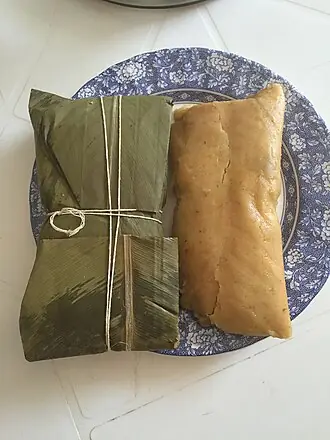
Hallaca (Venezuelan Stuffed Corn Dough)
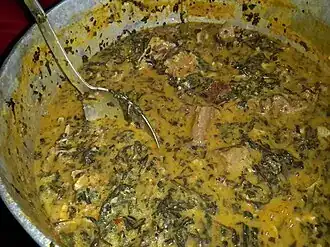
Ofe Onugbu (Bitter Leaf Soup)
A Taste of Iran: Exploring a Varied Culinary Tradition