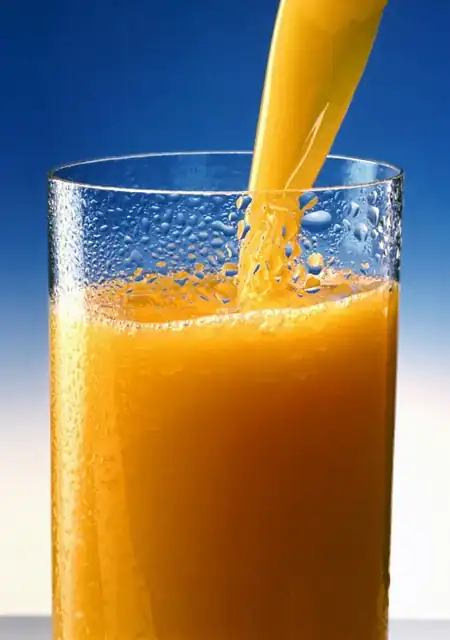
A drink can be an everyday routine, something shared with company, or a way to explore a food tradition. The background below looks more closely at the preparation and story behind the cup or glass.
In this story
OverviewTerminologyConsumptionPreparationPulsed electric fields processingEmerging or aspirational technologies100% fruit juiceOverview
Juice is a drink made from the extraction or pressing of the natural liquid contained in fruit and vegetables. It can also refer to liquids that are flavored with concentrate or other biological food sources like meat or seafood, such as clam juice. Juice is commonly consumed as a beverage or used as an ingredient or flavoring in foods or other beverages, such as smoothies. Juice emerged as a popular beverage choice after the development of pasteurization methods enabled its preservation without using fermentation (which is used in wine production). The largest fruit juice consumers are New Zealand (nearly a cup, or 8 ounces, each day) and Colombia (more than three quarters of a cup each day). Fruit juice consumption on average increases with a country's income level.
Terminology
In the United Kingdom, the name or names of the fruit followed by juice can only legally be used to describe a product that is 100% fruit juice, as required by the Fruit Juices and Fruit Nectars (England) Regulations and the Fruit Juices and Fruit Nectars (Scotland) Regulations 2003. However, a juice made by reconstituting concentrate can be called juice. A product described as fruit "nectar" must contain at least 25% to 50% juice, depending on the fruit. A juice or nectar including concentrate must state that it does. The term "juice drink" is not defined in the Regulations and can be used to describe any drink that includes juice, whatever the amount. Comparable rules apply in all EU member states in their respective languages.
In the US, fruit juice can only legally be used to describe a product that is 100% fruit juice. A blend of fruit juice(s) with other ingredients, such as high-fructose corn syrup, is called a juice cocktail or juice drink. According to the Food and Drug Administration (FDA), the term "nectar" is generally accepted in the US and in international trade for a diluted juice to denote a beverage that contains fruit juice or puree, water, and artificial sweeteners. "No added sugar" is commonly printed on the labels of juice containers, but the products may contain large amounts of naturally occurring sugars; however, sugar content is listed with other carbohydrates on labels in many countries.
Consumption
The largest fruit juice consumers are New Zealand (nearly a cup, or 8 ounces, each day) and Colombia (more than three quarters of a cup each day). Fruit juice consumption, on average, increased with country income level.
In 2007, a report stated that fruit juice consumption overall in Europe, Australia, New Zealand, and the US had increased in recent years.
In 2015, people in the United States consumed approximately 6.6 US gallons of juice per capita, with more than half of preschool-age children being regular drinkers.
Preparation
Juice is prepared by mechanically squeezing or macerating (sometimes referred to as cold pressing) fruit or vegetable flesh without the application of heat or solvents. For example, orange juice is the liquid extract of the fruit of the orange tree, and tomato juice is the liquid that results from pressing the fruit of the tomato plant. Juice may be prepared at home from fresh fruit and vegetables using a variety of hand or electric juicers. Many commercial juices are filtered to remove fiber or pulp, but high-pulp fresh orange juice is a popular beverage. Additives are put in some juices, such as sugar and artificial flavours (in some fruit juice-based beverages) or savoury seasonings (e.g., in Clamato or Caesar tomato juice drinks).
Common methods for the preservation and processing of fruit juices include canning, pasteurization, concentrating, freezing, evaporation, and spray drying.
Although processing methods vary between juices, the general processing method of juices includes:
Washing and sorting food source
Juice extraction
Straining, filtration and clarification
Blending pasteurization
Filling, sealing and sterilization
Cooling, labeling and packing
Pulsed electric fields processing
High-intensity pulsed electric fields are being used as an alternative to heat pasteurization in fruit juices. Heat treatments sometimes fail to make a quality, microbiologically stable product. However, it was found that processing with high-intensity pulsed electric fields (PEF) can be applied to fruit juices to provide a shelf-stable and safe product. In addition, it was found that pulsed electric fields provide a fresh-like product with high nutritional value. Pulsed electric field processing is a type of nonthermal method for food preservation.
Pulsed electric fields use short pulses of electricity to inactivate microbes. In addition, the use of PEF results in minimal detrimental effects on the quality of the food. PEFs kill microorganisms and provide better maintenance of the original colour, flavour, and nutritional value of the food as compared to heat treatments. This method of preservation works by placing two electrodes between liquid juices, then applying high-voltage pulses for microseconds to milliseconds. The high-voltage pulses have an intensity in the range of 10 to 80 kV/cm.
The processing time of the juice is calculated by multiplying the number of pulses by the effective pulse duration. The high voltage of the pulses produces an electric field that results in the inactivation of microbes that may be present in the juice. The PEF temperatures are below the temperatures used in thermal processing. After the high-voltage treatment, the juice is aseptically packaged and refrigerated. Juice is also able to transfer electricity due to the presence of several ions from the processing. When the electric field is applied to the juice, electric currents are then able to flow into the liquid juice and be transferred around due to the charged molecules in the juice.
Therefore, pulsed electric fields are able to inactivate microorganisms, extend shelf life, and reduce the enzymatic activity of the juice while maintaining similar quality as the original, fresh-pressed juice.
Emerging or aspirational technologies
Fruit juices contain compounds that can be undesirable to consumers. Apple juices can be cloudy, and grapefruit juices can be bitter. Enzymatic technologies, involving respectively pectinases and naringinase, address these problems.
100% fruit juice
Research suggests that 100% fruit juice is not associated with an increased risk of diabetes. A 2018 review concluded that 100% fruit juice increases the risk of tooth decay in children, but there is "no conclusive evidence that consumption of 100% fruit juice has adverse health effects." A 2025 umbrella review concluded that "the balance of evidence does not support the exclusion of 100% juice from food-based guides to healthy eating".
More to savor
Gambian Baobab Juice (Bouye)

Hallaca (Venezuelan Stuffed Corn Dough)
Beer: The Brewing Story Behind a Familiar Glass