The dish is a starting point for exploring a wider food story. The guide below looks more closely at its background and different forms. When you want to cook, visit the recipe collection for ingredient quantities and step-by-step methods.
In this story
Overview2010 kimchi ingredient price crisisIngredientsVegetablesSeasoningsProductionVarietiesOverview
Kimchi is a traditional Korean side dish (banchan) consisting of salted and fermented vegetables, most often Chinese cabbage or Korean radish. A wide selection of seasonings are used, including gochugaru (Korean chili powder), spring onions, garlic, ginger, and jeotgal (salted seafood). Kimchi is also used in a variety of soups and stews. Kimchi is a staple food in Korean cuisine and is eaten as a side dish with almost every Korean meal.
There are hundreds of different types of kimchi made with different vegetables as the main ingredients. Examples of variants include baechu-kimchi, kkakdugi, chonggak-kimchi, and oi-sobagi. Traditionally, winter kimchi, called gimjang, was stored in large earthenware fermentation vessels, called onggi, in the ground to prevent freezing during the winter months and to keep it cool enough to slow down the fermentation process during summer months. The process of making kimchi was called gimjang and was based on participation by the whole village. The vessels are also kept outdoors in special terraces called jangdokdae. The use of household kimchi refrigerators has become a more common method for keeping fermenting kimchi at the right temperature.
Kimchi has gained international recognition as a traditional Korean food and has been promoted as part of Korean cultural heritage. Its preparation methods and cultural significance have been documented as part of Korea's intangible cultural heritage.
2010 kimchi ingredient price crisis
Due to heavy rainfall shortening the harvesting time for cabbage and other main ingredients for kimchi in 2010, the price of kimchi ingredients and kimchi itself rose greatly. Korean and international newspapers described the rise in prices as a national crisis. Some restaurants stopped offering kimchi as a free side dish, which The New York Times compared to an American hamburger restaurant no longer offering free ketchup. In response to the kimchi price crisis, the South Korean government announced the temporary reduction of tariffs on imported cabbage to coincide with the kimjang season.
Ingredients
Kimchi varieties are named according to their main vegetable ingredients and the mix of seasonings used to flavor them.
Vegetables
Cabbages (napa cabbages, bomdong, headed cabbages) and radishes (Korean radishes, ponytail radishes, gegeol radishes, yeolmu radishes) are the most commonly used kimchi vegetables. Other kimchi vegetables include aster, balloon flower roots, burdock roots, celery, chamnamul, cilantro, cress, crown daisy greens, cucumber, eggplant, garlic chives, garlic scapes, ginger, Korean angelica-tree shoots, Korean parsley, Korean wild chive, lotus roots, mustard greens, onions, perilla leaves, bamboo shoot, Momordica charantia, pumpkins, radish greens, rapeseed leaves, scallions, seaweed, soybean sprouts, spinach, sugar beets, sweet potato vines, and tomatoes.
Seasonings
Brining salt (with a larger grain size compared to kitchen salt) is used mainly for initial salting of kimchi vegetables. Being minimally processed, it serves to help develop flavors in fermented foods. Cabbage is usually salted twice when making spicy kimchi.
Commonly used seasonings include gochugaru (chili powder), scallions, garlic, ginger, and jeotgal (salted seafood) Jeotgal can be replaced with raw seafood in colder Northern parts of the Korean Peninsula. If used, milder saeu-jeot (salted shrimp) or jogi-jeot (salted croaker) is preferred and the amount of jeotgal is also reduced in Northern and Central regions. In Southern Korea, on the other hand, a generous amount of stronger myeolchi-jeot (salted anchovies) and galchi-jeot (salted hairtail) is commonly used. Raw seafood or daegu-agami-jeot (salted cod gills) are used in the East coast areas.
Salt, scallions, garlic, fish sauce, and sugar are commonly added to flavor the kimchi.
Production
To make kimchi, cabbage or daikon is sliced into small, uniform pieces to increase surface area. The pieces are then coated with salt to draw out water and increase salt content, which helps preserve them by preventing the growth of harmful microorganisms. This salting process can use 5–7% salt for 12 hours or 15% salt for 3–7 hours.
After salting, excess water is drained and the seasoning ingredients are added. Sugar can be used to bind any remaining water. Finally, the brined vegetables are packed into airtight jars and left to ferment at room temperature for 24 to 48 hours. The ideal salt concentration during fermentation is about 3%.
Since the fermentation process results in the production of carbon dioxide, the jar should be "burped" daily to release the gas. The more fermentation that occurs, the more carbon dioxide will be incorporated, which results in a very carbonated-drink-like effect.
Varieties
Kimchi is one of the most important staples of Korean cuisine. The Korean term "Kimchi" refers to fermented vegetables, and encompasses salt and seasoned vegetables. It is mainly served as a side dish with every meal, but also can be served as a main dish. Kimchi is mainly recognized as a spicy fermented cabbage dish globally.
New variations of kimchi continue to be created, and the taste can vary depending on the region and season. Conventionally, the secret of kimchi preparation was passed down by mothers to their daughters in a bid to make them suitable wives to their husbands. However, with the current technological advancement and increase in social media use, many individuals worldwide can now access recipes for kimchi preparation.
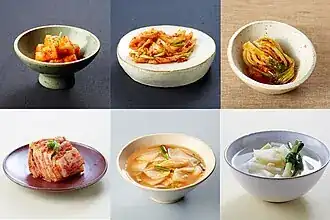
Kimchi can be categorized by main ingredients, regions or seasons. Korea's northern and southern sections have a considerable temperature difference. There are over 180 recognized varieties of kimchi. The most common kimchi variations are:
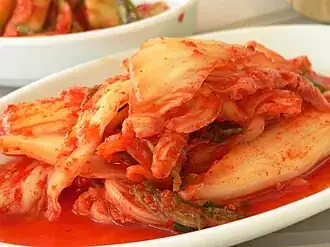
Baechu-kimchi (배추김치) spicy napa cabbage kimchi, made from whole cabbage leaves
Baechu-geotjeori (배추겉절이) unfermented napa cabbage kimchi
Bossam-kimchi (보쌈김치) wrapped kimchi
Baek-kimchi (백김치) white kimchi, made without chili pepper
Dongchimi (동치미) a non-spicy watery kimchi
Nabak-kimchi (나박김치) a mildly spicy watery kimchi
Chonggak-kimchi (총각김치) cubed chonggak "ponytail" radish, a popular spicy kimchi
Kkakdugi (깍두기) spicy cubed Korean radish strongly-scented kimchi containing fermented shrimp
Oi-sobagi (오이소박이) cucumber kimchi that can be stuffed with seafood and chili paste, and is a popular choice during the spring and summer seasons
Pa-kimchi (파김치) spicy green onion kimchi
Yeolmu-kimchi (열무김치) is also a popular choice during the spring and summer, and is made with yeolmu radishes, and does not necessarily have to be fermented.
Gat-kimchi (갓김치), made with Indian mustard
Yangbaechu-kimchi (양배추 김치) spicy cabbage kimchi, made from "headed" cabbage leaves (as opposed to napa cabbage)
More to savor
Cabbage Kimchi

Koko da Kosai (Fermented Corn Porridge and Bean Fritters)

Chicken Tikka Masala: A Creamy Curry with a Wider Story