This longer reference provides the background behind the topic. Read it alongside the recipe collection when you want to connect an ingredient or food idea with a dish to prepare.
Overview
Lettuce (Lactuca sativa) is an annual plant of the family Asteraceae mostly grown as a leaf vegetable. The leaves are most often used raw in green salads, although lettuce is also seen in other kinds of food, such as sandwiches, wraps and soups; it can also be grilled. Its stem and seeds are sometimes used; celtuce (asparagus lettuce) is one variety grown for its stems, which are eaten either raw or cooked. In addition to its main use as a leafy green, it has also gathered religious and medicinal significance over centuries of human consumption. Europe and North America originally dominated the market for lettuce, but by the late 20th century the consumption of lettuce had spread throughout the world.
In 2023, world production of lettuce (and chicory) was 28 million tonnes, led by China with 53% of the total.
Lettuce was originally farmed by the ancient Egyptians, who transformed it from a plant whose seeds were used to obtain oil into an important food crop raised for its succulent leaves and oil-rich seeds. Lettuce spread to the Greeks and Romans; the latter gave it the name lactuca, from which the English lettuce is derived. By 50 AD, many types were described, and lettuce appeared often in medieval writings, including several herbals. The 16th through 18th centuries saw the development of many varieties in Europe, and by the mid-18th century, cultivars were described that can still be found in modern gardens.
Description
Lettuce's native range spreads from the Mediterranean to Siberia, although it has been transported to almost all areas of the world. Plants generally have a height and spread of 15 to 30 cm. The leaves are colorful, mainly in the green and red color spectrums, with some variegated varieties. There are also a few varieties with yellow, gold or blue-teal leaves.
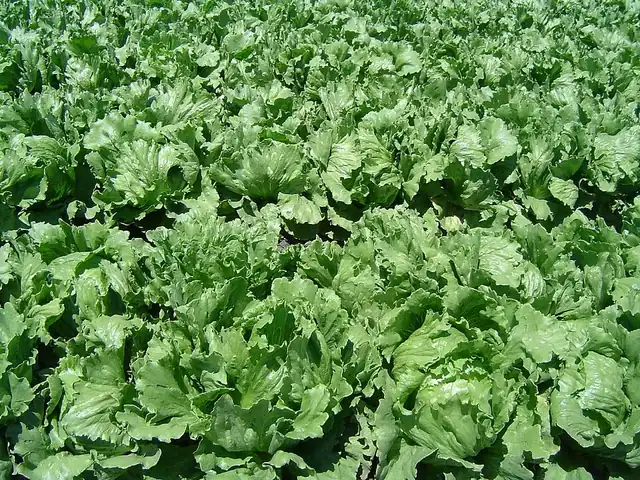
Lettuces have a wide range of shapes and textures, from the dense heads of the iceberg type to the notched, scalloped, frilly or ruffly leaves of leaf varieties. Lettuce plants have a root system that includes a main taproot and smaller secondary roots. Some varieties, especially those found in the United States and Western Europe, have long, narrow taproots and a small set of secondary roots. Longer taproots and more extensive secondary systems are found in varieties from Asia.
Cultivars (varieties)
There are several types and cultivars of lettuce. Categorization may sometimes refer to "leaf" versus "head", but there are seven main cultivar groups of lettuce, each including many varieties:
Leaf—Also known as looseleaf, cutting or bunching lettuce, this type has loosely bunched leaves and is the most widely planted. It is used mainly for salads.
Red leaf lettuce—A group of lettuce types with red leaves.
Production
In 2023, world production of lettuce (report combined with chicory) was 28 million tonnes, with China alone accounting for 53% of the total (table).
Lettuce is the only member of the genus Lactuca to be grown commercially.
Markets
Western Europe and North America were the original major markets for large-scale lettuce production. By the late 1900s, Asia, South America, Australia and Africa became more substantial markets. Different locations tended to prefer different types of lettuce, with butterhead prevailing in northern Europe and Great Britain, romaine in the Mediterranean and stem lettuce in China and Egypt. By the late 20th century, the preferred types began to change, with crisphead, especially iceberg, lettuce becoming the dominant type in northern Europe and Great Britain and more popular in western Europe. In the US, no one type predominated until the early 20th century, when crisphead lettuces began gaining popularity. After the 1940s, with the development of iceberg lettuce, 95 percent of the lettuce grown and consumed in the US was crisphead lettuce.
By the end of the century, other types began to regain popularity and eventually made up over 30 percent of production. Stem lettuce was first developed in China, where it remains primarily cultivated.
Culinary
As described around 50 AD, lettuce leaves were often cooked and served by the Romans with an oil-and-vinegar dressing; however, smaller leaves were sometimes eaten raw. During the 81–96 AD reign of Domitian, the tradition of serving a lettuce salad before a meal began. Post-Roman Europe continued the tradition of poaching lettuce, mainly with large romaine types, as well as the method of pouring a hot oil and vinegar mixture over the leaves.
Today, the majority of lettuce is grown for its leaves, although one type is grown for its stem and one for its seeds, which are made into an oil. Most lettuce is used in salads, either alone or with other greens, vegetables, meats and cheeses. Romaine lettuce is often used for Caesar salads. Lettuce leaves can also be found in soups, sandwiches and wraps, while the stems are eaten both raw and cooked.
The consumption of lettuce in China developed differently from in Western countries, due to health risks and cultural aversion to eating raw leaves; Chinese "salads" are composed of cooked vegetables and are served hot or cold. Lettuce is also used in a larger variety of dishes than in Western countries, contributing to a range of dishes including bean curd and meat dishes, soups and stir-frys plain or with other vegetables. Stem lettuce, widely consumed in China, is eaten either raw or cooked, the latter primarily in soups and stir-frys. Lettuce is also used as a primary ingredient in the preparation of lettuce soup.
Food-borne illness
Food-borne pathogens that can survive on lettuce include Listeria monocytogenes, the causative agent of listeriosis, which multiplies in storage. However, despite high levels of bacteria being found on ready-to-eat lettuce products, a 2008 study found no incidents of food-borne illness related to listeriosis, possibly due to the product's short shelf life, indigenous microflora competing with the Listeria bacteria or inhibition of bacteria to cause listeriosis.
Other bacteria found on lettuce include Aeromonas species, which have not been linked to any outbreaks; Campylobacter species, which cause campylobacteriosis; and Yersinia intermedia and Yersinia kristensenii (species of Yersinia), which have been found mainly in lettuce. Salmonella bacteria, including the uncommon Salmonella braenderup type, have also caused outbreaks traced to contaminated lettuce. Viruses, including hepatitis A, calicivirus and a Norwalk-like strain, have been found in lettuce. The vegetable has also been linked to outbreaks of parasitic infestations, including Giardia lamblia.
More to savor

Chicken Vindaloo

Koko da Kosai (Fermented Corn Porridge and Bean Fritters)
A Closer Look at Yams: From Ingredient to Meal