This longer reference provides the background behind the topic. Read it alongside the recipe collection when you want to connect an ingredient or food idea with a dish to prepare.
In this story
OverviewDescriptionDistribution and habitatEcologyMajor cultivated speciesD. cayennensisD. alataD. polystachyaProductionComparison to other staple foodsConsumptionOverview
Yam is the common name for some plant species in the genus Dioscorea (family Dioscoreaceae) that form edible tubers (some other species in the genus being toxic).
Yams are perennial herbaceous vines native to Africa, Asia, and the Americas and cultivated for the consumption of their starchy tubers in many temperate and tropical regions. The tubers themselves, also called "yams", come in a variety of forms owing to numerous cultivars and related species.
Description
A monocot related to lilies and grasses, yams are vigorous herbaceous, perennially growing vines from a tuber. Some 870 species of yams are known, a few of which are widely grown for their edible tuber but others of which are toxic (such as D. communis).
Yam plants can grow up to 15 m in length and 7 to 15 cm high. The tuber may grow into the soil up to 1.5 m deep. The plant disperses by seed.
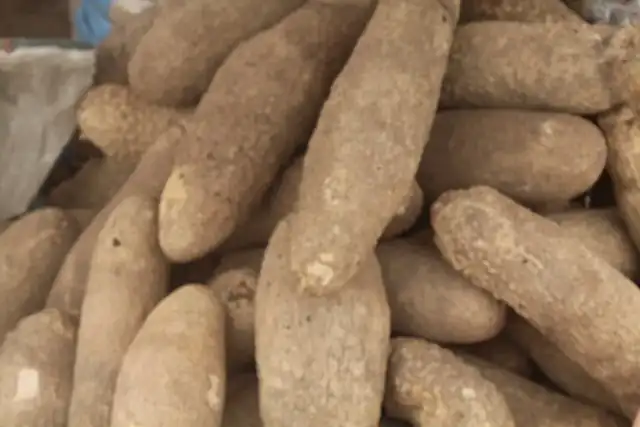
The edible tuber has a rough skin that is difficult to peel but readily softened by cooking. The skins vary in color from dark brown to light pink. The majority, or meat, of the vegetable is composed of a much softer substance ranging in color from white or yellow to purple or pink in mature yams.
Distribution and habitat
Yams are native to Africa, Asia, and the Americas. Three species were independently domesticated on those continents: D. rotundata (Africa), D. alata (Asia), and D. trifida (South America).
Ecology
Some yams are invasive plants, often considered a noxious weed outside cultivated areas.
Major cultivated species
Many cultivated species of Dioscorea yams are found throughout the humid tropics. The most economically important are discussed below.
Non-Dioscorea tubers that were historically important in Africa include Plectranthus rotundifolius (the Hausa potato) and P. esculentus (the Livingstone potato); these two tuber crops have now been largely displaced by the introduction of cassava.
D. cayennensis
The yellow yam, D. cayenensis, and the white yam, D. cayenensis subsp. rotundata, are native to Africa. They are the most important cultivated yams. In the past, the white yam was considered to be a separate species, D. rotundata, but most taxonomists now regard it as a subspecies of yellow yam. Over 200 varieties between them are cultivated.
White yam tuber is roughly cylindrical in shape, the skin is smooth and brown, and the flesh is usually white and firm. Yellow yam has yellow flesh, caused by the presence of carotenoids. It looks similar to the white yam in outer appearance; its tuber skin is usually a bit firmer and less extensively grooved. The yellow yam has a longer period of vegetation and a shorter dormancy than white yam.
The Kokoro variety is important in making dried yam chips.
They are large plants; the vines can be as long as 10 to 12 m. The tubers most often weigh about 2.5 to 5 kg each, but can weigh as much as 25 kg. After 7 to 12 months' growth, the tubers are harvested. In Africa, most are pounded into a paste to make the traditional dish of "pounded yam", known as Iyan.
D. alata
D. alata, called purple yam (not to be confused with the Okinawan purple "yam", which is a sweet potato), greater yam, winged yam, water yam, and (ambiguously) white yam, was first cultivated in Southeast Asia. Although not grown in the same quantities as the African yams, it has the largest distribution worldwide of any cultivated yam, being grown in Asia, the Pacific islands, Africa, and the West Indies. Even in Africa, the popularity of water yam is second only to white yam. The tuber shape is generally cylindrical, but can vary. Tuber flesh is white and watery in texture.
D. alata and D. esculenta (lesser yam) were important staple crops to the seafaring Austronesian cultures. They were carried along with the Austronesian migrations as canoe plants, from Island Southeast Asia to as far as Madagascar and Polynesia.
D. polystachya
Dioscorea polystachya, the Chinese yam, is native to temperate East Asia, from the southern Russian Far East through China to Taiwan and the Kuril Islands; Korea is also treated as part of the native range.It has long been cultivated in Japan, where it is generally regarded as an introduction of the 17th century or earlier.The plant is smaller than most African yams; the vines typically climb 3–5 m (10–16 ft), and it is more frost-tolerant than other edible yams, growing in cooler temperate climates than most cultivated species. It was introduced to Europe in the 19th century during the European Potato Failure, as a possible substitute crop; limited cultivation continues in France for the East Asian food market.
Regional cultivars differ in morphology and in how the tuber is used. In China, types are distinguished mainly by tuber shape (cylindrical, flattened, or round). Henan—especially the Jiaozuo (historical Huaiqing) area and the tiegun ('iron stick') strain—is the traditional prestige production region; tubers are eaten cooked, typically stir-fried or added to soups, and are also sliced and dried for use in traditional medicine as shān yào (山藥).
In Korea the crop is grown nationwide, with Andong in North Gyeongsang accounting for the bulk of output (commonly cited at around 70 percent) and Jinju as a long-standing secondary centre. Andong san-yak (산약) was used almost exclusively as a raw material for traditional medicine until the late 1980s; commercial processing infrastructure developed subsequently, and today it is marketed primarily as a health product—dried, powdered, or made into tonic drinks—rather than sold as a fresh table vegetable.
Production
In 2020, world production of yams was 75 e6MT, led by Nigeria with 67% of the total (table).
Comparison to other staple foods
The following table shows the nutrient content of yam and major staple foods in a raw harvested form on a dry weight basis to account for their different water contents. Raw forms, however, are inedible and indigestible. These must be sprouted or prepared and cooked for human consumption. In sprouted or cooked form, the relative nutritional and antinutritional contents of these staples are remarkably different from those in their raw form.
Consumption
Yams are consumed in a variety of preparations, such as flour or whole vegetable pieces across their range of distribution in Asia, Africa, North America, Central America, the Caribbean, South America, and Oceania.
More to savor

Chicken Vindaloo

Koko da Kosai (Fermented Corn Porridge and Bean Fritters)
A Closer Look at Mandarin orange: From Ingredient to Meal