This longer reference provides the background behind the topic. Read it alongside the recipe collection when you want to connect an ingredient or food idea with a dish to prepare.
Overview
Lychees are the fruit of the tree Litchi chinensis, the sole member of the genus Litchi, part of the soapberry family, Sapindaceae. They are edible, with a sweet, mildly tart flavor, and have a distinctive floral aroma often described as rose-like.
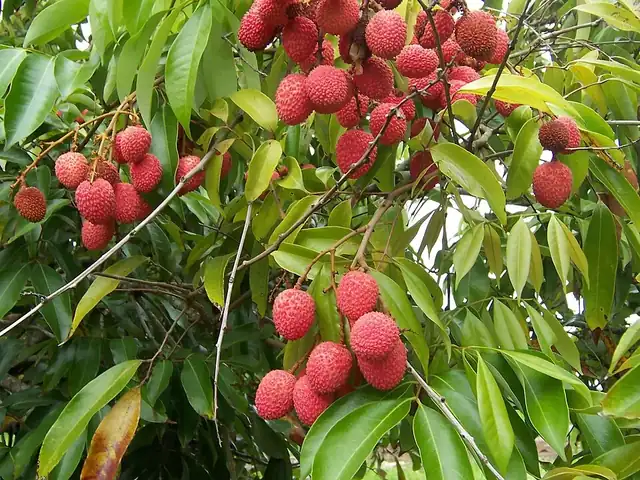
There are three distinct subspecies of lychee. The most common is the Indochinese lychee, found in South China, Malaysia, and northern Vietnam. The other two are the Philippine lychee (locally called alupag or matamata), found only in the Philippines, and the Javanese lychee, cultivated in Indonesia and Malaysia. The tree has been introduced throughout Southeast and South Asia. Cultivation in China has been documented since the 11th century. China is the main producer of lychees, followed by India, Vietnam, other countries in Southeast Asia, other countries in South Asia, Madagascar, and South Africa. A tall evergreen tree, it bears small fleshy sweet fruits. The outside of the fruit is a pink-red, rough-textured soft shell.
Lychee seeds contain methylene cyclopropyl glycine, which has caused hypoglycemia associated with outbreaks of encephalopathy in undernourished Indian and Vietnamese children who consumed lychee fruit.
Tree
Litchi chinensis is an evergreen tree that is frequently less than 15 m tall, sometimes reaching 28 m. Its leaves, 12.5 to 20 cm long, are pinnate, having 4 to 8 alternate, elliptic-oblong to lanceolate, abruptly pointed leaflets,
The bark is grey-black and the branches a brownish-red. The leaves are 12.5 to 20 cm long, with leaflets in two to four pairs. Lychees are similar in foliage to those of the family Lauraceae, likely due to convergent evolution. They adapted by developing water-repellent leaves which are called laurophyll or lauroid leaves.
Flowers grow on a terminal inflorescence with many panicles on the current season's growth. The panicles grow in clusters of 10 or more, reaching 10 to 40 cm or longer, holding hundreds of small white, yellow, or green flowers that are distinctively fragrant.
Fruit
The lychee tree bears fleshy fruits that mature in 80 to 112 days depending on climate, location, and cultivar. Fruits vary in shape from round to ovoid to heart-shaped, up to 5 cm long and 4 cm wide (2.0 in × 1.6 in), weighing approximately 20 g.
The thin, tough skin is green when immature, ripening to red or pink-red, and is smooth or covered with small, sharp, roughly-textured protuberances. The rind is inedible but easily removed to expose a layer of translucent white flesh with a floral aroma and a sweet flavor. The skin turns brown and dry when left out after harvesting.
The fleshy, edible portion of the fruit is an aril, surrounding one dark brown inedible seed that is 1 to 3.3 cm long and 0.6 to 1.2 cm wide (0.39–1.30 by 0.24–0.47 in). Some cultivars produce a high percentage of fruits with shriveled aborted seeds known as 'chicken tongues'. These fruits typically have a higher price, due to having more edible flesh. Since the floral flavor is lost in the process of canning, the fruit is usually eaten fresh.
Flavor and aroma
The edible aril of the lychee is juicy and translucent, with a sweet, mildly tart flavor and a distinctive floral aroma often described as rose-like.
Its sweetness is primarily due to sucrose, glucose, and fructose, while malic and citric acids provide acidity. Aroma-active compounds in the flesh include the monoterpenes linalool, geraniol, nerol, limonene, and cis-rose oxide, which contribute rose-like and citrus-like notes, as well as furaneol (sweet, caramel-like), methional (cooked-potato nuance), and sulfur volatiles such as dimethyl trisulfide.
Double domestication
Genomic studies indicate that the lychee resulted from double domestication by independent cultivation in two different regions of ancient China.
Culinary
Lychees are commonly sold fresh in Asian markets. The red rind turns dark brown when the fruit is refrigerated, but the taste is not affected. It is sold canned year-round. The fruit can be dried with the rind intact, at which point the flesh shrinks and darkens.
Lychees can be used to make lychee liquour and lychee wine.
Cultivars
There are numerous lychee cultivars, with considerable confusion regarding their naming and identification. The same cultivar grown in different climates can produce very different fruit. Cultivars can also have different synonyms in various parts of the world. Southeast Asian countries, along with Australia, use the original Chinese names for the main cultivars. India grows more than a dozen different cultivars. South Africa grows mainly the "Mauritius" cultivar. Most cultivars grown in the United States were imported from China, except for the "Groff", which was developed in the state of Hawaii.
Different cultivars of lychee are popular in various growing regions and countries. In China popular cultivars include Kwai Mai, Sanyuehong, Baitangying, Baila, Muzaffarpur, Samastipur, Shuidong, Feizixiao, Dazou, Heiye, Nuomici, Guiwei, Huaizhi, Lanzhu, and Chenzi. In Vietnam the most popular cultivar is Vai Thieu Hai Duong. In the U.S., production is based on several cultivars, including Mauritius, Brewster, and Hak Ip. India grows more than a dozen named cultivars, including Shahi (highest pulp percentage), Dehradun, Early Large Red, Kalkattia, and Rose Scented.
More to savor

Chicken Vindaloo

Banoffee Pie
Oranges in the Kitchen: Exploring an Everyday Ingredient