This longer reference provides the background behind the topic. Read it alongside the recipe collection when you want to connect an ingredient or food idea with a dish to prepare.
In this story
OverviewDescriptionDistributionToxicity and allergenicityAgriculturalCulinarySupplementOverview
Morus is a genus of flowering plants in the family Moraceae, consisting of 17 species of deciduous trees commonly known as mulberries, growing wild and under cultivation in many warm-temperate world regions. Generally, the genus has 64 subordinate taxa; although the three of most common are referred to as white, red, and black, originating from the colour of their dormant buds, and not necessarily the fruit colour (Morus alba, M. rubra, and M. nigra, respectively), with numerous cultivars and some taxa currently unchecked and awaiting taxonomic scrutiny. Morus alba is native to China, but is widely cultivated and often naturalised across Europe, Southern Africa, South America, and North America; it is also the species most preferred by the silkworm. It is regarded as an invasive species in Brazil, the United States and some states of Australia.
Species in the closely related genus Broussonetia are also commonly known as mulberries, notably the paper mulberry (Broussonetia papyrifera).
Despite their similar appearance, mulberries are not closely related to raspberries or blackberries. All three species belong to the order Rosales, but while the mulberry is a tree belonging to the family Moraceae (also including the fig, jackfruit, and other fruits), raspberries and blackberries are brambles and belong to the family Rosaceae.
Description
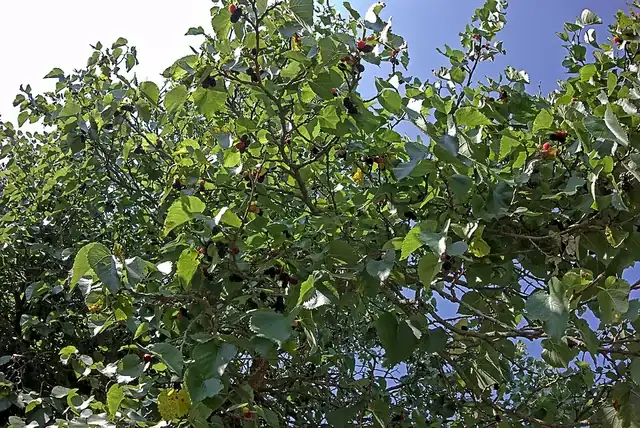
Mulberries are fast-growing when young, and can grow to 24 m tall. The leaves are alternately arranged, simple, and often lobed and serrated on the margin. Lobes are more common on juvenile shoots than on mature trees. The trees can be monoecious or dioecious.
The mulberry fruit is a multiple fruit, about 2-3 cm long. The immature fruit are white, green, or pale yellow. The fruit turns from pink to red while ripening, then dark purple or black, and has a sweet flavour when fully ripe.
Mulberry identification is complex, with leaf shape (heavily dependent on age and vigour) and fruit colour being of no value. Leaf texture of the upper surface is more significant; the two most commonly cultivated species across Europe, M. nigra and M. alba, are easily distinguished by the matt, rough-textured leaves of M. nigra, and the smooth, glossy leaves of M. alba. In North America, M. rubra also has rough leaves, but is distinguished by the leaves being downy on the undersides.
Distribution
The genus is widespread in warm temperate to tropical regions of Asia, eastern and southern North America, and northwestern South America.
Black and white mulberries are widespread in cultivation in Southern Europe, the Middle East, Central Asia, Northern Africa, and the Indian subcontinent, where the tree and the fruit have names under regional dialects.
Black mulberry was imported to Britain in the 17th century in the hopes that it would be useful in the cultivation of silkworms. It was much used in folk medicine, especially in the treatment of tapeworms.
The United States has native red mulberries, as well as imported black and white mulberries. In North America, the white mulberry is considered an invasive exotic and has taken over extensive tracts from native plant species, including the red mulberry.
Mulberries are also widespread in Greece, particularly in the Peloponnese, which in the Middle Ages was known as Morea, deriving from the Greek word for the tree (mouria).
Australia has two types of native mulberries: Hedycarya angustifolia, and Pipturus argenteus, which are both from different families to Moraceae. The exotic black, red and white Morus mulberries are also commonly grown in Australian backyards. White mulberry is considered an environmental weed in the states of Queensland and New South Wales.
Toxicity and allergenicity
All parts of the plant besides the ripe fruit can exude a milky sap (latex) which is mildly toxic if ingested, causing digestive distress and, at larger doses, hallucinations. It is also an irritant and may cause a skin rash on contact. Unripe green fruit may cause nausea, cramps, and be hallucinogenic. The berries have a laxative effect; too many will cause diarrhea.
Some North American cities have banned the planting of mulberries because of the large amounts of pollen they produce, posing a potential health hazard for some pollen allergy sufferers. Only the male mulberry trees produce pollen; this lightweight pollen can be inhaled deeply into the lungs, sometimes triggering asthma. Conversely, female mulberry trees produce all-female flowers, which draw pollen and dust from the air. Because of this pollen-absorbing feature, all-female mulberry trees have an OPALS allergy scale rating of just 1 (lowest level of allergy potential), and some consider it "allergy-free".
Agricultural
The leaves are harvested three or four times a year by a leaf-picking method under rain-fed or semi-arid conditions, depending on the monsoon. The leaves are useful as animal fodder. The tree branches pruned in the fall (autumn; after the leaves have fallen) are cut and used to make durable baskets supporting agriculture and animal husbandry.
Culinary
As the fruit matures, mulberries change in texture and colour, becoming succulent, plump, and juicy, resembling a blackberry. The colour of the fruit does not distinguish the mulberry species, as mulberries may be white, lavender or black. The fruit of the black mulberry (native to southwest Asia) and the red mulberry (native to eastern North America) have distinct flavours. White mulberry fruit are typically sweet, but not tart, while red mulberries are usually deep red, sweet, and juicy. Black mulberries are large and juicy, with balanced sweetness and tartness. The fruit of the East Asian white mulberry – a species extensively naturalised in urban regions of eastern North America – has a different flavour, sometimes characterised as refreshing and a little tart, with a bit of gumminess to it and a hint of vanilla.
Mulberries are used in pies, tarts, wines, cordials, and herbal teas. Jams and sherbets are often made from the fruit in the Old World. In spring, new tender twigs are semisweet and can be eaten raw or cooked.
In Armenia, mulberries are common, with wide usage in homemade oghi (moonshine) production, known as tti oghi, and syrup known as doshab.
Supplement
The fruit and leaves are sold in various forms as dietary supplements.
More to savor

Chicken Vindaloo

Ugali (Rwandan Cornmeal Porridge)
Lychee in the Kitchen: Exploring an Everyday Ingredient