This longer reference provides the background behind the topic. Read it alongside the recipe collection when you want to connect an ingredient or food idea with a dish to prepare.
Overview
A mango is an edible stone fruit produced by the tropical tree Mangifera indica. It originated in the northeastern part of the South Asia, in what is now Bangladesh, northeastern India and Myanmar. M. indica has been cultivated in South and Southeast Asia since ancient times, resulting in two modern mango cultivar lineages: the "Indian" and the "Southeast Asian" types. Other species in the genus Mangifera also produce edible fruits called "mangoes", most of which are found in the Malesian ecoregion.
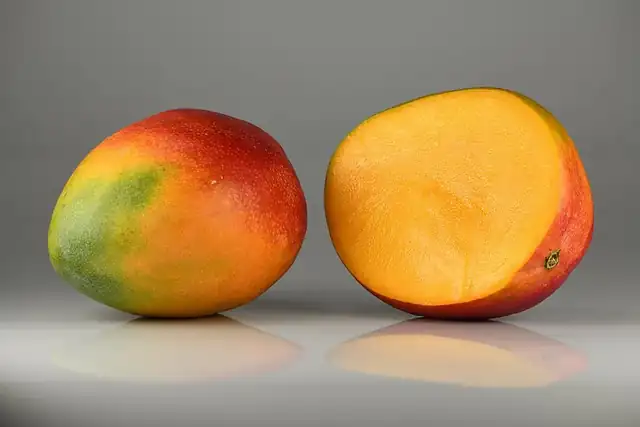
There are several hundred cultivars of mango worldwide. Depending on the cultivar, mango fruits vary in size, shape, sweetness, skin colour, and flesh colour, which may be pale yellow, gold, green, or orange. Mango is the national fruit of India, Pakistan, and the Philippines, while the mango tree is the national tree of Bangladesh.
Description
Mango trees grow to 30 – 40 m tall, with a crown radius of 10-15 m. The trees are long-lived, as some specimens still fruit after 300 years.
In deep soil, the taproot descends to a depth of 6 m, with profuse, wide-spreading feeder roots and anchor roots penetrating deeply into the soil. The leaves are evergreen, alternate, simple, 15 – 35 cm long, and 6 – 16 cm broad; when the leaves are young they are orange-pink, rapidly changing to a dark, glossy red, then dark green as they mature.
The flowers are produced in terminal panicles 10 – 40 cm long; each flower is small and white with five petals 5 – 10 mm long, with a mild, sweet fragrance.
Fruit
The fruit has a single flat, oblong stone that can be fibrous or hairy on the surface and does not separate easily from the pulp. The fruit may be somewhat round, oval, or kidney-shaped, ranging from 2 – 10 in in length and from 5 oz to 5 lbs in weight per individual fruit. The skin is leather-like, waxy, smooth, and fragrant, with colours ranging from green to yellow, yellow-orange, yellow-red, or blushed with various shades of red, purple, pink, or yellow when fully ripe.
The ripe fruits vary according to cultivar in size, shape, colour, sweetness, and eating quality. Depending on the cultivar, the fruit is variously yellow, orange, red, or green. Over 500 cultivars of mango are known, many of which ripen in summer, while some give a double crop. The fruit takes four to five months from flowering to ripening.
Ripe intact mangoes give off a distinctive resinous, sweet smell. Inside the stone with its 1 – 2 mm thick woody endocarp is a single seed, 4 – 7 cm long. Mangoes have recalcitrant seeds which do not survive freezing and drying. Mango trees grow readily from seeds, with germination success highest when seeds are obtained from mature fruit.
Cultivars
There are hundreds of named mango cultivars. Mango orchards often grow several cultivars together to improve pollination. Many desired cultivars are monoembryonic and must be propagated by grafting to ensure they breed true. A common monoembryonic cultivar is 'Alphonso', an important export product, considered "the king of mangoes".
Cultivars that excel in one climate may fail elsewhere. For example, Indian cultivars such as 'Julie', a prolific cultivar in Jamaica, require annual fungicide treatments to escape the lethal fungal disease anthracnose in Florida. Asian mangoes are resistant to anthracnose.
The current western market is dominated by the cultivar 'Tommy Atkins', a seedling of 'Haden' that first fruited in 1940 in southern Florida and was initially rejected commercially by Florida researchers. Growers and importers worldwide have embraced the cultivar for its excellent productivity and disease resistance, shelf life, transportability, size, and appealing colour. Although the Tommy Atkins cultivar is commercially successful, other cultivars may be preferred by consumers for eating pleasure, such as Alphonso.
Production
In 2023, world production of mangoes, mangosteens and guavas was 61 million tonnes, led by India with 43% of the total, and Indonesia and China as secondary producers.
Culinary uses
Mangoes are generally sweet, although the taste and texture of the flesh varies across cultivars; some, such as Alphonso, have a soft, pulpy, juicy texture similar to an overripe plum, while others, such as Tommy Atkins, are firmer with a fibrous texture.
Mangoes are used in many cuisines. Sour, unripe mangoes are used in side dishes in Indian cuisine such as mango chutney and pickles such as avakaya.
A summer drink called aam panna is made with mangoes. Mango lassi is consumed throughout South Asia, prepared by mixing ripe mangoes or mango pulp with buttermilk and sugar.
In Indonesian cuisine, unripe mango is processed into asinan, rujak and sambal pencit/mangga muda, or eaten with edible salt.
Raw green mangoes can be sliced and eaten like a salad. In most parts of Southeast Asia, they are commonly eaten with fish sauce, vinegar, soy sauce, or with a dash of salt (plain or spicy)a combination usually known as "mango salad" in English. In the Philippines, green mangoes are eaten with savory condiments such as bagoong (salty fish or shrimp paste), soy sauce, vinegar, or chilis. Mango float and mango cake, which use slices of ripe mangoes, are eaten in the Philippines.
Flavour
The flavour of mango fruit is conferred by several volatile organic chemicals, mainly terpenes, furanones, lactones, and esters. Different varieties or cultivars of mangoes can have flavours composed of different volatile chemicals, or the same volatile chemicals in different quantities. In general, New World mango cultivars are characterized by the dominance of δ-3-carene, a monoterpene flavorant; whereas, high concentration of other monoterpenes such as (Z)-ocimene and myrcene, as well as the presence of lactones and furanones, is the unique feature of Old World cultivars. In India, 'Alphonso' is one of the most popular cultivars. In 'Alphonso' mango, the lactones and furanones are synthesized during ripening, whereas terpenes and the other flavorants are present in both the developing (immature) and ripening fruit.
Ethylene, a ripening-related hormone well known to be involved in ripening of mango fruit, also causes changes in the flavour composition of mango fruit upon exogenous application. In contrast to the huge amount of information available on the chemical composition of mango flavour, the biosynthesis of these chemicals has not been studied in depth; only a handful of genes encoding the enzymes of flavour biosynthetic pathways have been characterized to date.
More to savor

Chicken Vindaloo
Pancakes (Vegan)
Lychee in the Kitchen: Exploring an Everyday Ingredient