This longer reference provides the background behind the topic. Read it alongside the recipe collection when you want to connect an ingredient or food idea with a dish to prepare.
Overview
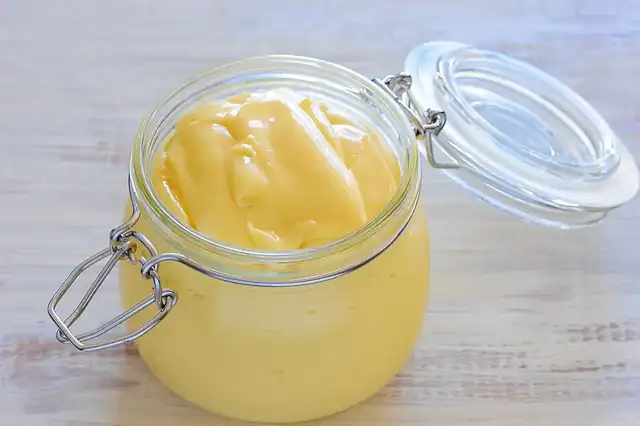
Mayonnaise, colloquially referred to as "mayo", is a thick, creamy sauce with a rich and tangy taste that is commonly used on sandwiches, hamburgers, bound salads, and French fries. It also forms the base for other sauces, including tartar sauce, fry sauce, remoulade, salsa golf, ranch dressing, and rouille.
Mayonnaise is an emulsion of oil, egg yolk, and an acid, either vinegar or lemon juice; there are many variants using additional flavorings. The color varies from near-white to pale yellow, and its texture from a light cream to a thick gel.
Commercial eggless versions are available for those who avoid eggs.
History
Mayonnaise is a French cuisine appellation that seems to have appeared for the first time in 1806. The hypotheses invoked over time as to the origin(s) of mayonnaise have been numerous and contradictory. Most hypotheses do however agree on the geographic origin of the sauce: Mahón in Menorca, Spain during the occupation by French troops in the Seven Years' War. Other theories have been dismissed by some authors as being somewhat a retrospective invention aiming to credit the sauce as an invention of southwestern France, when, most likely, its origin can be found in the port city of Menorca.
Mayonnaise sauce may have its origins in the ancient remoulade. Another hypothesis is that mayonnaise is derived from aioli. Finally, the process of emulsifying egg yolk was known for a long time to pharmacists, who used it to prepare ointments and salves. Some have pointed out that it would make sense that mayonnaise originated in Spain given its requirement of olive oil, a liquid produced and consumed mostly there at the time. This hypothesis is similar to another that places the origins of French fries in Spain using the same rationale.
In 1750, Francesc Roger Gomila, a Valencian friar, published a recipe for a sauce similar to mayonnaise in Art de la Cuina ('Art of the Kitchen'). He calls the sauce aioli bo. If he does not describe precisely the recipe—suggesting that it was known by everyone on the island—the way it is used, the preparations for which it is used as a base and the dishes with which it is associated are most often inconceivable with an aioli. Earlier recipes of similar emulsified sauces, usually containing garlic, appear in a number of Spanish recipe books dating back to the 14th-century Llibre de Sent Soví, where it is called all-i-oli, literally 'garlic and oil' in Catalan.
Preparation
Recipes for mayonnaise date to the early nineteenth century. In 1815, Louis Eustache Ude wrote:
No 58.—Mayonnaise. Take three spoonfuls of Allemande, six ditto of aspic, and two of oil. Add a little tarragon vinegar, that has not boiled, some pepper and salt, and minced ravigotte, or merely some parsley. Then put in the members of fowl, or fillets of soles, &c. Your mayonnaise must be put to ice; neither are you to put the members into your sauce till it begins to freeze. Next dish your meat or fish, mask with the sauce before it be quite frozen, and garnish your dish with whatever you think proper, as beet root, jelly, nasturtiums, &c.
In an 1820 work, Viard describes something like the more familiar emulsified version:
This sauce is made to "take" in many ways: with raw egg yolks, with gelatine, with veal or veal brain glaze. The most common method is to take a raw egg yolk in a small terrine, with a little salt and lemon juice: take a wooden spoon, turn it while letting a trickle of oil fall and stirring constantly; as your sauce thickens, add a little vinegar; put in too a pound of good oil: serve your sauce with good salt: serve it white or green, adding green of ravigote or green of spinach.
Imitations
Miracle Whip was developed as a less expensive imitation of mayonnaise. Lacking sufficient oil, it does not meet the legal definition of mayonnaise, and so is marketed as salad dressing.
Egg-free versions
Egg-free versions of mayonnaise are available for vegans and others who avoid eggs or cholesterol, or who have egg allergies. In the U.S., these versions cannot be labelled as "mayonnaise" because the FDA definition of mayonnaise requires egg. Egg-free versions generally contain soya or pea protein as the emulsifying agent to stabilize oil droplets in water. Well-known brands include Nasoya's Nayonaise, Vegenaise and Just Mayo in North America, and Plamil Egg Free in the United Kingdom.
Uses
Mayonnaise is used commonly around the world, and is also a base for many other chilled sauces and salad dressings. For example, sauce rémoulade, in classic French cuisine, is a mix of mayonnaise and mustard, gherkins, capers, parsley, chervil, tarragon, and possibly anchovy essence.
Chile is the world's third major per capita consumer of mayonnaise and first in Latin America. Commercial mayonnaise became widely accessible in the 1980s.
Guidelines issued in September 1991 by Europe's Federation of the Condiment Sauce Industries recommend that mayonnaise should contain at least 70% oil and 5% liquid egg yolk. The Netherlands incorporated this guideline in 1998 into the law Warenwetbesluit Gereserveerde aanduidingen in article 4. Most available brands easily exceed these targets. In countries influenced by French culture, mustard is also a common ingredient that acts as an additional emulsifier.
Foodborne illness risk
Mayonnaise, both commercially processed and home-made, has been associated with illnesses from Salmonella globally. The source of the Salmonella has been confirmed to be raw eggs. Several outbreaks with fatal cases have been recorded, with a few major incidents. In a 1955 outbreak in Denmark, 10,000 people were affected by Salmonella from contaminated mayonnaise made by a large kitchen. The pH of the mayonnaise was found to be 5.1, with Salmonella counts of 180,000 CFU/g. The second outbreak, also in Denmark, caused 41 infections with two fatalities. The pH of the contaminated mayonnaise was 6.0, with Salmonella counts of 6 million CFU/g. In 1976 there were serious salmonellosis outbreaks on four flights to and from Spain which caused 500 cases and six fatalities.
In 1984 in the US, 404 people became ill and nine died in a New York City hospital due to hospital-prepared mayonnaise. In all salmonellosis cases, the major reason was inadequate acidification of the mayonnaise, with a pH higher than the recommended upper limit of 4.1, with acetic acid as the main acidifying agent. Some brands use pasteurized eggs which would reduce this risk factor.
More to savor

Chicken Vindaloo

Koko da Kosai (Fermented Corn Porridge and Bean Fritters)

A Closer Look at Wasabi: From Ingredient to Meal