This longer reference provides the background behind the topic. Read it alongside the recipe collection when you want to connect an ingredient or food idea with a dish to prepare.
In this story
OverviewDescriptionFloweringAs condimentAs flavoringOthersSurrogatesTraditional growing methodsOverview
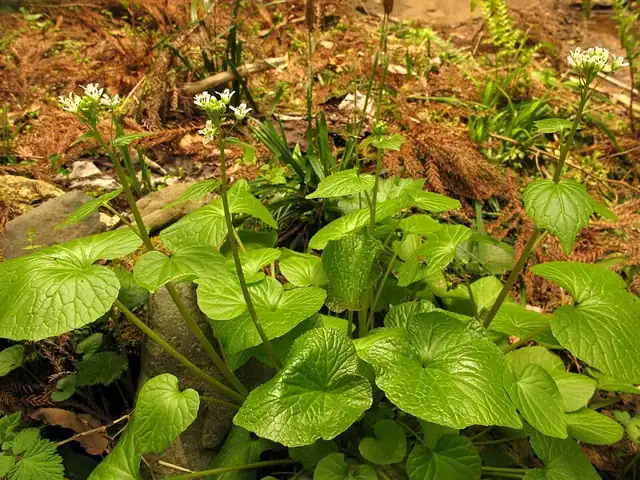
Wasabi (Japanese: ワサビ, わさび, or 山葵) or Japanese horseradish (Eutrema japonicum syn. Wasabia japonica) is a plant of the family Brassicaceae, which also includes horseradish and mustard in other genera. The plant is native to Japan, the Russian Far East including Sakhalin, and the Korean Peninsula. It grows naturally along stream beds in mountain river valleys in Japan.
Wasabi is grown for its rhizomes, which are ground into a paste as a pungent condiment for sushi and other foods. It is similar in taste to hot mustard or horseradish rather than chilli peppers, in that it stimulates the nose more than the tongue, but freshly grated wasabi has a subtly distinct flavour. The main cultivars in the marketplace are E. japonicum 'Daruma' and 'Mazuma', but there are many others.
The oldest record of wasabi as a food dates to the 8th century. The popularity of wasabi in English-speaking countries has coincided with that of sushi, growing steadily from about 1980. Due to constraints that limit the Japanese wasabi plant's mass cultivation and thus increase its price and decrease availability outside Japan, the western horseradish plant is widely used in place of wasabi. This is commonly referred to as "western wasabi" (西洋わさび) in Japan.
Description
It has large leaves produced from long, thin stalks. They are simple and large, 3-6 in long and 3-6 in wide with palmate veins.
Flowering
Wasabi flowers appear in clusters from long stems that bloom from late winter to early spring.
In Japan, Wasabi begins to flower in January, as cold temperatures cause vernalization (induction of flowering). Flowering peaks in April and ends in May. Seed pods mature 50–60 days after flowering. Wasabi seeds have high dormancy and often fail to germinate. In nature the cold winter temperatures break their dormancy, with sprouting beginning in February.
As condiment
Wasabi is mainly used to make wasabi paste, which is a pungent, spicy condiment eaten with foods like sushi. The part used for wasabi paste is commonly called the "root". It has been more accurately characterized as the rhizome or the stem, or the "rhizome plus the base part of the stem". Stores generally sell only this part of the plant.
The fresh rhizome is grated into a paste, and eaten in small amounts at a time. Traditionally, coarse sharkskin is used to grate the root, but metal graters called oroshigane are used in modern times. Fresh wasabi paste loses its flavor quickly if left uncovered, and so the paste is grated on the spot in some high-end restaurants. Sushi chefs usually put the wasabi between the fish and the rice, to cover the wasabi and preserve its flavour. Store-bought wasabi paste is usually made from dried wasabi powder, and sold in bottles or squeezable toothpaste-like tubes.
As flavoring
Wasabi is used to flavor many foods, especially dry snacks. are legumes (peanuts, soybeans, or peas) that are roasted or fried and then coated with wasabi powder, and eaten as a snack.
Others
Fresh wasabi leaves can be eaten raw, having a spicy flavor, but a common side effect is diarrhea. Wasabizuke is made of wasabi leaves pickled in sake lees, and is considered a specialty of Shizuoka Prefecture.
Surrogates
Wasabi favors growing conditions that restrict its wide cultivation – among other things, it is quite intolerant of direct sunlight, requires an air temperature between 8 and 20 C, and prefers high humidity in summer. This makes fully satisfying commercial demand impossible for growers, which makes wasabi quite expensive. Therefore, outside Japan, finding real wasabi plants is rare.
A common substitute is a mixture of horseradish, mustard, starch, and green food coloring or spinach powder. Often packages are labelled as wasabi while the ingredients do not include any part of the wasabi plant. The primary difference is colour, with wasabi being naturally green. Fresh horseradish root is described as having a similar (albeit simpler) flavor and texture to that of fresh wasabi. It feels "sharper and earthier" compared to wasabi, with a more noticeable pungent aftertaste.
In Japan, horseradish is referred to as . Outside of Japan, where fresh wasabi is hard to obtain, a powdered mixture of horseradish and mustard oil, known as kona wasabi, is used at a majority of sushi restaurants, including reputable ones. In the United States, true wasabi is generally found only at specialty grocers and high-end restaurants.
Traditional growing methods
Traditional wasabi growing methods generally make use of a stream of flowing water without recycling and a permeable medium (instead of soil). The oldest cultivation method, called the Jizawa style (地沢式 "ground pond style") involves the spreading of pebbles and sand on wasabi fields on steep terrain with an inclination of 3-4%.
This is followed by the terraced Tatamiishi style (畳石式 "rock-stacking style") of 1892. Spring water flows from the upper fields to the lower levels. The Tatamiishi consists of a bottom layer composed of large rocks and is covered by a layer of pebbles, and finally a surface soil layer of sand. It provides for stable production of wasabi year-round and often produce larger wasabi stems. Nowadays, the "Tatamiishi“ style is the ideal cultivation method in the Izu and Shizuoka regions. A variant is the Hokusun style (北寸式) of 1897, an improvement of Tatamiishi making use of drain pipes.
Keiryu style (渓流式 "stream style") of the middle 18th century sees fields built alongside a sloping stream. Rocks and small stones are laid to provide a medium. It is known for efficiently making use of water in low-rainfall conditions. Finally, there is Hirachi style (平地式 "flatland style"), where a pit is dug near a river, covered with sand ridges, on which wasabi is grown.
More to savor

Chicken Vindaloo
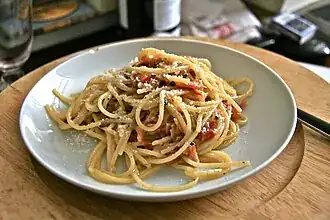
Spaghetti alla Carbonara
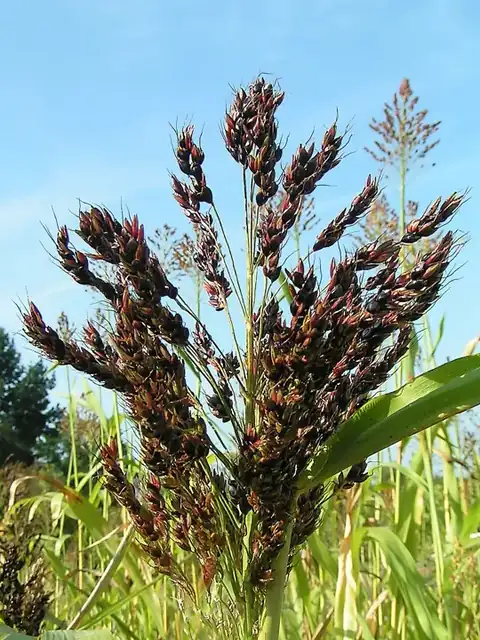
A Closer Look at Sorghum: From Ingredient to Meal