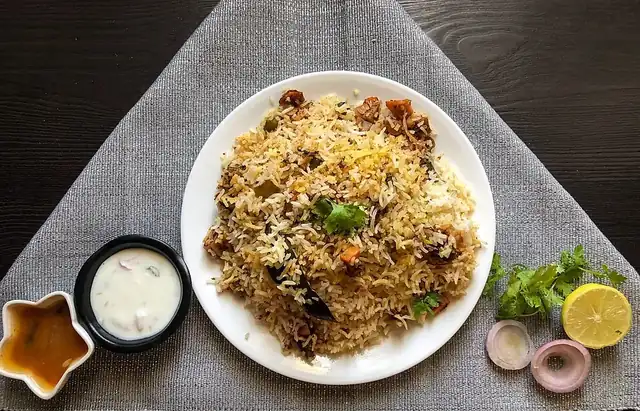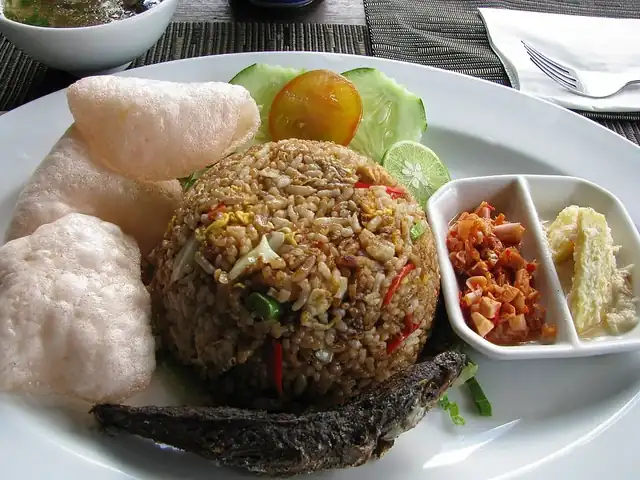
The dish is a starting point for exploring a wider food story. The guide below looks more closely at its background and different forms. When you want to cook, visit the recipe collection for ingredient quantities and step-by-step methods.
In this story
OverviewIntroduction to Southeast Asia through Chinese migration and culinary influenceLocal adaptationColonial-era influenceCulinary profileSpice and seasoningsCondimentsOverview
Nasi goreng (English ), (Indonesian and Malay for 'fried rice') is a Southeast Asian rice dish typically prepared with pre-cooked rice stir-fried in a small amount of oil or margarine and seasoned with ingredients such as sweet soy sauce, shallots, garlic, ground shrimp paste, tamarind and chilli. It is commonly served with additional ingredients, including egg, chicken, prawns and vegetables.
The dish is widely consumed across Maritime Southeast Asia, particularly in Indonesia, Malaysia, Singapore, Brunei, and southern Thailand, where it forms part of daily meals, street-food culture and festive cuisine. Nasi goreng is distinguished from other Asian fried rice recipes by its aromatic, smoky flavour, often derived from caramelised sweet soy sauce and powdered shrimp paste, and is generally spicier than Chinese-style fried rice. Over time, many regional variations of nasi goreng have emerged, reflecting local ingredients, culinary influences and distinctive cooking techniques.
Introduction to Southeast Asia through Chinese migration and culinary influence
The expansion of Chinese maritime trade from the Tang dynasty (7th–10th centuries) established enduring connections between China and Southeast Asia. Chinese merchants, sailors and envoys regularly visited major ports and trading centres across Java, Sumatra, the Malay Peninsula, Borneo, Indochina and the Philippines. These ports became hubs of cultural exchange, where culinary practices merged with local religion, language and material culture.
It is unclear when the people of present-day Indonesia began to adopt the practice of cooking fried rice. The trade between China and the Indonesian archipelago flourished from the era of Srivijaya around the 10th century and intensified in the Majapahit era around the 15th century. By that time Chinese immigrants had begun to settle in the archipelago, bringing along with them their culture and cuisine. Chinese people usually favor freshly cooked hot food, and it is taboo to throw away uneaten foodstuffs in their culture. As a result, the previous day's leftover rice was often recooked in the morning. Gregory Rodgers suggested that frying the rice could prevent the propagation of dangerous microbes, especially in pre-refrigeration technology in Indonesia, and also avoid the need to throw out precious food.
Local adaptation
Nasi goreng is mentioned in early 19th century Javanese literature Serat Centhini as sekul goreng. However, according to Harry Nazarudin, a culinary expert, the fried rice written in this Javanese book is different from the fried rice we know today. This fried rice is made without using soy sauce and is not eaten as a single dish like fried rice in general, but is a variant of rice that is eaten with side dishes. On the island of Java there are two types of fried rice; the Sundanese gagrak fried rice is savory, and the Javanese one tends to be sweet. Sekul goreng mentioned in Serat Centhini is the closest to the Sundanese version.
Writer Fadly Rahman from Padjajaran University claimed that there is no historical evidence that proves that nasi goreng is native to Indonesia, and suggested another theory besides Chinese influence: that nasi goreng was actually inspired by a Middle Eastern dish called pilaf, which is rice cooked in seasoned broth. A particular variant, Betawi-style nasi goreng kambing (goat fried rice), uses mutton or goat meat (traditionally favoured by Arab Indonesians), rich spices and minyak samin (ghee), all typical ingredients used in the preparation of Middle-eastern pilaf.
Colonial-era influence
Nasi goreng was considered as part of the Indies culture during the colonial period. The mention of nasi goreng appears in colonial literature of Dutch East Indies, such as in the Student Hidjo by Marco Kartodikoromo, a serial story published in Sinar Hindia newspaper in 1918. It was mentioned in a 1925 Dutch cookbook Groot Nieuw Volledig Oost Indisch Kookboek. Trade between the Netherlands and the Dutch East Indies during that time has increased the popularity of Indonesian-style nasi goreng to the world.
The colonial period introduced new dynamics to the development of fried rice in Southeast Asia. European powers such as the Portuguese, Dutch and British dominated spice and commodity trade in the region, indirectly influencing local cuisines. Fried rice itself, however, remained primarily a Chinese culinary tradition. The wider circulation of seasonings such as soy sauce, chilli, pepper and nutmeg helped shape regional adaptations, particularly nasi goreng.
Culinary profile
Nasi goreng is distinguished from other Asian fried rice recipes by its aromatic, earthy and smoky flavour. Nasi goreng is traditionally served at home for breakfast and it is traditionally made out of leftover rice from the night before. The texture of leftover cooked rice is considered more suitable for nasi goreng than that of freshly cooked rice which may be too moist and soft to withstand frying in a wok.
Other than cooked rice, nasi goreng consists of at least three components; ingredients (e.g. egg, shrimp, meat, cooking oil), bumbu spice or seasoning (e.g. garlic, shallot, salt, chili pepper) and condiments (e.g. bawang goreng, krupuk, acar pickles, slices of fresh cucumber and tomato). The combination of spices and ingredients in different ratios allows for the creation of a myriad of flavours.
Spice and seasonings
Typical seasonings for nasi goreng include but are not limited to salt, chilli pepper, spring onions, turmeric, palm sugar, bumbu paste made from ground garlic and onion or shallot, kecap manis (sweet soy sauce), shrimp paste, black pepper, fish sauce, powdered broth and so on. Eggs may be scrambled into the rice during the cooking process, or served as accompaniments in the form of sunny side up eggs, omelettes and boiled eggs. Scraps of leftovers from a prepared dish, perhaps chicken or beef pieces, may also be used.
Condiments
Nasi goreng often adds condiments or garnishes as add-ons. Fried shallot and traditional crackers are often sprinkled upon to give crispy texture, slices of cucumber and tomato for garnishing and to give freshness in an otherwise oily dish, a fried egg is often placed on top of the dish to add savouriness, while chili paste is to add the zesty spiciness according to one's preference. Some common condiments are:
Bawang goreng: Deep-fried shallots, sprinkled upon nasi goreng
Kerupuk: various types of crackers, usually emping or prawn crackers
Acar: pickles made from vinegar preserved cucumber, shallots, carrot and small chilli peppers.
Telur: egg; can be cooked in many ways and placed on the nasi goreng, usually sunny-side up fried or omelette.
Sambal: chilli sauce.
More to savor
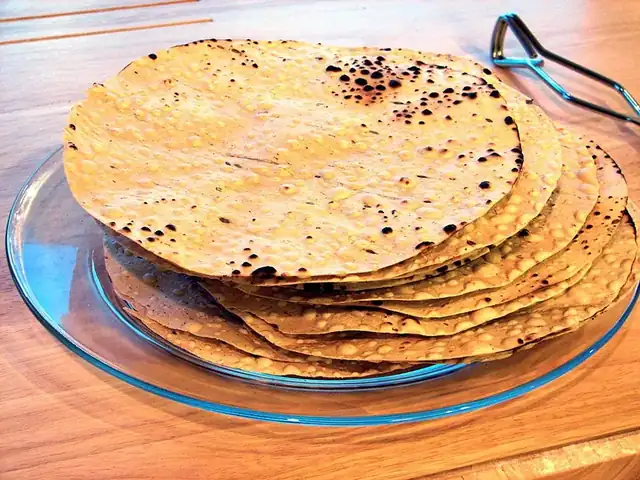
Papadam (Black Gram Flatbread)

English Breakfast
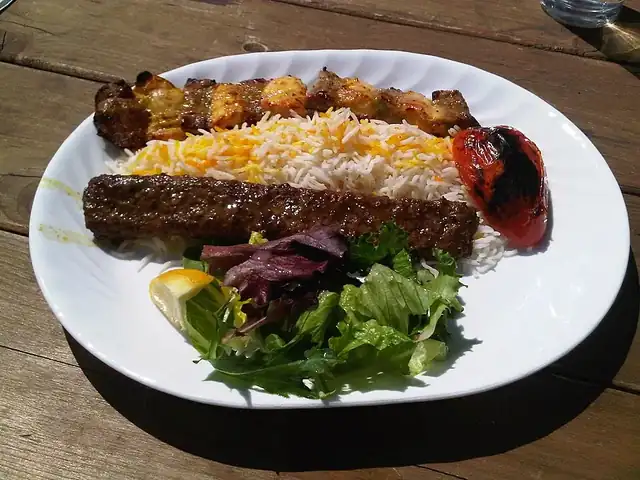
A Taste of Iran: Exploring a Varied Culinary Tradition