The dish is a starting point for exploring a wider food story. The guide below looks more closely at its background and different forms. When you want to cook, visit the recipe collection for ingredient quantities and step-by-step methods.
Overview
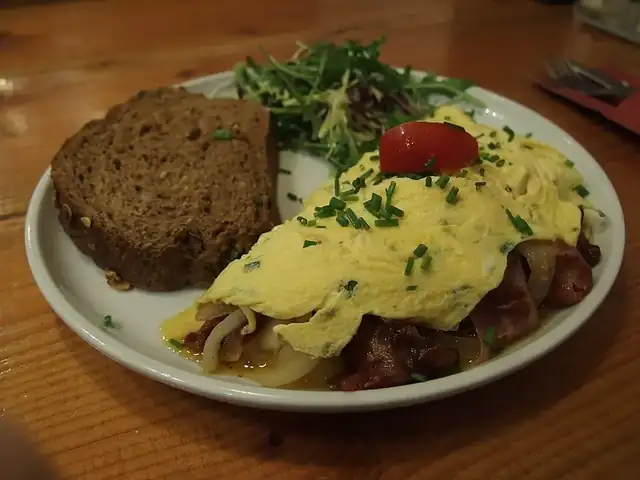
An omelette (omelet in American English; see spelling differences) is a dish made from eggs (usually chicken eggs), fried with butter or oil in a frying pan. It is a common practice for an omelette to include fillings such as chives, vegetables, mushrooms, meat (often ham or bacon), cheese, onions or some combination of the above. Whole eggs or egg whites are often beaten with a small amount of milk, cream, or water.
China
Egg foo young, a Cantonese omelette made with beaten eggs and usually ham.
An oyster omelette, a dish of Hokkien and Teochew origin made with oysters, starch and egg batter.
France
Depending on sources, a standard omelette is cooked in butter on medium (or sometimes high) heat, is supposed to be golden brown or "unbrowned or very lightly browned" on the outside and soft in the inside (though variations are possible according to preference); according to some American cookbooks reflecting high-end restaurant practices, a "French Omelette" should be unbrowned, cooked slowly over medium-low to medium heat, with initial stirring to prevent curds and sticking. Seasoned with just salt and pepper, this omelette is often flavored with finely chopped herbs (often fines herbes or tarragon, chervil, parsley and chives) or chopped onions.
The omelette de la mère Poulard, a Norman specialty first developed in Mont-Saint-Michel, has been called the most famous omelette in the world. It is served without fillings but often served with heavy garnishes.
The Provençal omelette is more similar to a frittata than to a traditional rolled or folded French omelette. The eggs are cooked like a traditional French omelette until the time any fillings are added; instead of adding fillings in a strip or on half the omelette, they are scattered over the entire surface of the omelette, and then the entire omelette is flipped and slipped back into the pan to cook what had been the top and is now the bottom. A tourne omelette or vire omelette, a concave platter similar to a cake plate, is often used as an aid and can be used to serve the finished omelette. According to Bernard Duplessy the tourne omelette dates to "several centuries before Christ".
Crespéou, another Provençal dish (also called gâteau d'omelettes or omelettes en sandwich), is made by stacking open-faced omelettes.
India
In Parsi cuisine, pora is an omelette made from eggs, onion, tomato, green chillies, and coriander leaves. It is usually served for breakfast with Indian/Irani tea and bread.
In India, eggs are beaten with onions and poured directly on a hot pan with salt and pepper. These omelettes are consumed frequently in many Indian households.
Bread Omelette is a snack made with bread and egg that is widespread across India.
In South Indian hotels, omelettes may be mixed with mutton gravy (salna) in a semi-cooked manner, and many omelette variants like kalakki, plain omelettes, Karandi omelettes, and Podi omelettes are found in Tamil Nadu.
Indonesia
In Betawi cuisine, kerak telor is a traditional spicy omelette that made from glutinous rice cooked with egg and served with serundeng (fried shredded coconut), fried shallots and dried shrimp as topping.
Fuyunghai or puyonghai is a Chinese Indonesian omelette, usually made from the mixture of vegetables such as carrots, bean sprouts, and cabbages, mixed with meats such as crab, shrimp, or minced chicken.
Iran
Iranian omelette is an omelette differing from its European counterpart in that it contains tomatoes, tomato paste and frequently other ingredients such as fried onions.
Kuku is an omelette frequently containing large proportions of other ingredients, including herbs, folded in.
Nargesi or spinach omelette is an Iranian dish, made with fried onions and spinach, and is spiced with salt, garlic, and pepper.
Italy
A frittata is an open-faced Italian omelette-like dish that can contain cheese, vegetables, or even leftover pasta. Frittatas are cooked slowly. Except for the cooking oil, all ingredients are fully mixed with the eggs before cooking starts.
Japan
In Japan, tamagoyaki is a traditional omelette in which eggs are beaten with mirin, soy sauce, bonito flakes, sugar and water, and cooked in a special rectangular frying pan.
Omurice (from the French word "omelette" and English word "rice") is an omelette filled with fried rice and usually served with a large amount of tomato ketchup. Omu-soba is an omelette with yakisoba as its filling. There are several styles of this dish, including omelette cooked and filled with fried rice, a soft-cooked omelette served over the fried rice that is then sliced open, and a "tornado" style omelette over the rice.
Tenshindon is a Japanese-Chinese specialty, consisting of a crab meat omelette on rice.
Korea
In Korean cuisine, traditional omelettes are known as gyeran-mari (계란말이, "rolled-eggs") which is a type of savory banchan. Gyeran-mari is made with beaten eggs, mixed with finely diced vegetables, meats, and seafood. This side dish is often found in Korean banquet (janchi) meals, as well as Korean fast food (bunsik) restaurants.
More to savor
Reindling (Austrian Yeasted Easter Cake)

Basic Omelet
Fried Eggs: The Small Panful That Changes a Meal