The dish is a starting point for exploring a wider food story. The guide below looks more closely at its background and different forms. When you want to cook, visit the recipe collection for ingredient quantities and step-by-step methods.
In this story
OverviewVersions and variationsArroz con cosasBasic cooking methodsCompetitions and recordsPaella emoji controversy: depiction of seafood in paellaRelated dishesOverview
Paella (;or ) is a rice dish originally from the Valencian Community. Paella is regarded as one of the community's identifying symbols. It is one of the best-known dishes in Spanish cuisine.
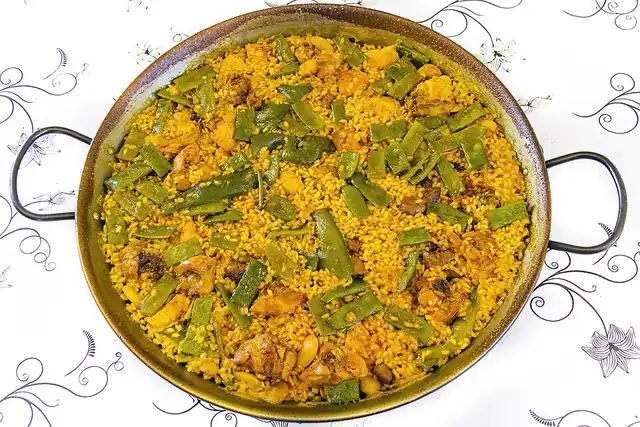
There are three versions of paella: paella valenciana, which includes rabbit, chicken, duck, and snails; paella mixta, which includes livestock; and paella de marisco, which includes seafood. Valencians claim that only the recipe for paella valenciana is the true paella.
The dish takes its name from the wide, shallow traditional pan used to cook the dish on an open fire, paella being the word for a frying pan in both Catalan and the Valencian language. The word traces its roots further back to Old French and the Latin word "patella".
As a dish, it may have ancient roots, but in its modern form, it is traced back to the mid-19th century, in the rural area around the Albufera de València lagoon adjacent to Valencia.
Other popular local variations of paella are cooked throughout the Mediterranean area, the rest of Spain, and internationally. In Spain, paella is traditionally included in restaurant menus on Thursdays.
Versions and variations
== Paella valenciana ==Paella valenciana is the traditional paella of the Valencia region, believed to be the original recipe, and consists of Valencian rice, olive oil, rabbit, chicken, duck, snails, saffron or a substitute, tomato, ferradura or flat green bean, lima beans, salt and water. The dish is sometimes seasoned with whole rosemary branches. Traditionally, the yellow color comes from saffron, but turmeric, paprika, Calendula or artificial colorants can be used as substitutes. Artichoke hearts and stems may be used as seasonal ingredients. Most paella cooks use bomba rice, but a cultivar known as senia is also used in the Valencia region.
Originally, paella made in Valencia was a lunchtime meal for farmers and farm laborers. Workers would gather what was available to them around the rice fields. This often included tomatoes, onions, and snails. Rabbit or duck was a common addition, or chicken less often.
On special occasions, 18th-century Valencians used calderos to cook the rice in the open air of their orchards near lake Albufera. Water vole meat was one of the main ingredients of early paellas, along with eel and butter beans.
Novelist Vicente Blasco Ibáñez described the Valencia custom of eating water voles in Cañas y barro (novela) (1902), a realistic novel about life among the fishermen and peasants near lake Albufera.
Living standards rose with the sociological changes of the late 19th century in Spain, giving rise to gatherings and outings in the countryside. This led to a change in paella's ingredients, as well, using instead rabbit, chicken, duck, and sometimes snails. The dish became so popular that in 1840, a local Spanish newspaper first used the word paella to refer to the recipe rather than the pan, according to food historian Lynne Olver.
Arroz con cosas
Some non-Spanish chefs include chorizo in their paellas and other ingredients, which Valencians assert do not belong in paella of any type. The alternative name proposed for these dishes, although pejorative, is arroz con cosas ('rice with things'). Famous cases are Jamie Oliver's paella recipe (which included chorizo) and Gordon Ramsay's. The author Josep Pla once noted: "The abuses committed in the name of Paella Valenciana are excessive – an absolute scandal."
However, in an article for El País, Spanish food writer Ana Vega 'Biscayenne', citing historical references, showed that traditional Valencian paella did indeed include chorizo, exclaiming, "Ah Jamie, we'll have to invite you to the Falles."
Basic cooking methods
According to tradition in Valencia, paella is cooked over an open fire, fueled by orange tree and pine branches and pine cones. This produces an aromatic smoke which infuses the paella. Also, dining guests traditionally eat directly out of the pan instead of serving in plates.
Some recipes call for paella to be covered and left to settle for five to ten minutes after cooking.
After cooking paella, a layer of scorched rice may be at the bottom of the pan, called socarrat in Valencià. The layer develops on its own if the paella is cooked over a burner or open fire. This is traditionally considered positive (as long as it is not burnt), and Valencia natives enjoy eating it.
Competitions and records
Paella has become a custom at mass gatherings in the Valencian Community (festivals, political campaigns, protests, etc.) to prepare enormous paellas, sometimes to win a place in the Guinness World Records book. Chefs use gargantuan paelleras for these events.
Valencia restaurateur Juan Galbis claims to have made the world's largest paella with help from a team of workers on 2 October 2001. This paella fed about 110,000 people, according to Galbis' former website. Galbis says this paella was even larger than his earlier world-record paella made on 8 March 1992, which fed about 100,000 people. Galbis' record-breaking 1992 paella is listed in Guinness World Records.
Paella emoji controversy: depiction of seafood in paella
In 2015, an emoji for paella was proposed to Unicode. The emoji was approved for Unicode 9.0 as in June 2016. Apple Inc.'s version of the emoji originally depicted paella de marisco, but was later changed to a more traditional appearance with chicken after online controversy.
Related dishes
Traditional Valencian cuisine offers recipes similar to paella valenciana and paella de marisco such as arròs negre, arròs al forn, arròs a banda and arròs amb fesols i naps since rice is the base of much of the local cuisine.
Fideuà is a Valencian pasta noodle dish variation cooked similarly in a paella. It may be served with allioli sauce.
Other related dishes:
Arroz del senyoret – A seafood paella typical of Alicante, with chunks of grouper or squid and peeled prawns, so it is easier to eat. The name senyoret translates as "young gentleman".
Arroz con costra (Crusted rice), so named because it is covered with an egg crust.
Arroz a la valenciana – Latin American and Filipino adaptation of the Valencian style of cooking rice, uses annatto instead of saffron
Arroz con gandules – Latin American (Caribbean) adaptation
Arroz con pollo – Latin American adaptation with chicken
Arroz de marisco – similar Portuguese dish
Bringhe – pre-colonial Filipino dish derived from biryani dishes but merged with paella during the colonial period. Uses glutinous rice, turmeric, and coconut milk.
Jambalaya – Louisiana dish influenced by paella and the French jambalaia from Provence
Locrio – Dominican descendant of paella.
More to savor
Paella de Marisco

Chicken Vindaloo
Chicken Tikka Masala: A Creamy Curry with a Wider Story