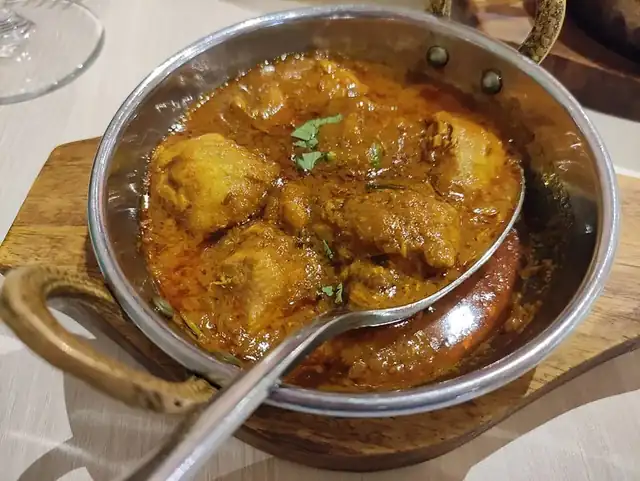
The dish is a starting point for exploring a wider food story. The guide below looks more closely at its background and different forms. When you want to cook, visit the recipe collection for ingredient quantities and step-by-step methods.
In this story
OverviewCategories of pastaTypes of pastaDevelopment of pasta in ItalyIndustrial productionIngredients and preparationCookingOverview
Pasta is a type of food typically made from an unleavened dough of wheat flour mixed with water or eggs, and formed into sheets or other shapes, then cooked by boiling or baking. Pasta was originally only made with durum, although the definition has been expanded to include alternatives for a gluten-free diet, such as rice flour, or legumes such as beans or lentils. Pasta is a staple food of Italian cuisine, and many historians believe that pasta in a form recognizable today was introduced to Italy through Sicily in the Middle Ages as a result of Mediterranean trade networks.
Categories of pasta
Pastas are divided into two broad categories: dried (pasta secca) and fresh (Italian: pasta fresca). Most dried pasta is produced commercially via an extrusion process, although it can be produced at home. Fresh pasta is traditionally produced by hand, sometimes with the aid of simple machines. Fresh pastas available in grocery stores are produced commercially by large-scale machines.
Both dried and fresh pastas come in a number of shapes and varieties, with 310 specific forms known by over 1,300 documented names. In Italy, the names of specific pasta shapes or types often vary by locale. For example, the pasta form cavatelli is known by 28 different names depending upon the town and region.
Both fresh and dried pastas are classically used in one of three kinds of prepared dishes: as pasta asciutta (or pastasciutta), cooked pasta is plated and served with a complementary sauce or condiment; a second classification of pasta dishes is pasta in brodo, in which the pasta is part of a soup-type dish. A third category is pasta al forno, in which the pasta is incorporated into a dish that is subsequently baked in the oven. Pasta dishes are generally simple, but individual dishes vary in preparation. Some pasta dishes are served as a small first course or for light lunches, such as pasta salads. Other dishes may be portioned larger and used for dinner. Pasta sauces similarly may vary in taste, color and texture.
Types of pasta
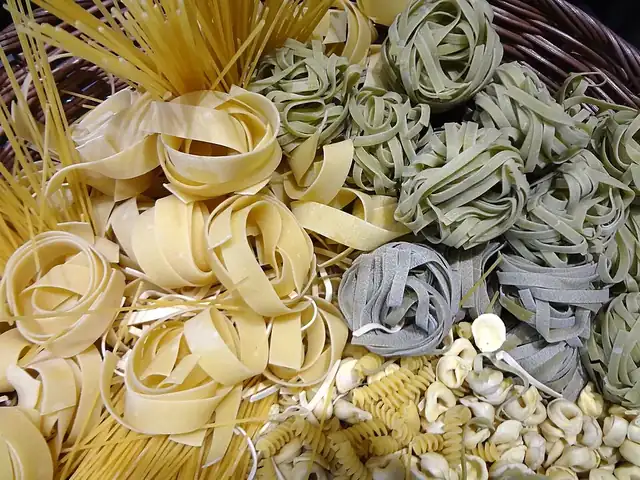
Common forms of pasta include long and short shapes, tubes, flat shapes or sheets, miniature shapes for soup, those meant to be filled or stuffed, and specialty or decorative shapes.
Long pasta is typically made with the rolling and cutting method or by extruding. They are generally complemented with thinner toppings to prevent chunks of meat or vegetables in a thick sauce from sticking to the pasta. Short pastas are made by extrusion and are usually paired with thicker sauces as their shape allows them to hold the sauce better. Stuffed pasta is pasta folded to hold ingredients like meat and vegetables.
Development of pasta in Italy
The first concrete information on pasta products in Italy dates to the 13th or 14th centuries. Food historians estimate that the dish probably took hold in Italy as a result of extensive Mediterranean trading in the Middle Ages. From the 13th century, references to pasta dishes crop up with increasing frequency across the Italian peninsula. In the 14th-century writer Boccaccio's collection of earthy tales, The Decameron, he recounts a mouthwatering fantasy concerning a mountain of Parmesan cheese down which pasta chefs roll macaroni and ravioli to gluttons waiting below.
The popular belief that Marco Polo introduced pasta to Italy from China to Italy is considered a myth by many historians. Rustichello da Pisa writes in his Travels that Marco Polo described a food similar to lagana. The exact route where pasta had first reached Europe is uncertain, however there are many theories of its transmission. Jeffrey Steingarten asserts that Moors introduced pasta in the Emirate of Sicily in the 9th century, mentioning also that traces of pasta have been found in ancient Greece and that Jane Grigson believed the Marco Polo story to have originated in the 1920s or 1930s in an advertisement for a Canadian spaghetti company.
In the 14th and 15th centuries, dried pasta became popular for its easy storage. This allowed people to store pasta on ships when exploring the New World. A century later, pasta was present around the globe during the voyages of discovery.
Industrial production
At the beginning of the 17th century, Naples had rudimentary machines for producing pasta, later establishing the kneading machine and press, making pasta manufacturing cost-effective.
In 1740, a license for the first pasta factory was issued in Venice. During the 1800s, watermills and stone grinders were used to separate semolina from the bran, initiating expansion of the pasta market.
In 1859, Joseph Topits (1824−1876) founded Hungary's first pasta factory, in the city of Pest, which worked with steam machines; it was one of the first pasta factories in Central Europe. By 1867, Buitoni Company in Sansepolcro, Tuscany, was an established pasta manufacturer.
Ingredients and preparation
Since at least the time of Cato's De Agri Cultura, basic pasta dough has been made mostly of wheat flour or semolina, with durum wheat used predominantly in the south and soft wheat in the north of Italy. Regionally other grains have been used, including those from barley, buckwheat, rye, rice and maize, as well as chestnut and chickpea flours. Liquid, often in the form of eggs, is used to turn the flour into a dough.
To address the needs of people affected by gluten-related disorders (such as coeliac disease, non-celiac gluten sensitivity and wheat allergy sufferers), some recipes use rice or maize for making pasta. Grain flours may also be supplemented with cooked potatoes.
Other additions to the basic flour-liquid mixture may include vegetable purees such as spinach or tomato, mushrooms, cheeses, herbs, spices and other seasonings. While pastas are, most typically, made from unleavened doughs, at least nine different pasta forms are known to use yeast-raised doughs.
Cooking
Pasta, whether dry or fresh, is eaten after cooking it in hot water. For Italian pasta, which is unsalted, salt is added to the cooking water. This is not the case for Asian wheat noodles, such as udon and lo mein, both of which are made from salty dough.
In Italy, pasta is often cooked to be al dente, such that it is still firm to the bite. This is because it is then often cooked in the sauce for a short time, which makes it soften further.
More to savor
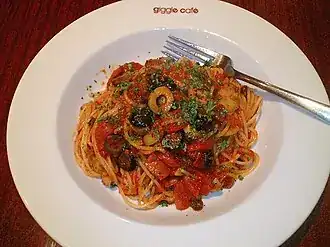
Spaghetti alla Puttanesca
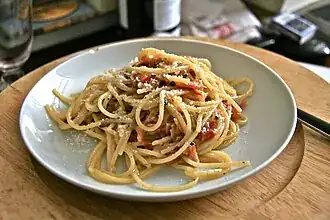
Spaghetti alla Carbonara
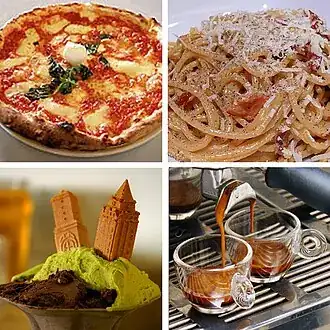
Beyond Pasta: A Taste of Italy's Regional Tables