This longer reference provides the background behind the topic. Read it alongside the recipe collection when you want to connect an ingredient or food idea with a dish to prepare.
In this story
OverviewMilkMedical equipmentPasteurization processEquipmentVerificationEfficacy against pathogenic bacteriaOverview
In food processing, pasteurization (-isation) is a process of food preservation in which packaged foods (e.g., milk and fruit juices) are treated with mild heat, usually to less than 100 C, to eliminate pathogens and extend shelf life. Pasteurization either destroys or deactivates microorganisms and enzymes that contribute to food spoilage or the risk of disease, including vegetative bacteria, but most bacterial spores survive the process.
Pasteurization is named after French microbiologist Louis Pasteur, whose research in the 1860s demonstrated that thermal processing would deactivate unwanted microorganisms in wine. Spoilage enzymes are also inactivated during pasteurization. Today, pasteurization is used widely in the dairy industry and other food processing industries for food preservation and food safety.
Milk
Milk is an excellent medium for microbial growth, and when it is stored at ambient temperature, bacteria and other pathogens soon proliferate. The US Centers for Disease Control and Prevention (CDC) says improperly handled raw milk is responsible for nearly three times more hospitalizations than any other food-borne disease source, making it one of the world's most dangerous food products. Diseases prevented by pasteurization include tuberculosis, brucellosis, diphtheria, scarlet fever, and Q-fever; it also kills the harmful bacteria Salmonella, Listeria, Yersinia, Campylobacter, Staphylococcus aureus, and Escherichia coli O157:H7, among others.
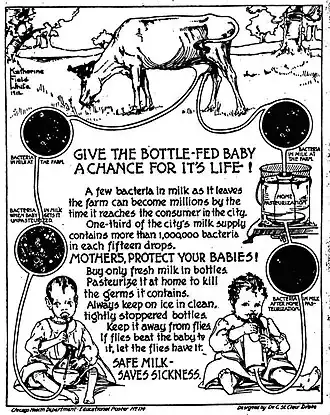
Before industrialization, dairy cows were kept in urban areas to limit the time between milk production and consumption, hence the risk of disease transmission via raw milk was reduced. As urban densities increased and supply chains lengthened to the distance from country to city, raw milk (often days old) became recognized as a source of disease. For example, between 1912 and 1937, some 65,000 people died of tuberculosis contracted from consuming milk in England and Wales alone. Because tuberculosis has a long incubation period in humans, it was difficult to link unpasteurized milk consumption with the disease. In 1892, chemist Ernst Lederle experimentally inoculated milk from tuberculosis-diseased cows into guinea pigs, which caused them to develop the disease. In 1910, Lederle, then in the role of Commissioner of Health, introduced mandatory pasteurization of milk in New York City.
Medical equipment
Medical equipment, notably respiratory and anesthesia equipment, is often disinfected using hot water, as an alternative to chemical disinfection. The temperature is raised to 70 C for 30 minutes. More thorough sterilization can be performed at higher temperatures and pressures in an autoclave.
Pasteurization process
Pasteurization is a mild heat treatment of liquid foods (both packaged and unpackaged) where products are typically heated to below 100 C. The heat treatment and cooling process are designed to inhibit a phase change in the product. The acidity of the food determines the parameters (time and temperature) of the heat treatment as well as the duration of shelf life. Parameters also take into account nutritional and sensory qualities that are sensitive to heat.
In acidic foods (with pH of 4.6 or less), such as fruit juice and beer, the heat treatments are designed to inactivate enzymes (pectin methylesterase and polygalacturonase in fruit juices) and destroy spoilage microbes (yeast and lactobacillus). Due to the low pH of acidic foods, pathogens cannot grow. The shelf-life is thereby extended by several weeks. In less acidic foods (with pH greater than 4.6), such as milk and liquid eggs, heat treatments are designed to destroy pathogens and spoilage organisms (yeast and molds). Not all spoilage organisms are destroyed under pasteurization parameters, so subsequent refrigeration is necessary.
Equipment
Food can be pasteurized before or after being packaged into containers. Pasteurization of food in containers generally uses steam or hot water. When food is packaged in glass, hot water is used to avoid cracking the glass from thermal shock. When plastic or metal packaging is used, the risk of thermal shock is low, so steam or hot water is used.
Most liquid foods are pasteurized by using a continuous process that passes the food through a heating zone, a hold tube to keep it at the pasteurization temperature for the desired time, and a cooling zone, after which the product is filled into the package. Plate heat exchangers are often used for low-viscosity products such as animal milk, nut milk, and juices. A plate heat exchanger is composed of many thin vertical stainless steel plates that separate the liquid from the heating or cooling medium.
Verification
Direct microbiological techniques are the ultimate measurement of pathogen contamination, but these are costly and time-consuming, which means that products have a reduced shelf-life by the time pasteurization is verified.
As a result of the unsuitability of microbiological techniques, milk pasteurization efficacy is typically monitored by checking for the presence of alkaline phosphatase, which is denatured by pasteurization. Destruction of alkaline phosphatase ensures the destruction of common milk pathogens. Therefore, the presence of alkaline phosphatase is an ideal indicator of pasteurization efficacy. For liquid eggs, the effectiveness of the heat treatment is measured by the residual activity of α-amylase.
Efficacy against pathogenic bacteria
During the early 20th century, there was no robust knowledge of what time and temperature combinations would inactivate pathogenic bacteria in milk, so several different pasteurization standards were in use. By 1943, both HTST pasteurization conditions of 72 C for 15 seconds, as well as batch pasteurization conditions of 63 C for 30 minutes, were confirmed by studies of the complete thermal death (as best as could be measured at that time) for a range of pathogenic bacteria in milk. Complete inactivation of Coxiella burnetii (which was thought at the time to cause Q fever by oral ingestion of infected milk) as well as of Mycobacterium tuberculosis (which causes tuberculosis) were later demonstrated.
For all practical purposes, these conditions were adequate for destroying almost all yeasts, molds, and common spoilage bacteria and also for ensuring adequate destruction of common pathogenic, heat-resistant organisms. However, the microbiological techniques used until the 1960s did not allow for the actual reduction of bacteria to be enumerated. Demonstration of the extent of inactivation of pathogenic bacteria by milk pasteurization came from a study of surviving bacteria in milk that was heat-treated after being deliberately spiked with high levels of the most heat-resistant strains of the most significant milk-borne pathogens.
The mean log10 reductions and temperatures of inactivation of the major milk-borne pathogens during a 15-second treatment are:
Staphylococcus aureus > 6.7 at 66.5 C
Yersinia enterocolitica > 6.8 at 62.5 C
Pathogenic Escherichia coli > 6.8 at 65 C
Cronobacter sakazakii > 6.7 at 67.5 C
Listeria monocytogenes > 6.9 at 65.5 C
Salmonella ser. Typhimurium > 6.9 at 61.5 C
More to savor

Boeuf Bourguignon

Anzac Biscuits I

Sauce: A Closer Look at Food and How We Eat