The dish is a starting point for exploring a wider food story. The guide below looks more closely at its background and different forms. When you want to cook, visit the recipe collection for ingredient quantities and step-by-step methods.
Overview
Pilaf ( or pilau ) is a rice dish, or in some regions, a wheat dish, whose recipe usually involves cooking in stock or broth, adding spices, and other ingredients such as vegetables and meat, and employing some technique for achieving cooked grains that do not adhere.
During the Abbasid Caliphate, such methods of cooking rice first spread across a vast territory from South Asia to Spain, and eventually to a wider world. The Spanish paella, and the South Asian pilau or pulao, and biryani, evolved from such dishes.
Pilaf and similar dishes are common to Middle Eastern, West Asian, Balkan, Caribbean, South Caucasian, Central Asian, East African, Eastern European, Latin American, Maritime Southeast Asia, and South Asian cuisines; in these areas, they are regarded as staple dishes.
Preparation
Some cooks prefer to use basmati rice because it is easier to prepare a pilaf where the grains stay "light, fluffy and separate" with this type of rice. However, other types of long-grain rice are also used. The rice is rinsed thoroughly before use to remove the surface starch. Pilaf can be cooked in water or stock. Common additions include fried onions and fragrant spices like cardamom, bay leaves and cinnamon.
Pilaf is usually made with meat or vegetables, but it can also be made plain which is called sade pilav in Turkish, chelo in Persian and ruzz mufalfal in Arabic. Persian pilaf uses saffron which gives Persian rice flavor and a yellow color. Pilaf is often made by adding the rice to hot fat and stirring briefly before adding the cooking liquid. The fat used varies from recipe to recipe. Cooking methods vary with respect to details such as pre-soaking the rice and steaming after boiling.
Local varieties
There are thousands of variations of pilaf made with rice or other grains like bulgur.Some include different combinations of meats, fruits or vegetables, while others are simple and served plain.
Central Asian, South Asian, Iranian and Caribbean cuisine are some with distinctive styles of making pilaf.
Afghanistan
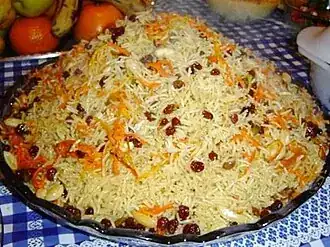
In Afghan cuisine, Kabuli palaw (کابلی پلو) is made by cooking basmati with mutton, lamb, beef or chicken, and oil. Kabuli palaw is cooked in large shallow and thick dishes. Fried sliced carrots and raisins are added. Chopped nuts like pistachios, walnuts, or almonds may be added as well. The meat is covered by the rice or buried in the middle of the dish. Kabuli palaw rice with carrots and raisins is very popular in Saudi Arabia, where it is known as roz Bukhari (رز بخاري), meaning 'Bukharan rice'.
Albania
In Albanian cuisine, pilaf is a very common dish. It is typically accompanied by yogurt and eaten with bean stew, meat soup or baked meats such as chicken and lamb. Medium-long grain rice is used, and it is cooked plainly with butter, resulting in a soft yet non-sticky texture.
There are various rice dishes in Albania, which are all commonly referred to as pilaf.
Albania ranks among the top three countries in Europe for rice consumption.
Armenia
Armenians use a lot of bulgur ("cracked wheat") in their pilaf dishes. Armenian recipes may combine vermicelli or orzo with rice cooked in stock seasoned with mint, parsley and allspice. One traditional Armenian pilaf is made with the same noodle rice mixture cooked in stock with raisins, almonds and allspice.
Armenian kinds of rice are discussed by Rose Baboian in her cookbook from 1964 which includes recipes for different pilafs, most rooted in her birthplace of Antep in Turkey. Baboian recommends that the noodles be stir-fried first in chicken fat before being added to the pilaf. Another Armenian cookbook written by Vağinag Pürad recommends to render poultry fat in the oven with red pepper until the fat mixture turns a red color before using the strained fat to prepare pilaf.
Lapa is an Armenian word with several meanings one of which is a "watery boiled rice, thick rice soup, mush" and lepe which refers to various rice dishes differing by region. Antranig Azhderian describes Armenian pilaf as a "dish resembling porridge".
Azerbaijan
Azerbaijani cuisine includes more than 40 different plov recipes. Traditional Azerbaijani plov consists of three distinct components, served simultaneously on separate platters: rice (warm, never hot), meat, and herbs.
Bangladesh
In Bangladesh, polao (পোলাও), is a popular ceremonial dish cooked only with aromatic rice. Bangladesh cultivates many varieties of aromatic rice, which can be found only in this country and some surrounding Indian states with predominantly Bengali populations. Historically, there were many varieties of aromatic rice. These included short-grain rice with buttery and other fragrances depending on the variety. Over a long span of time, many recipes were lost and then reinvented.
Since the 1970s in Bangladesh pulao has referred to aromatic rice (বাসন্তী পোলাও) Bashonti polao, first fried either in oil or clarified butter with onions, fresh ginger and whole aromatic spices such as cardamom, cinnamon, black pepper, and more, depending on each household and region. This is then cooked in stock or water, first boiled and then steamed. It is finished off with a bit more clarified butter and fragrant essences such as rose water or kewra water. For presentation, beresta (fried onions) are sprinkled on top. Chicken pulao, (morog pulao) is a traditional ceremonial dish among the Bangladeshi Muslim community. There are several different types of morog pulao found only in particular regions or communities.
In Sylhet and Chittagong, a popular ceremonial dish called akhni polao. Aqni being the rich stock in which mutton is cooked and then used to cook the rice. Another very spicy Polao dish very popular and unique to Bangladesh is called Tehari. It is very different in taste to the tahris found in some parts of neighboring India. They are most popularly eaten with beef and chevon (goat meat) but are also paired with chicken. Young small potatoes, mustard oil (which is alternated with clarified butter or oil depending on individual taste), and a unique spice blend found in teharis distinguish them from other meat polaos. The most famous tehari in the capital city of Dhaka is called Hajir biryani.
Although here the name biryani is a misnomer, in usage among the urban young population it differentiates the popular dish mutton biryanis (goat meat).
More to savor

Chicken Vindaloo
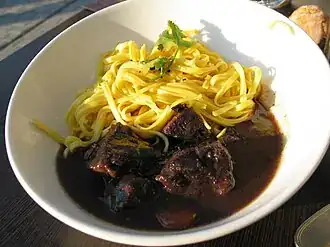
Boeuf Bourguignon
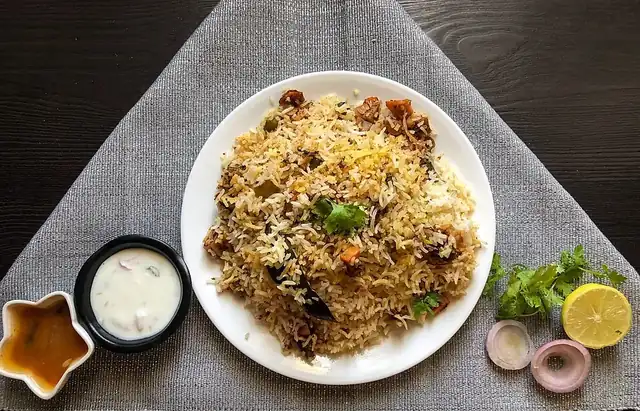
Biryani: The Rice Dish with a Story in Every Layer