This longer reference provides the background behind the topic. Read it alongside the recipe collection when you want to connect an ingredient or food idea with a dish to prepare.
In this story
OverviewDescriptionDistribution and habitatCommercial productionWater needsToxicityPriority allergenUsesOverview
The pistachio (; Pistacia vera) is a small to medium-sized tree of the cashew family. The tree produces seeds that are widely consumed as food. Pistachios can be used as an ingredient in desserts, chocolate, candy, ice cream, and as a paste or butter. As a tree nut, pistachios are considered a priority allergen that may induce allergic reactions in susceptible people.
In 2024 the world production of pistachios was 1.4 million tonnes, with the United States, Iran, and Turkey combined accounting for 87% of the total.
Description
The tree grows up to 10 m tall. It has deciduous, pinnate leaves 10–20 cm long. The plants are dioecious, with separate male and female trees. The flowers are apetalous and unisexual and borne in panicles.
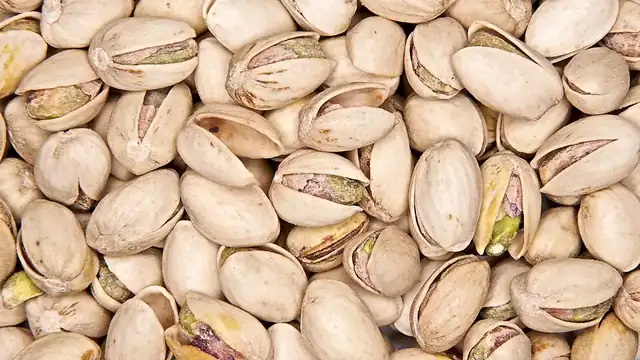
The fruit is a drupe, containing an elongated seed, which is the edible portion. The seed, commonly thought of as a nut, is a culinary nut, not a botanical nut. The fruit has a hard, cream-colored exterior shell. The seed has a mauve-colored skin and light green flesh, with a distinctive flavor. When the fruit ripens, the shell changes from green to an autumnal yellow/red and abruptly splits partly open. This is known as dehiscence and happens with an audible pop. Humans selected the trait of splitting open. Commercial cultivars vary in how consistently they split open.
Each mature pistachio tree averages around 50 kg of seeds, or around 50,000 seeds, every two years.
Distribution and habitat
Pistachio is a desert plant and is highly tolerant of saline soil. It has been reported to grow well when irrigated with water having 3,000–4,000 ppm of soluble salts. Pistachio trees are fairly hardy in the right conditions and can survive temperatures ranging between -10 C in winter and 118 F in summer. They need a sunny position and well-drained soil. Pistachio trees do poorly in high humidity conditions and are susceptible to root rot in winter if they get too much water and the soil is not sufficiently free-draining. Long, hot summers are required for proper ripening of the fruit.
Commercial production
In 2024, world production of pistachios (in shells) was 1.4 million tonnes (3.1 billion pounds), with the United States, Turkey, and Iran together accounting for 87% of the total (table).
In 2023, the state of California produced 99% of the pistachios grown in the United States, with more than 428000 acre devoted to the crop in 2022.
Water needs
In a typical California orchard of 1 acre, pistachios require over 1000000 USgal of water per year, an amount adding stress to the state's water problem. Nearly all California pistachios grow in state regions classified as having extremely high water stress.
Toxicity
As with other tree seeds, aflatoxin is found in poorly harvested or processed pistachios. Aflatoxins are potent carcinogens produced by molds such as Aspergillus flavus and A. parasiticus. The mold contamination may occur from soil or poor storage and be spread by pests. High levels of mold growth typically appear as gray to black filament-like growth. Eating mold-infected and aflatoxin-contaminated pistachios is unsafe. Aflatoxin contamination is a frequent risk, particularly in warmer and humid environments. Food contaminated with aflatoxins has caused frequent outbreaks of acute illnesses in parts of the world. In some cases, such as in Kenya, this has led to several deaths.
Pistachio shells typically split naturally before harvest, with a hull covering the intact seeds. The hull protects the kernel from invasion by molds and insects, but this hull protection can be damaged in the orchard by poor orchard management practices, by birds, or after harvest, which makes exposure to contamination much easier. Some pistachios undergo a so-called "early split", wherein both the hull and the shell split. Damage or early splits can lead to aflatoxin contamination. In some cases, a harvest may be treated to keep contamination below strict food safety thresholds; in other cases, an entire batch of pistachios must be destroyed because of aflatoxin contamination.
Like other members of the family Anacardiaceae (which includes poison ivy, sumac, mango, and cashew), pistachios contain urushiol, an irritant that can cause allergic skin reactions.
Large quantities of pistachios are self-heating in the presence of moisture due to their high oil content in addition to naturally occurring lipases, and can spontaneously combust if stored with a combustible fabric such as jute.
Priority allergen
Pistachios are included among other tree nuts as a priority allergen that may cause severe allergic reactions in susceptible people. An allergic reaction to pistachio consumption may lead to anaphylaxis, having symptoms such as hives or swelling of the face, lips, or tongue, coughing or shortness of breath, and upset stomach, among other effects.
Uses
The kernels are often eaten whole, either fresh or roasted and salted, and are also used in Turkish delight candy, pistachio ice cream, traditional Persian ice cream, kulfi, spumoni, pistachio butter, pistachio paste, and confections such as baklava, pistachio chocolate, pistachio halva, pistachio lokum or biscotti, and cold cuts, such as mortadella. Americans make pistachio salad, which includes fresh pistachios or pistachio pudding, whipped cream, and canned fruit. Indian cooking uses pounded pistachios with grilled meats, and in pulao rice dishes.
The shell of the pistachio is naturally a beige color, but it may be dyed red or green in commercial pistachios. Originally, dye was applied to hide stains on the shells caused when the nuts were picked by hand. In the 21st century, most pistachios are harvested by machine and the shells remain unstained.
More to savor

Chicken Vindaloo

Penne with Hearty Meat Sauce
Cranberry at the Table: The Food Behind the Name