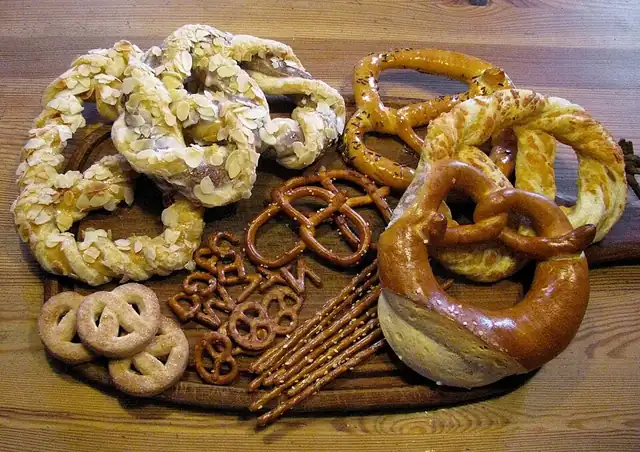
The dish is a starting point for exploring a wider food story. The guide below looks more closely at its background and different forms. When you want to cook, visit the recipe collection for ingredient quantities and step-by-step methods.
In this story
OverviewSouthern German-speaking regionsUnited StatesPennsylvaniaOther regionsOther countriesIn popular cultureOverview
A pretzel ( . From Breze or Brezel, ; Brezn) is a type of baked pastry made from dough that is commonly shaped into a knot. The traditional pretzel shape is a distinctive symmetrical form, with the ends of a long strip of dough intertwined and then twisted back onto itself in a particular way (a pretzel loop or pretzel bow). Today, pretzels come in various shapes, textures, and colors, but the original soft pretzel remains one of the most common pretzel types.
Salt is the most common seasoning, or topping, for pretzels, complementing the washing soda or lye treatment that gives pretzels their traditional skin and flavor acquired through the Maillard reaction. Other toppings are mustard, cheeses, sugar, chocolate, cinnamon, sweet glazing, seeds, and nuts. Regional specialties like Spundekäs have been designed to go along with pretzels. Varieties of pretzels include soft pretzels, which should be eaten shortly after preparation, and hard-baked pretzels, which have a long shelf life.
Southern German-speaking regions
Pretzel baking has most firmly taken root in the region of Franconia and adjoining Upper German-speaking areas, and pretzels have been an integral part of German baking traditions for centuries. Lye pretzels are popular in southern Germany, Alsace, Austria, and German-speaking Switzerland as a variety of bread, a side dish or a snack, and come in many local varieties. Examples for pretzel names in various Upper-German dialects are Breze, Brezn, Bretzel, Brezzl, Brezgen, Bretzga, Bretzet, Bretschl, Kringel, Silserli, and Sülzerli. Baked for consumption on the same day, they are sold in every bakery and in special booths or stands in downtown streets. Often, they are sliced horizontally, buttered, and sold as Butterbrezel, or come with slices of cold meats or cheese. Butter-filled pretzels are also commonly sold under this name.
Sesame, poppy, sunflower, pumpkin, or caraway seeds, melted cheese, and bacon bits are other popular toppings. Some bakeries offer pretzels made of different flours, such as whole wheat, rye or spelt.
United States
In the late 18th century, southern German and Swiss German immigrants introduced the pretzel to North America. The immigrants became known as the Pennsylvania Dutch, and in time, many handmade pretzel bakeries populated the central Pennsylvania countryside, and the pretzel's popularity spread.
In the 20th century, soft pretzels became popular in other regions of the United States. Cities such as Philadelphia, Chicago, and New York became renowned for their soft pretzels. The key to success was the introduction of the new mass production methods of the industrialized age, which increased the availability and quantity, and the opening up of multiple points of distribution at schools, convenience and grocery stores, and entertainment venues such as movie theaters, arenas, concert halls, and sport stadiums. Prior to that, street vendors used to sell pretzels on street corners in wooden glass-enclosed cases.
Pennsylvania
Southeastern Pennsylvania, with its large population of German background, including the Pennsylvania Dutch, is considered the birthplace of the American pretzel industry, and many pretzel bakers are still located in the area. Pennsylvania produces 80% of the nation's pretzels.
Hard pretzels originated in the United States, where, in 1850, the Sturgis bakery in Lititz, Pennsylvania, became the first commercial hard pretzel bakery. Snack food hard pretzels are made in the form of loops, braids, letters, little pretzels, or sticks around 3 mm thick and 12 cm long; they have become a popular snack in many countries around the world. A thicker variety of sticks can be 1.5 cm thick; in the U.S. these are called Bavarian pretzels or pretzel rods. Unlike the soft pretzels, these were durable when kept in an airtight environment and marketable in a variety of convenience stores. Large-scale production began in the first half of the 1900s, more so during 1930 to 1950.
A prime example was in 1949, when highly innovative American Machine and Foundry Co., of New York City, developed the "pretzel bender": a new automatic crispy-styled baked pretzel-twisting machine that rolled and tied them at the rate of 50 a minute—more than twice as fast as skilled hand twisters could make them—and conveyed them through the baking and salting process.
Other regions
Freeport, Illinois, which sits about 100 miles outside of Chicago, is another city known for its rich pretzel history. In 1869, a German immigrant named John Billerbeck established the first Billerbeck Bakery which was known for selling German style pretzels to complement the large number of breweries that existed in Freeport during this time. Prohibition eventually shut down the breweries which led to the decline of pretzel sales in Freeport, but the city never lost its pretzel pride. For more than 100 years, Freeport has been known as "Pretzel City, USA." Their high school athletic mascot is the Pretzel and the football stadium has been appropriately named "Pretzel Field." In 2003, local citizens launched Freeport's first Pretzel Festival which is a large community event where residents get together to celebrate the city's pretzel history.
Contestants are chosen to be crowned Pretzel Prince and Princess and a festival mascot by the name of "Pretzel Bill" (stemming from the Billerbeck Bakery name) dresses as a 6-foot tall walking talking pretzel who hands out pretzels from floats and takes photos with the local festival goers.
Other countries
The looped pretzel is known in other European countries and in other countries around the world.
In Hungary it is called perec, a softer variant of the German pastry, usually eaten with cheese or salt-syrup baked on it.
Pretzel sticks, known as Paluszki, are a popular snack in Poland, often consumed alongside beer.
In Romania, the pretzel is known as a variety of covrigi; it is a very common street food.
In popular culture
The pretzel is well known in popular culture for its unique twisted shape, and celebrated as a beloved snack food.
Landscape architecture and sculpture memorialized the strong identity that the city of Philadelphia had with pretzel cuisine of local bakers and popularity in Philadelphia. The Philadelphia Recreation Department renamed in 2004 a facility formerly identified as Manayunk Park, located on the 4300 block of Silverwood Street as "Pretzel Park". The re-designed park includes pretzel-like looped pathways and a public art statue in the shape of a pretzel sculpted by Warren C. Holzman. The municipal government of the City of Freeport, Illinois, also known as "Pretzel City USA", have also adopted a pretzel logo as their trademark.
The pretzel dance move was part of swing dancing in the 1920s.
More to savor

English Breakfast

Austrian Napkin Dumpling (Serviettenknödel)
Satay: Small Skewers, Big Flavor, Many Traditions