The dish is a starting point for exploring a wider food story. The guide below looks more closely at its background and different forms. When you want to cook, visit the recipe collection for ingredient quantities and step-by-step methods.
In this story
OverviewInspiration from foreign food traditionsEmergence in Maritime Southeast AsiaRegional diversificationColonial-era dispersal and diasporaModern globalisationPreparationOverview
Satay or sate is a Southeast Asian dish consisting of small pieces of seasoned meat, seafood or vegetables skewered on sticks and grilled over charcoal. It is typically served with a sauce, most commonly peanut-based and accompanied by rice cakes, cucumber or pickled vegetables. Common ingredients include chicken, beef, goat, pork and seafood, while regional and vegetarian variations are also found.
The dish evolved through a blend of foreign and local culinary influences. Middle Eastern kebabs introduced by Muslim traders, South Asian cooking techniques brought by Tamil and Gujarati merchants, and Chinese practices such as bamboo skewering and bite-sized portions were adapted in the port cities of Java, Sumatra and the Malay Peninsula. Combined with the use of regional ingredients and spices including lemongrass, turmeric, galangal, and peanuts, these influences gave rise to a distinctly Southeast Asian style of grilled skewered meat.
Inspiration from foreign food traditions
The culinary technique underlying satay is widely regarded as the result of multiple streams of foreign influence that reached Maritime Southeast Asia through long-distance trade and migration. The skewered and grilled meat dishes of the Middle East, particularly Turkish and Arab kebabs, spread eastward along established trade routes. Muslim merchants introduced these practices to South Asia, where they were adapted into local culinary traditions. Tamil and Gujarati Muslim traders, who were active in the Indian Ocean trading networks, prepared seasoned and grilled meats that bore similarities to kebabs, and these foodways accompanied them when they established communities in Southeast Asian port cities.
Chinese migrants also contributed to the evolution of the dish. Their culinary techniques emphasised the use of bamboo skewers and the preparation of meat in small, bite-sized portions suited to quick grilling over charcoal fires. These methods complemented South Asian and Middle Eastern influences, resulting in a hybrid style of preparation that was well suited to the demands of street vending and communal dining in the region.
Emergence in Maritime Southeast Asia
By the early modern period, the combined influences of Middle Eastern, South Asian and Chinese food traditions had taken root in the Malay archipelago and surrounding regions. Java, Sumatra and the Malay Peninsula were central nodes of maritime trade, attracting Muslim merchants from Gujarat, Tamil Nadu and the Arabian Peninsula, alongside large communities of Chinese migrants. In these multicultural port towns, local populations were exposed to diverse methods of preparing and seasoning meat.
The introduction of satay, and other now-iconic dishes such as tongseng and gulai kambing based on meats such as goat and lamb, coincided with an influx of Indian and Arab traders and immigrants starting in the 18th century. The Indonesian publication Koran Jakarta claimed that sate, and ultimately satay, originated from Javanese term sak beteng which means one stick, and that the dish had existed as early as the 15th century. Meanwhile, the satay relief is found at the ancient Cabean Kunti bathing site which was built around the 8th to 10th century in Boyolali Regency, Central Java.
Regional diversification
As satay spread throughout Maritime Southeast Asia, it underwent a process of localisation that reflected the diverse cultural and ecological settings of the region. The basic technique of grilling skewered meat over charcoal was retained, but local communities adapted the dish according to their own culinary traditions, preferred proteins and seasoning styles.
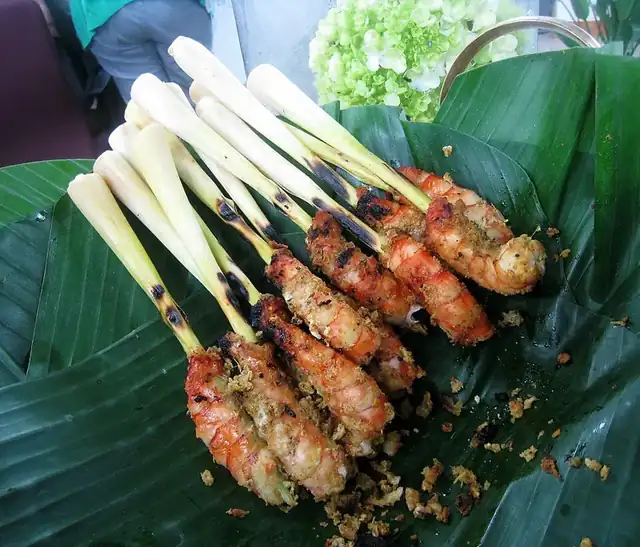
In Indonesia, the dish developed into a wide variety of regional forms. In Java, chicken (sate ayam) and goat (sate kambing) became popular, often marinated in sweet soy sauce and served with peanut sauce or sliced shallots, and the two famous ones are sate Madura and sate Ponorogo from East Java. Central Java and Yogyakarta are also known for sate klathak, made from skewered mutton seasoned simply with salt and grilled over open charcoal. In Bali, sate lilit features minced meat mixed with grated coconut and spices, wrapped around bamboo sticks or lemongrass stalks. In Sumatra, Minangkabau cooks developed sate Padang, characterised by its thick, spicy turmeric-based sauce, while Aceh's sate matang offered their own variants satay with broth.
Colonial-era dispersal and diaspora
During the colonial era satay travelled beyond Maritime Southeast Asia through several overlapping channels: indentured labour recruitment, penal and military transfers, merchant networks and later migration of colonial-era administrators and their families. The movement was not a single event but a series of flows from the late 18th century through the first half of the 20th century that carried both people and culinary practices to new social and ecological settings.
Javanese labourers introduced satay to Suriname, where it became a hallmark of Javanese-Surinamese cuisine and later integrated into the broader national food culture. In the Netherlands, returning colonial officials, Indo-Dutch families and post-war migrants brought the dish into domestic cooking and restaurant traditions, where sate became a central feature of the rijsttafel and remains a popular staple of Dutch cuisine.
Modern globalisation
During the colonial era, satay was documented by Dutch and British observers as a popular food across the Indonesian archipelago and the Malay Peninsula. By the 19th century, street vendors in Java, Malay Peninsula, Singapore and Siam were noted for selling skewered meats grilled over portable charcoal braziers. In British Malaya, satay was commonly associated with Malay night markets, festive occasions, and roadside stalls, while in the Dutch East Indies it was reported as a widespread urban street food.
Preparation
Chicken is the most common meat used in satay, with other common choices including lamb, goat, mutton, beef, venison, and rabbit; seafood such as fish, shrimp, and squid; offal such as liver, intestine, and tripe, is also used. Most satay is made by cutting the meat into small thumb-size cubes, however, such recipes as Ponorogo use a single finger-like chicken fillet.
The skewers used for chicken satay are traditionally made from lidi, a midrib of coconut fronds. Bamboo skewers might be used instead. For firmer meats, such as lamb, goat, and beef, a thicker bamboo skewer is used. The skewers are usually soaked in water before using to avoid burning during grilling. Each skewer usually holds three or four pieces of meat. A goat meat satay might insert a cube of fat between meat cubes. Turmeric gives the dish its characteristic yellow colour. Another popular marinade is kecap manis (sweet soy sauce) mixed with coconut oil or palm margarine. The skewered meat is seasoned, marinated, and then grilled on charcoal embers.
More to savor

English Breakfast

Chicken Vindaloo
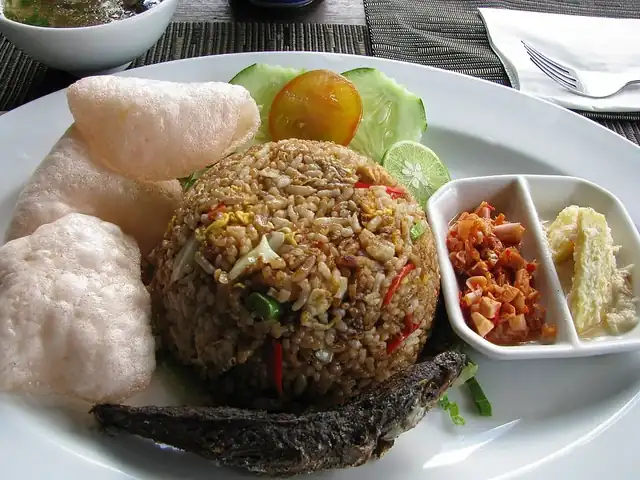
Nasi Goreng: The Fried-Rice Story of Southeast Asia