This longer reference provides the background behind the topic. Read it alongside the recipe collection when you want to connect an ingredient or food idea with a dish to prepare.
In this story
OverviewDescriptionGrapevinesDistribution of agricultureProductionTable and wine grapesCulinaryOverview
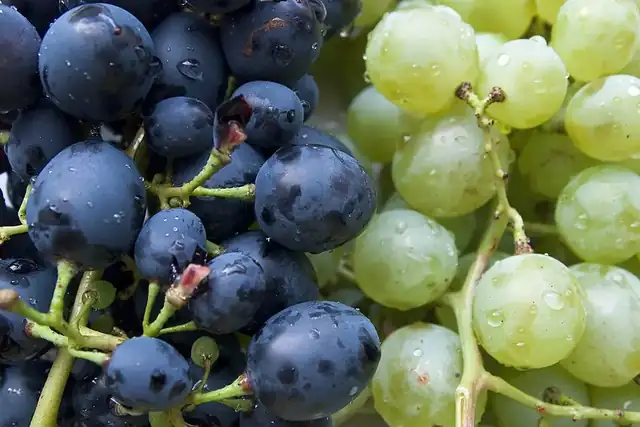
A grape is a fruit, botanically a berry, of the deciduous woody vines of the flowering plant genus Vitis. Grapes are a non-climacteric type of fruit, generally occurring in clusters.
The cultivation of grapes began approximately 8,000 years ago, and the fruit has been used as human food throughout its history. Eaten fresh or in dried form (as raisins, currants and sultanas), grapes also hold cultural significance in many parts of the world, particularly for their role in winemaking. Other grape-derived products include various types of jam, juice, vinegar and oil.
Description
Grapes are a type of berry fruit that grow in clusters of 15 to 300. The berries appear within a 60 day period after fertilization first producing tartaric acid, then later malic acid when their flesh increases in reaction to the hormone of ethylene; these acids give slight sour tastes to the berries other than their sweetness. When these young berries reach a ripening stage (called véraison from the French language), the berries change to darker colours, increase in size and produce sugars; this véraison period begins in August taking around about 45 days with normal conditions in the Northern Hemisphere. Ripe grape berries are typically ellipsoid in shape resembling a prolate spheroid.
Their flesh has 75-85% water content; the water is obtained from the plant xylem before ripening, the phloem supplies water with soluble sugars glucose and fructose following the ripening stage.
Anthocyanins and other pigment chemicals of the larger family of polyphenols in purple grapes are responsible for the varying shades of purple in the grape berries and red wines they produce. Various grapes ripen can be crimson, black, dark blue, yellow, green, orange, and pink. "White" grapes are actually green in color and are evolutionarily derived from the purple grape. Mutations in two regulatory genes of white grapes turn off production of anthocyanins, which are responsible for the color of purple grapes.
Grapevines
Most domesticated grapes come from cultivars of Vitis vinifera, a grapevine native to the Mediterranean and Central Asia. Minor amounts of fruit and wine come from American and Asian species such as:
Vitis amurensis, the most important Asian species
Vitis labrusca, the North American table and grape juice grapevines (including the Concord cultivar), sometimes used for wine, are native to the Eastern United States and Canada.
Vitis mustangensis (the mustang grape), found in Mississippi, Alabama, Louisiana, Texas, and Oklahoma
Vitis riparia, a wild vine of North America, is sometimes used for winemaking and jam. It is native to the entire Eastern United States and north to Quebec.
Vitis rotundifolia (the muscadine), used for jams and wine, is native to the Southeastern United States from Delaware to the Gulf of Mexico.
Distribution of agriculture
In 2023, the world total of land dedicated to grape growing (in hectares, ha) was 6595680 ha. By country dedicating farmland for grape growing in 2023, Spain had 913000 ha, France 753340 ha, Italy 713350 ha, and China 607030 ha. Approximately 71% of world grape production is used for wine, 27% as fresh fruit, and 2% as dried fruit.
There are no reliable statistics that break down grape production by variety. It is believed that the most widely planted variety is Sultana, also known as Thompson Seedless, with at least 3,600 km2 (880,000 acres) dedicated to it. The second most common variety is Airén. Other popular varieties include Cabernet Sauvignon, Sauvignon blanc, Cabernet Franc, Merlot, Grenache, Tempranillo, Riesling, and Chardonnay.
Production
In 2023, world production of grapes was 72.5 million tonnes, led by China with 19% of the total, with Italy and France as major secondary producers (table).
Table and wine grapes
Commercially cultivated grapes can usually be classified as either table or wine grapes, based on their intended method of consumption: eaten raw (table grapes) or used to make wine (wine grapes). The sweetness of grapes depends on when they are harvested, as they do not continue to ripen once picked. While almost all belong to the same species, Vitis vinifera, table and wine grapes have significant differences, brought about through selective breeding. Table grape cultivars tend to have large, seedless fruit (see below) with relatively thin skin. Wine grapes are smaller, usually seeded, and have relatively thick skins (a desirable characteristic in winemaking, since much of the aroma in wine comes from the skin).
Grapes accumulate sugars as they grow on the grapevine through the transportation of sucrose molecules that are produced by photosynthesis from the leaves. During ripening the sucrose molecules are hydrolyzed (separated) into glucose and fructose. Wine grapes tend to be very sweet: they are harvested at the time when their juice is approximately 24% sugar by weight. By comparison, commercially produced "100% grape juice", made from table grapes, is usually around 15% sugar by weight.
Culinary
Grapes are eaten raw, dried (as raisins, currants and sultanas), or cooked. Also, depending on the grape cultivar, grapes are used in winemaking. Grapes can be processed into a multitude of products such as jams, juices, vinegars and oils.
Commercially cultivated grapes are classified as either table or wine grapes. These categories are based on their intended method of consumption: grapes that are eaten raw (table grapes), or grapes that are used to make wine (wine grapes).
Table grape cultivars normally have large, seedless fruit and thin skins. Wine grapes are smaller (in comparison to table grapes), usually contain seeds, and have thicker skins (a desirable characteristic in making wine). Most of the aroma in wine is from the skin. Wine grapes tend to have a high sugar content. They are harvested at peak sugar levels (approximately 24% sugar by weight.) In comparison, commercially produced "100% grape juice" made from table grapes are normally around 15% sugar by weight.
More to savor

Chicken Vindaloo

Tofu Scramble I
Getting to Know Cardamom: A Food Lover’s Guide