This longer reference provides the background behind the topic. Read it alongside the recipe collection when you want to connect an ingredient or food idea with a dish to prepare.
Overview
Quinoa (Chenopodium quinoa, from Quechua kinwa or kinuwa) is a flowering plant in the amaranth family. It is a herbaceous annual plant grown as a crop primarily for its edible seeds; the seeds are high in protein, dietary fiber, B vitamins and dietary minerals especially potassium and magnesium in amounts greater than in many grains. Quinoa is not a grass but rather a pseudocereal botanically related to spinach and amaranth (Amaranthus spp.), and originated in the Andean region of northwestern South America. It was first used to feed livestock 5,2007,000 years ago, and for human consumption 3,0004,000 years ago in the Lake Titicaca basin of Bolivia and Peru.
The plant thrives at high elevations and produces seeds that are rich in protein. Almost all production in the Andean region is done by small farms and associations. Its cultivation has spread to more than 70 countries, including Kenya, India, the United States, and European countries. As a result of increased consumption in North America, Europe, and Australasia, quinoa crop prices tripled between 2006 and 2014, entering a boom and bust cycle.
The quinoa monoculture that arose from increased production, combined with climate change effects in the native Andean region, created challenges for production and yield, and led to environmental degradation.
Description
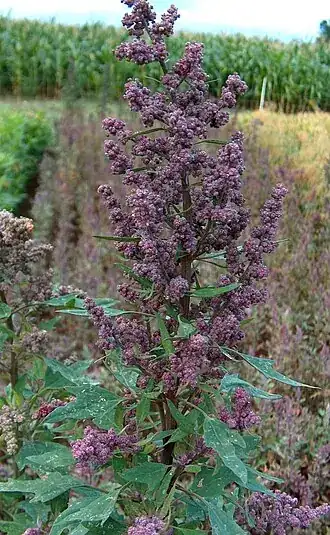
Chenopodium quinoa is a dicotyledonous annual plant, usually about 1 – 2 m high. It has broad, generally powdery, hairy, lobed leaves, normally arranged alternately. The woody central stem is branched or unbranched depending on the variety and may be green, red or purple. The flowering panicles arise from the top of the plant or from leaf axils along the stem. Each panicle has a central axis from which a secondary axis emerges either with flowers (amaranthiform) or bearing a tertiary axis carrying the flowers (glomeruliform). These are small, incomplete, sessile flowers of the same colour as the sepals, and both pistillate and perfect forms occur. Pistillate flowers are generally located at the proximal end of the glomeruli and the perfect ones at the distal end of it.
A perfect flower has five sepals, five anthers and a superior ovary, from which two to three stigmatic branches emerge.
The green hypogynous flowers have a simple perianth and are generally self-fertilizing, though cross-pollination occurs. In the natural environment, betalains serve to attract animals to generate a greater rate of pollination and ensure, or improve, seed dissemination. The fruits (seeds) are about 2 mm in diameter and of various colors — from white to red or black, depending on the cultivar.
Distribution
Chenopodium quinoa is believed to have been domesticated in the surroundings of the Lake Titicaca, in the Bolivian and Peruvian Andes, from wild or weed populations of the same species. There are non-cultivated quinoa plants (Chenopodium quinoa var. melanospermum) that grow in the area it is cultivated; these may either be related to wild predecessors, or they could be descendants of cultivated plants.
Climate requirements
The plant's growth is highly variable due to the number of different subspecies, varieties and landraces (domesticated plants or animals adapted to the environment in which they originated). However, it is generally undemanding and altitude-hardy; it is grown from coastal regions to over 4000 m in the Andes near the equator, with most of the cultivars being grown between 2500 m and 4000 m. Depending on the variety, optimal growing conditions are in cool climates with temperatures that vary between -4 C during the night to near 35 C during the day. Some cultivars can withstand lower temperatures without damage. Light frosts normally do not affect the plants at any stage of development, except during flowering. Midsummer frosts during flowering, a frequent occurrence in the Andes, lead to sterilization of the pollen.
Rainfall requirements are highly variable between the different cultivars, ranging from 300 to 1000 mm during the growing season. Growth is optimal with well-distributed rainfall during early growth and no rain during seed maturation and harvesting. Royal Quinoa (Quinoa Real), grown in the Intersalar region of Bolivia between the Uyuni and Coipasa salt flats, endures an extreme environment characterised by high altitude, high salinity, intense UV radiation, aridity, and temperature fluctuations.
United States
Quinoa has been cultivated in the United States, primarily in the high elevation San Luis Valley of Colorado where it was introduced in 1983. In this high-altitude desert valley, maximum summer temperatures rarely exceed 30 °C and night temperatures are about 7 °C. In the 2010s, experimental production was attempted in the Palouse region of Eastern Washington, and farmers in Western Washington began producing the crop. The Washington State University Skagit River Valley research facility near Mount Vernon grew thousands of its own experimental varieties. The Puget Sound region's climate is similar to that of coastal Chile where the crop has been grown for centuries. Due to the short growing season, North American cultivation requires short-maturity varieties, typically of Bolivian origin.
Quinoa is planted in Idaho where a variety developed and bred specifically for the high-altitude Snake River Plain is the largest planted variety in North America.
Production
In 2023, world production of quinoa was 112,251 tonnes, led by Peru with 62% of the total and Bolivia with 37% (table).
Price
Since the early 21st century when quinoa became more commonly consumed in North America, Europe, and Australasia where it was not typically grown, the crop value increased. Between 2006 and 2013, quinoa crop prices tripled. In 2011, the average price was US$3,115 per tonne with some varieties selling as high as $8,000 per tonne. This contrasts with wheat prices of about US$340 per tonne, making wheat about 10% of the value of quinoa. The resulting effect on traditional production regions in Peru and Bolivia also influenced new commercial quinoa production elsewhere in the world, such as the United States. By 2013, quinoa was being cultivated in some 70 countries. As a result of expanding production outside the Andean highlands native for quinoa, the price plummeted starting in early 2015 and remained low for years. From 2018 to 2019, quinoa production in Peru declined by 22%.
Some refer to this as the "quinoa bust" because of the devastation the price fall caused for farmers and industry.
More to savor

Chicken Vindaloo
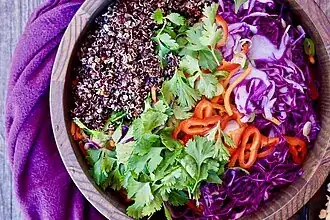
Quinoa Vegetable Slaw With Peanut Dressing (Gluten-Free)
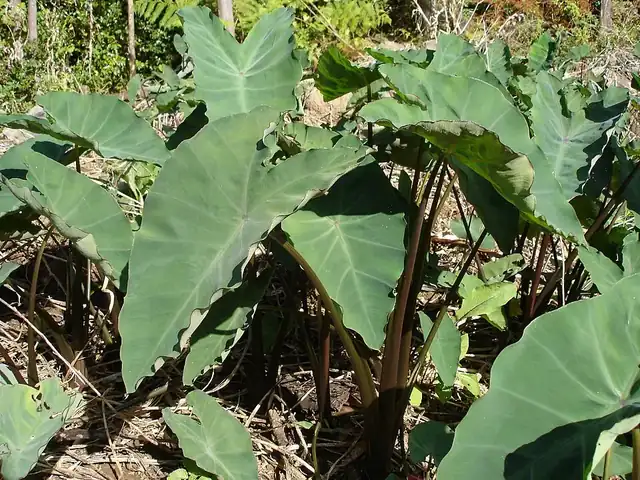
Getting to Know Taro: A Food Lover’s Guide