The dish is a starting point for exploring a wider food story. The guide below looks more closely at its background and different forms. When you want to cook, visit the recipe collection for ingredient quantities and step-by-step methods.
Overview
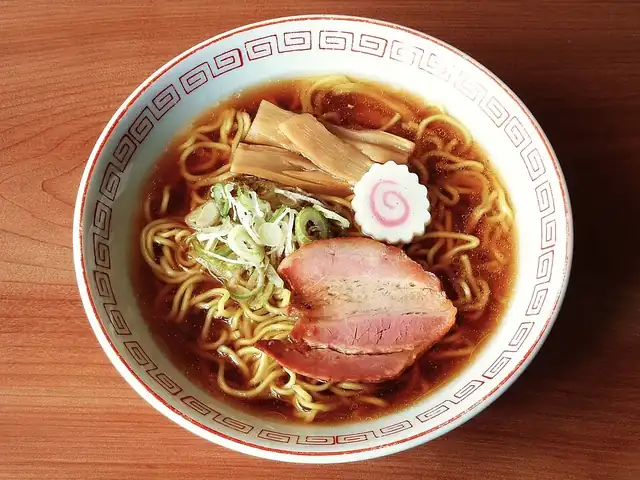
Ramen is a Japanese-Chinese fusion noodle dish. It includes Chinese-style alkaline wheat noodles served in several flavors of hot broth. Common flavors are soy sauce and miso, with typical toppings including sliced pork, nori (dried seaweed), lacto-fermented bamboo shoots (menma), narutomaki, and scallions. Nearly every region in Japan has its own variation of ramen, such as the tonkotsu (pork bone broth) ramen of Kyushu and the miso ramen of Hokkaido.
The origins of ramen can be traced back to Yokohama Chinatown in the late 19th century. While the word "ramen" is a Japanese borrowing of the Chinese word lāmiàn (拉麵), meaning "pulled noodles", the ramen does not actually derive from any lamian dishes. Lamian is a part of northern Chinese cuisine, whereas the ramen evolved from southern Chinese noodle dishes from regions such as Guangdong, reflecting the demographics of Chinese immigrants in Yokohama. Ramen was largely confined to the Chinese community in Japan and was never popular nationwide until after World War II (specifically the Second Sino-Japanese War), following increased wheat consumption due to rice shortages and the return of millions of Japanese colonizers from China. In 1958, instant noodles were invented by Momofuku Ando, further popularizing the dish.
Ramen was originally looked down upon by the Japanese due to racial discrimination against the Chinese and its status as an inexpensive food associated with the working class. Today, ramen is considered a national dish of Japan, with many regional varieties and a wide range of toppings. Examples include Sapporo's rich miso ramen, Hakodate's salt-flavored ramen, Kitakata's thick, flat noodles in pork-and-niboshi broth, Tokyo-style ramen with soy-flavored chicken broth, Yokohama's Iekei ramen with soy-flavored pork broth, Wakayama's soy sauce and pork bone broth, and Hakata's milky tonkotsu (pork bone) broth. Ramen is offered in various establishments and locations, with the best quality usually found in specialist ramen shops called rāmen'ya (ラーメン屋).
Types
A wide variety of ramen exists in Japan, with geographical and vendor-specific differences even in varieties that share the same name. Usually varieties of ramen are differentiated by the type of broth and tare used. There are five components to a bowl of ramen: tare, aroma oil, broth, noodles, and toppings.
Noodles
The type of noodles used in ramen are called , which are derived from traditional Chinese alkaline noodles known as jiǎnshuǐ miàn (鹼水麵). Most are made from four basic ingredients: wheat flour, salt, water, and kansui, derived from the Chinese jiǎnshuǐ (鹼水), a type of alkaline mineral water containing sodium carbonate and usually potassium carbonate, as well as sometimes a small amount of phosphoric acid. Ramen is not to be confused with different kinds of noodle such as soba, udon, or somen.
The origin of jiǎnshuǐ is unclear. It is said to originate in Inner Mongolia. Making noodles with jiǎnshuǐ lends them a yellowish hue as well as a firm texture. But since there is no natural jiǎnshuǐ or kansui in Japan, it was difficult to make jiǎnshuǐ miàn or chūkamen before the Meiji Restoration (1868).
Ramen comes in various shapes and lengths. It may be thick, thin, or even ribbon-like, as well as straight or wrinkled.
Soup
Similar to Chinese soup bases, ramen soup is generally made from chicken or pork, though vegetable and fish stock is also used. This base stock is often combined with dashi stock components such as katsuobushi (skipjack tuna flakes), niboshi (dried baby sardines), saba bushi (mackerel flakes), shiitake, and kombu (kelp). Ramen stock is usually divided into two categories: chintan and paitan.
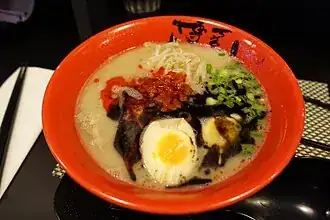
Chintan (清湯), derived from the Chinese qīngtāng , is a clear stock, made by simmering ingredients and frequently skimming foam and scum off the top of the pot. Chintan stocks are the most common kind, and can be made from chicken, pork, vegetables and/or niboshi.Paitan (白湯), derived from the Chinese baitang , is a broth with an opaque white colored appearance and a creamy consistency that rivals milk, melted butter or gravy (depending on the shop). Paitan stock is made by boiling pork or chicken bones at a high heat for hours at a time, allowing the bones to emulsify into the soup. The most well-known and common paitan stock is tonkotsu (豚骨, 'pork bone'; not to be confused with tonkatsu).
Although tonkotsu is merely a kind of broth, some people consider tonkotsu ramen (specialty of Kyushu, its birthplace) a distinct flavor category. When chicken bones are used to make a paitan stock, the resulting soup is called tori paitan (鶏白湯).
Tare
Tare is a sauce that is used to flavor the broth. The main purpose of tare is to provide salt to the broth, but tare also usually adds other flavors, such as umami. There are three main kinds of tare.
Shio (塩, 'salt') ramen is the oldest of the four types. This tare is made from cooking alcohols like mirin and sake, umami ingredients like kombu, niboshi and MSG, and salt. Occasionally pork bones are also used, but they are not boiled for as long as they are for tonkotsu ramen, so the soup remains light and clear. In shio ramen, chāshū is sometimes swapped for lean chicken meatballs, and pickled plums and kamaboko (a slice of processed fish roll sometimes served as a frilly white circle with a pink or red spiral called narutomaki) are popular toppings as well. Noodle texture and thickness varies among shio ramen, but they are usually straight rather than curly.
Toppings
After basic preparation, ramen can be adorned with any number of toppings, including but not limited to:
Chāshū (sliced roasted or red cooked pork)
Negi (green onion)
Takana-zuke (pickled and seasoned mustard leaves)
Regional variations
While standard versions of ramen are available throughout Japan since the Taishō period, the last few decades have shown a proliferation of regional variations, commonly referred to as gotouchi ramen (ご当地ラーメン "regional ramen"). Some of these which have gone on to national prominence are:
Sapporo, the capital of Hokkaido, is especially famous for its ramen. Most people in Japan associate Sapporo with its rich miso ramen, which was invented there and which is ideal for Hokkaido's harsh, snowy winters. Sapporo miso ramen is typically topped with sweetcorn, butter, bean sprouts, finely chopped pork, and garlic, and sometimes local seafood such as scallop, squid, and crab. Hakodate, another city of Hokkaido, is famous for its salt-flavored ramen, while Asahikawa in the north of the island offers a soy sauce-flavored variation. In Muroran, many ramen restaurants offer Muroran curry ramen.
More to savor
Tonkotsu Ramen

Chicken Vindaloo
Noodles Around the World: A Strand of Everyday Food Culture