The dish is a starting point for exploring a wider food story. The guide below looks more closely at its background and different forms. When you want to cook, visit the recipe collection for ingredient quantities and step-by-step methods.
Overview
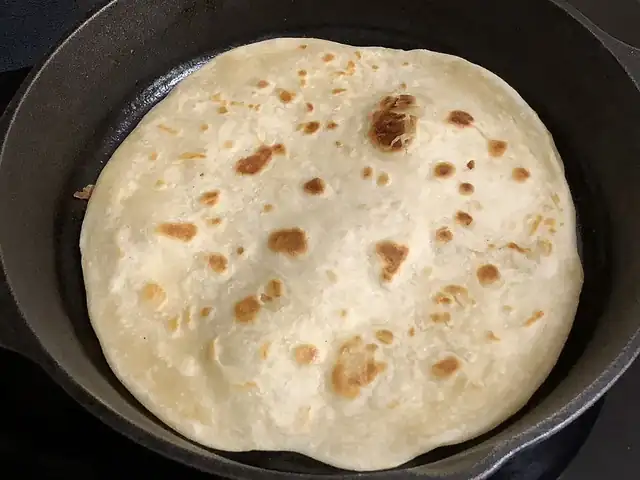
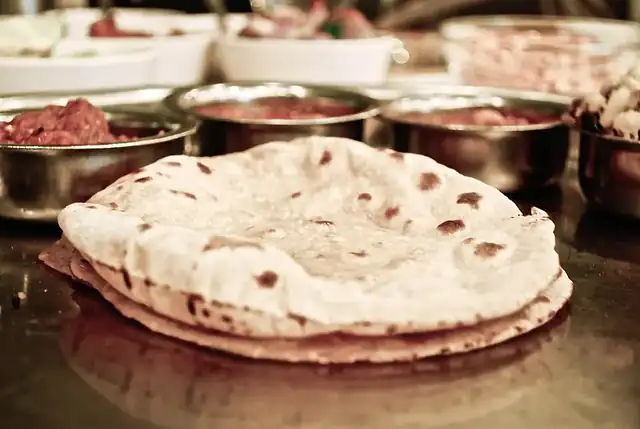
Roti is a round flatbread originating from the Indian subcontinent. It is commonly consumed in many South Asian, Southeast Asian, Caribbean, East African, and Southeast African countries.
It is made from stoneground whole-wheat flour, known as atta, combined into a dough with added water. Its defining characteristic is that it is unleavened. Naan from the Indian subcontinent, by contrast, is a yeast-leavened bread, as is kulcha. Like breads around the world, roti is a staple accompaniment to other foods.
Types
Makki roti: corn flour roti served with sarson ka saag, a classic dish of Punjab.
Akki roti: Rice flour roti with grated vegetables and spices, served with chutney, a famous dish of Karnataka.
Thalipeeth roti: Maharashtrian roti is made with bajra, jowar, rice, chickpea, and spices, served with yogurt or ghee, also popular in Karnataka.
Missi roti: Rajasthani roti similar to chapati with added spices like red chili, cumin, and turmeric, served with gravy or vegetables.
Kuttu roti: Buckwheat flour roti with potatoes, gluten-free and common during Navratri fasting.
Rumali roti: Thin, soft roti foldable like a handkerchief, popular in Awadhi, Mughlai, and Hyderabadi cuisine, best served with gravy.
Preparation
Roti is made from a mixture of flour, water, and optionally salt and butter or oil. The ingredients are mixed together to create a dough which is left to rest. The dough is then divided into balls which are flattened with a rolling pin to form rotis. The rotis are then cooked on a tava or pan.
Indian subcontinent
Many variations of flatbreads and roti are found in many cultures across the globe, from the Indian subcontinent to Africa to Oceania to the Malay Peninsula to the Americas. The roti is a traditional flatbread from the Indian subcontinent. It is normally eaten with cooked vegetables or curries; it can be used as a carrier for them. It is made most often from wheat flour, cooked on a flat or slightly concave iron griddle called a tawa. Traditionally, rotis have also been made from the flour of millet, maize, jowar, bajra, and even rice. Tandoori roti is cooked by sticking the flattened dough to the inside wall of a tandoor oven, where it bakes quickly at a high temperature.
Chapatis are made of whole-wheat flour known as atta, mixed into a dough with water, edible oil and optional salt in a mixing utensil called a parat, and is cooked on a tava (flat skillet). It is known as phulka in Punjabi and Saraiki, and maani in Sindhi.
Sri Lanka
In Sri Lanka, there is a variant of roti called pol roti (coconut roti), made of wheat flour, and/or kurakkan flour, and scraped coconut. Sometimes, chopped green chilis and onion are added to the mixture before cooking. These are usually thicker and harder than other roti types. They are usually eaten with curries, or some types of sambol or lunu miris and considered a main meal rather than a supplement.
Another variety of roti popular in Sri Lanka is kottu roti, which is made up of paratha or godamba roti, These are cut into small pieces, small in size and rectangular or square in shape. Then on a square heating pan, vegetables and onions are fried. Eggs, cooked meat, or fish are added to fried vegetables and heated for a few minutes. Finally, the pieces of cut paratha are added. These are chopped and mixed by repeated pounding using heavy iron blades/spatula, the sound of which can be heard from a long distance. Depending upon what ingredients are used, the variations are vegetable, egg, chicken, beef, mutton, and fish kottu roti. It is sometimes prepared and served as a fast food dish.
Godamba roti is another variety found in Sri Lanka. Plain godamba roti is eaten with curry or it can also be wrapped around a savory filling.
Caribbean
Roti is eaten widely across the Caribbean, especially in countries with large Indo-Caribbean populations such as Trinidad and Tobago, Guyana, Suriname, and Jamaica. Originally brought to the islands by indentured laborers from the Indian subcontinent, roti has become a popular staple in the culturally rich cuisines of these countries. In the Caribbean, roti is commonly eaten as an accompaniment to various curries and stews. The traditional way of eating roti is to break the roti by hand, using it to sop up sauce and pieces of meat from the curry. However, in the Caribbean, the term roti may refer to both the flatbread (roti) itself and the more popular street food item, in which the roti is folded around a savory filling in the form of a wrap.
The roti wrap is the commercialization of roti and curry together as a fast-food or street-food item in the Caribbean. This wrap form of roti originated in southern Trinidad. It was first created in the mid-1940s by Sackina Karamath, who later founded Hummingbird Roti Shop in San Fernando, Trinidad and Tobago. The wrap was convenient, as the meal could be eaten faster and while on the go, as well as keeping one's hands from getting dirty. In Trinidad and Tobago, various wrapped roti are served, including chicken, conch, goat, beef, and shrimp. Vegetables can also be added including potato, pumpkin, and spinach as well a variety of local condiments, with pepper sauce (hot sauce) and mango chutney being the most popular.
Guyana
Dosti roti is common in Guyana. A small amount of fat is placed in each piece of dough before it is rolled out to make the roti softer. Usually, vegetable oil is used, but butter or margarine can also be used. Ghee is not used in everyday cooking, but is used on special occasions, especially amongst Hindus. The roti is usually clapped by hand or beaten a bit, hot off the tava, so it softens but does not break.
A good roti in Guyana is very soft, with layers (almost like pastry layers if possible), which remains whole.
The type of roti is determined by what is placed in the dough before it is rolled out. Various types include dhalpuri, aloo (potato) roti, and sugar.
In Guyana, a rolled-out, thin, flat dough like a roti that is deep-fried in ghee is called a puri. Therefore, a dhalpuri is not really a puri.
More to savor
Roti Jala (Malaysian Lacy Pancakes)
French Onion Soup
Chapati: The Everyday Flatbread That Completes the Plate