This longer reference provides the background behind the topic. Read it alongside the recipe collection when you want to connect an ingredient or food idea with a dish to prepare.
Overview
Sesame (Sesamum indicum) is a plant in the genus Sesamum, also called benne. Numerous wild relatives occur in Africa and a smaller number in India. It is widely naturalized in tropical regions around the world and is cultivated for its edible seeds, which grow in pods. World production in 2024 was 6.7 e6t, with India, Myanmar, and Sudan as the largest producers.
Sesame seed is one of the oldest oilseed crops known, domesticated well over 3,000 years ago. Sesamum has many other species, most being wild and native to sub-Saharan Africa. S. indicum, the cultivated type, originated in India. It tolerates drought conditions well, growing where other crops fail. Sesame has one of the highest oil contents of any seed. With a rich, nutty flavor, it is a common ingredient in cuisines around the world. Sesame allergies are common relative to other foods.
Description
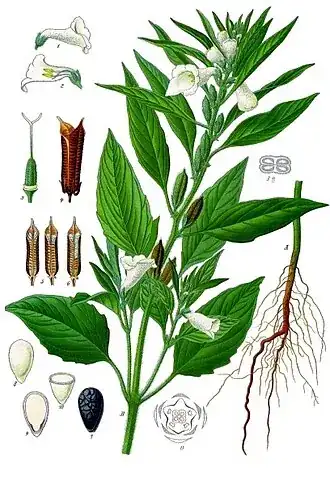
Sesame is a perennial plant growing 50 to 100 cm tall, with opposite leaves 4 to 14 cm long with an entire margin; they are broad lanceolate, to 5 cm broad, at the base of the plant, narrowing to just 1 cm broad on the flowering stem. The flowers are tubular, 2.5 to 3 cm long. The flowers vary in colour, from white to pink or purple.
The fruit is a capsule, normally pubescent. The length of the fruit capsule varies from 2 to 3 cm, its width varies between 0.6 and 1.2 cm; there are four locules. The seeds are either white or black.
Sesame seeds are small. Their sizes vary widely by cultivar. Typically, the seeds are 3 to 4 mm (0.12 to 0.16 in). The seeds are ovate, slightly flattened, and somewhat thinner at the eye of the seed (hilum) than at the opposite end. The mass of 100 seeds sampled from a market in Ibadan, Nigeria is 0.203 g.
Processing
Sesame seeds are protected by a capsule that bursts when the seeds are ripe. The time of this bursting, or "dehiscence", tends to vary, so farmers cut plants by hand and place them together in an upright position to continue ripening until all the capsules have opened. The 1943 discovery of an indehiscent mutant (analogous to nonshattering in cereals) led breeders to try to create a high-yield variety that does not drop its seeds. Despite some progress, dehiscence continues to limit production. Agronomists in Israel are working on modern cultivars of sesame that can be harvested by mechanical means.
Since sesame seed is small and flat, it is hard to dry after harvest because the seeds pack closely together, impeding the flow of air in a drying bin. Therefore, the harvested seeds need to be as dry as possible, and then stored at 6% moisture or less. Moist seed stores can rapidly heat up and become rancid.
Production
In 2024, world production of sesame seeds was 6.7 million tonnes, led by India, Myanmar, and Sudan, which together accounted for 33% of the total (table). Along with Niger seed and soybeans, sesame seeds constitute approximately 20 percent of Ethiopia's export gains.
The white and other lighter-colored sesame seeds are common in Europe, the Americas, West Asia, and the Indian subcontinent. The black and darker-colored sesame seeds are mostly produced in China and Southeast Asia.
In the United States most sesame is raised by farmers under contract to Sesaco, which also supplies proprietary seed.
Trade
Japan is the world's largest sesame importer. Sesame oil, particularly from roasted seed, is an important component of Japanese cooking and traditionally the principal use of the seed. China is the second-largest importer of sesame, mostly oil-grade. China exports lower-priced food-grade sesame seeds, particularly to Southeast Asia. Other major importers are the United States, Canada, the Netherlands, Turkey, and France.
Sesame seed is a high-value cash crop. Prices ranged between US$800 and 1700 /t between 2008 and 2010. Prices depend on perceived quality, based on factors such as the seed's appearance, freedom from impurities, oil content of at least 40%, and sorting by size and colour.
Composition
Dried whole sesame seeds are 5% water, 23% carbohydrates, 50% fat, and 18% protein (table). In a reference amount of 100 g, dried sesame seeds supply 2400 kJ of food energy, and are a rich source (20% or more of the Daily Value, DV) of several B vitamins and dietary minerals, such as calcium, iron, and magnesium (all 75% or more of the DV, table).
The byproduct that remains after oil extraction from sesame seeds, also called sesame oil meal, is rich in protein (35–50%) and is used as feed for poultry and livestock.
As many seeds do, whole sesame seeds contain a significant amount of phytic acid, which is considered an antinutrient in that it binds to certain nutritional elements consumed at the same time, especially minerals, and prevents their absorption by carrying them along as they pass through the small intestine. Heating and cooking reduce the amount of the acid in the seeds. The seeds contain the lignans sesamolin, sesamin, pinoresinol, and lariciresinol.
Culinary use
Sesame seed is a common ingredient in many cuisines. Sesame seeds were brought into 17th-century colonial America by enslaved West Africans. The whole plant was used in West African cuisine. The seeds thickened soups and puddings, or were roasted and infused to produce a coffee-like drink. Oil from the seeds substituted for butter, and served as a shortening for cakes. The leaves on mature plants, which are rich in mucilage, can be used as a laxative as well as a treatment for dysentery and cholera. After arriving in North America, the plant was grown by slaves as a subsistence staple to supplement their weekly rations. In Caribbean cuisine, sugar and white sesame seeds are combined into a bar resembling peanut brittle and sold in stores and street corners, like Bahamian Benny cakes.
In Japan, whole seeds are found in many salads and baked snacks, and tan and black sesame seed varieties are roasted and used to make the flavouring gomashio. Ground black sesame and rice form zhimahu, a Chinese dessert and breakfast dish. The seeds and oil are used extensively in India, where sesame seeds mixed with heated jaggery, sugar, or palm sugar are made into balls and bars similar to peanut brittle or nut clusters and eaten as snacks, such as chikki.
Sesame is a common ingredient in Middle Eastern cuisine. The seeds are made into tahini paste and sweet halva. It is a common component of the Levantine spice mixture za'atar, popular throughout the Middle East.
More to savor

Chicken Vindaloo
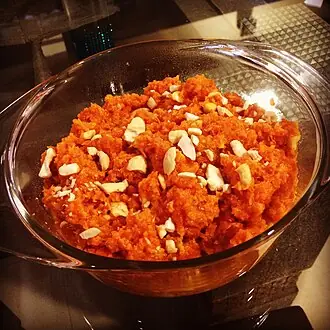
Gajjar Halwa (Carrot Pudding)
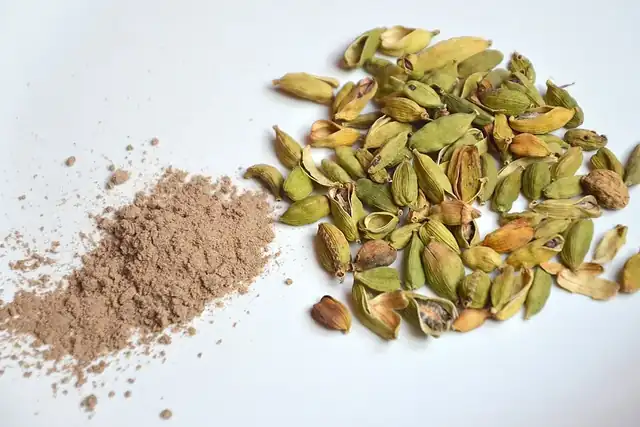
Getting to Know Cardamom: A Food Lover’s Guide